
Spatial awareness Normal Geometry Worksheets for Ages 7-8
4 filtered results
Difficulty Level
Grade
Age
-
From - To
Subject
Activity
Standards
Enhance your child's spatial awareness with our engaging geometry worksheets tailored for kids aged 7-8. Designed to build crucial skills such as recognizing shapes, understanding positions, and exploring symmetry, these worksheets offer fun and interactive activities that promote spatial thinking. Each exercise encourages problem-solving and critical thinking, aiding in the development of foundational math skills in alignment with educational standards. Ideal for both classroom use and at-home practice, these worksheets ensure your child excels in geometry while enjoying the learning journey. Discover how our carefully crafted worksheets can make a significant difference in your child's mathematical proficiency.
Favorites
With answer key
Interactive
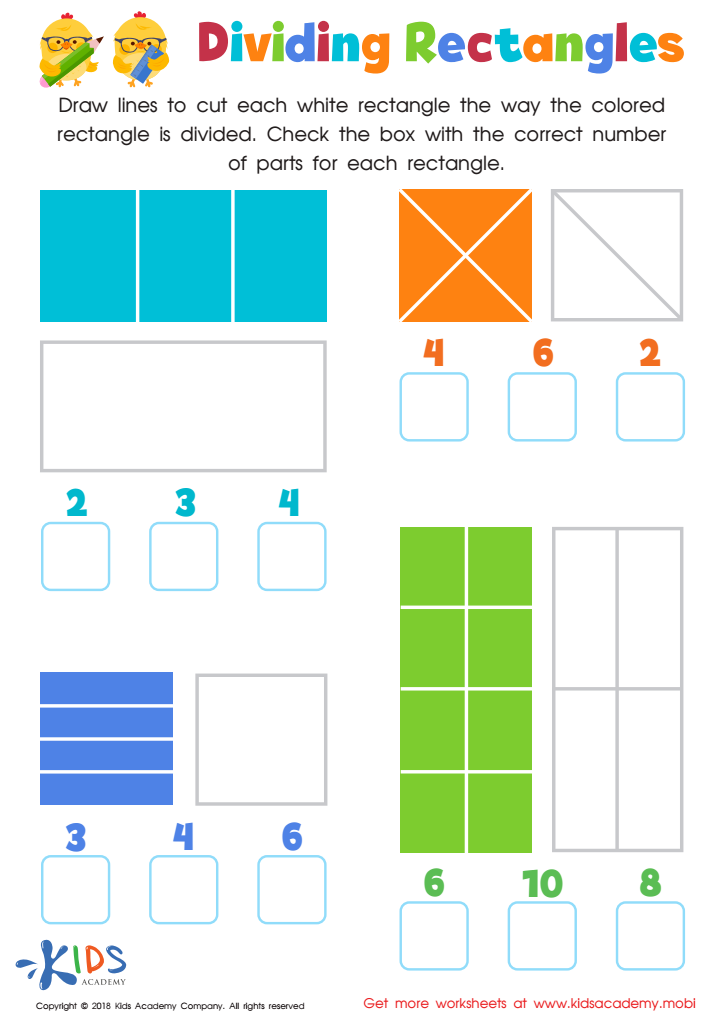
Dividing Rectangles Worksheet
Ask your child to draw lines to divide the white rectangles like the colored ones. Then, have them count the parts in each and choose the correct number. This worksheet will help them practice counting and dividing.
 Assign to My Students
Dividing Rectangles Worksheet
Worksheet











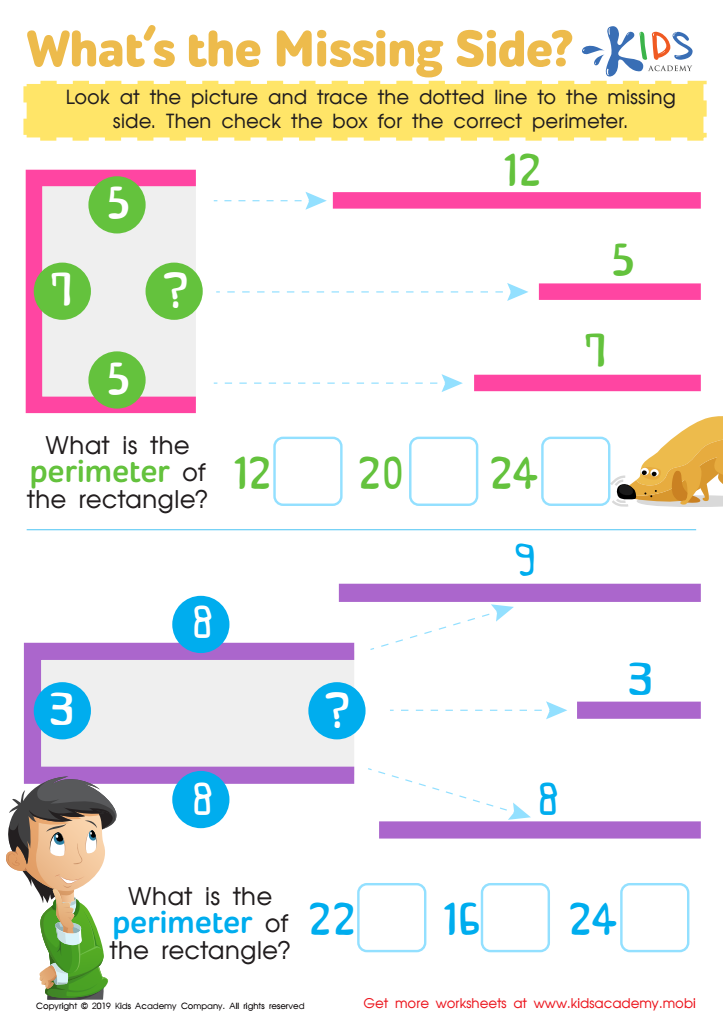
What's the Missing Side Worksheet
Assist your pupils in improving math skills with fun exercises like the tracing sheet. Show them the picture and guide them to trace the missing side. Ask them to check the box of the right perimeter afterwards. Doing this regularly can help them to enjoy and appreciate the subject more.
What's the Missing Side Worksheet
Worksheet
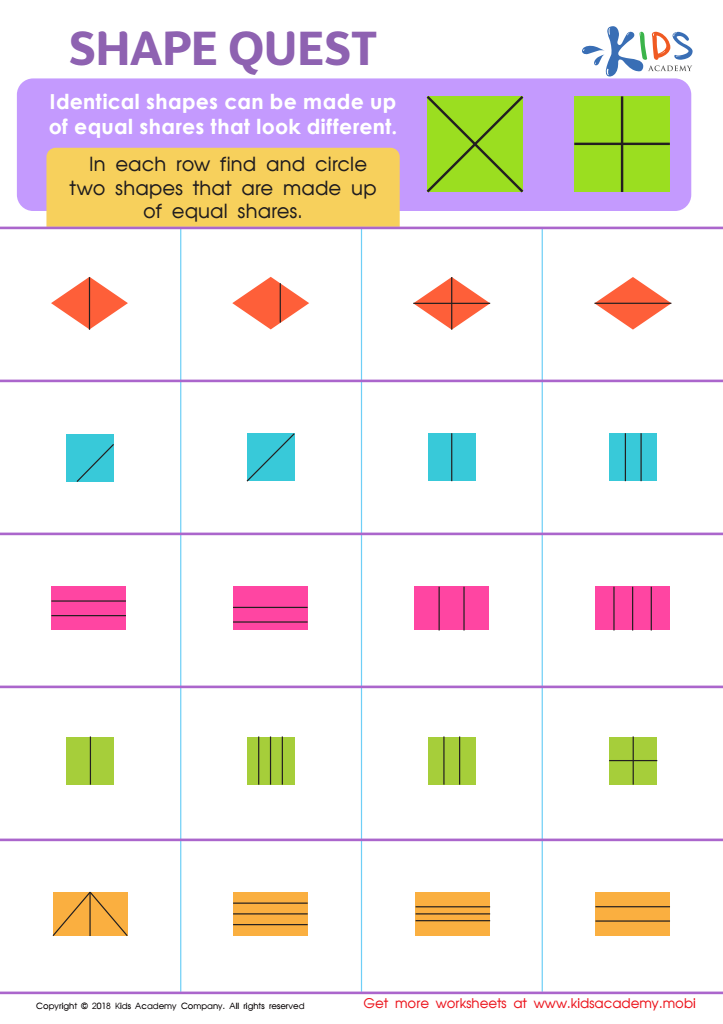
Shape Quest Worksheet
Help your child identify shapes by having them find shapes made up of equal parts. This colorful worksheet challenges them to look through each row and circle two matching shapes. It's a great way to teach them the unique features of each shape, while also helping them understand that identical shapes can look different.
Shape Quest Worksheet
Worksheet
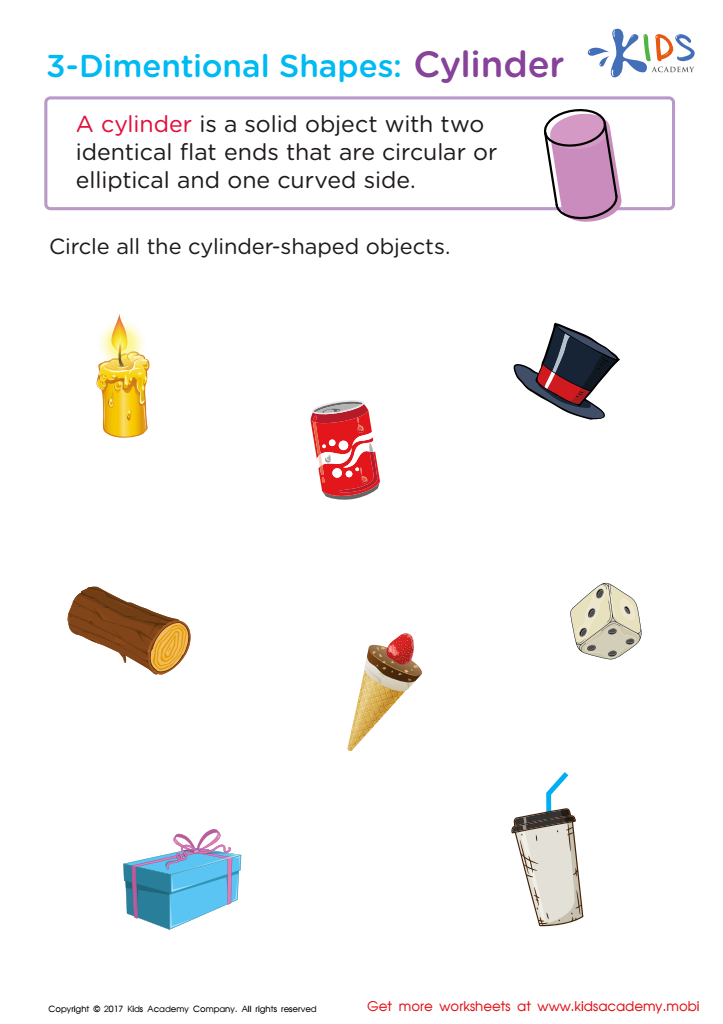
Three–Dimensional Shapes: Cylinder Worksheet
Introduce your toddler to geometry and 3D cylinders with this printable and watch their knowledge grow. It will help them recognize, define, and identify cylinders, as well as differentiate between 3D objects.
Three–Dimensional Shapes: Cylinder Worksheet
Worksheet
Join Kids Academy for Free
Who is primarily going to use this learning content?








Spatial awareness and basic geometry are essential components of early childhood education that parents and teachers should prioritize for children aged 7-8. During this developmental stage, children experience rapid growth in cognitive abilities, and understanding spatial relationships becomes foundational for more complex problem-solving and critical thinking skills.
First, spatial awareness involves the ability to understand and interact with the world around us. It aids children in navigating spaces, understanding directions, and becoming proficient in tasks ranging from sports to daily activities. By mastering this skill, children gain confidence and the ability to discern how objects relate to each other within a given area.
Second, early exposure to geometry does more than improve math skills; it enhances logical reasoning. Measuring distances, recognizing shapes, and comprehending symmetrical patterns are elementary skills in geometry that contribute significantly to further mathematical education. Understanding concepts such as closeness and distance can later evolve into more advanced topics like algebra and calculus.
Moreover, nurturing spatial awareness supports language development and literacy. Descriptive spatial terms like "above," "below," and "next to" become easier for children to grasp, positively impacting their reading and comprehension skills.
In summary, fostering spatial awareness and geometric understanding in young children equips them with essential life skills, bolstering their academic and personal growth during these formative years.








