
Pattern recognition Normal Math Worksheets for Ages 7-8
3 filtered results
Difficulty Level
Grade
Age
-
From - To
Subject
Activity
Standards
Discover an engaging collection of pattern recognition math worksheets designed specifically for ages 7-8. These worksheets foster crucial analytical skills, enabling young learners to identify, analyze, and predict patterns in numbers and shapes. With vibrant visuals and age-appropriate challenges, children can practice their pattern recognition skills while enhancing their mathematical understanding. Ideal for classroom settings or at-home learning, these resources promote critical thinking and problem-solving abilities. Encourage your child’s love for math with our easy-to-use, printable worksheets that make learning fun and interactive. Explore your child’s potential and lay the foundation for future mathematical success with our pattern recognition activities!
Favorites
With answer key
Interactive
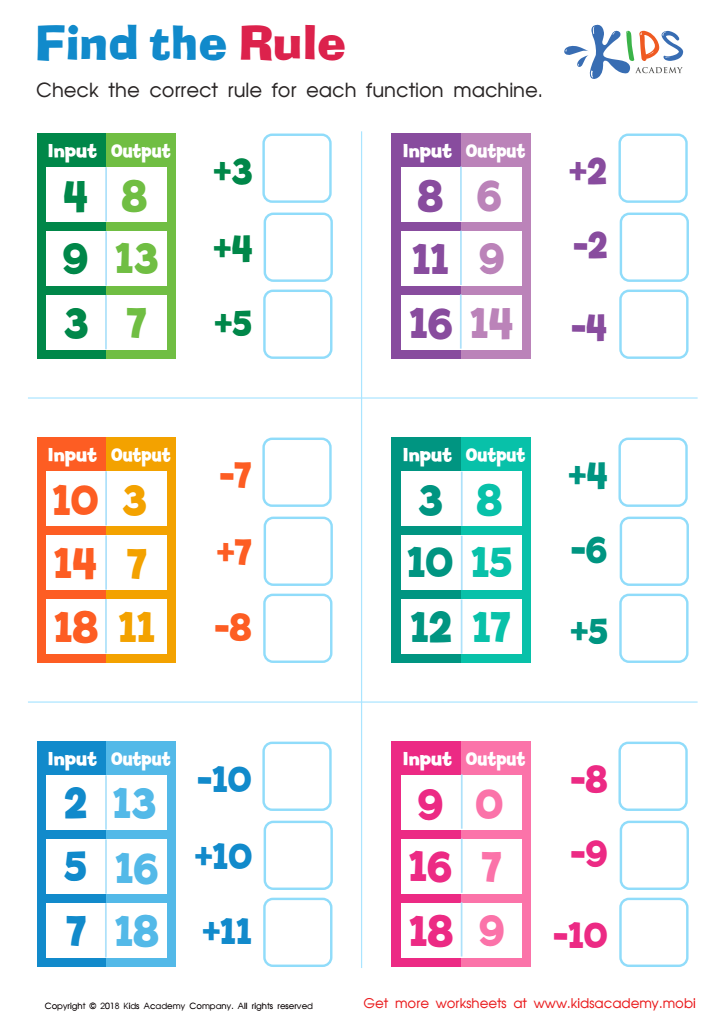
Find the Rule Worksheet
A function machine is an elementary math tool used to find an output by applying a rule, like addition or subtraction, to an input. Children use the diagram to understand the relationship between each input and output, with this worksheet helping them to analyze the machine and find the rule being used.
 Assign to My Students
Find the Rule Worksheet
Worksheet
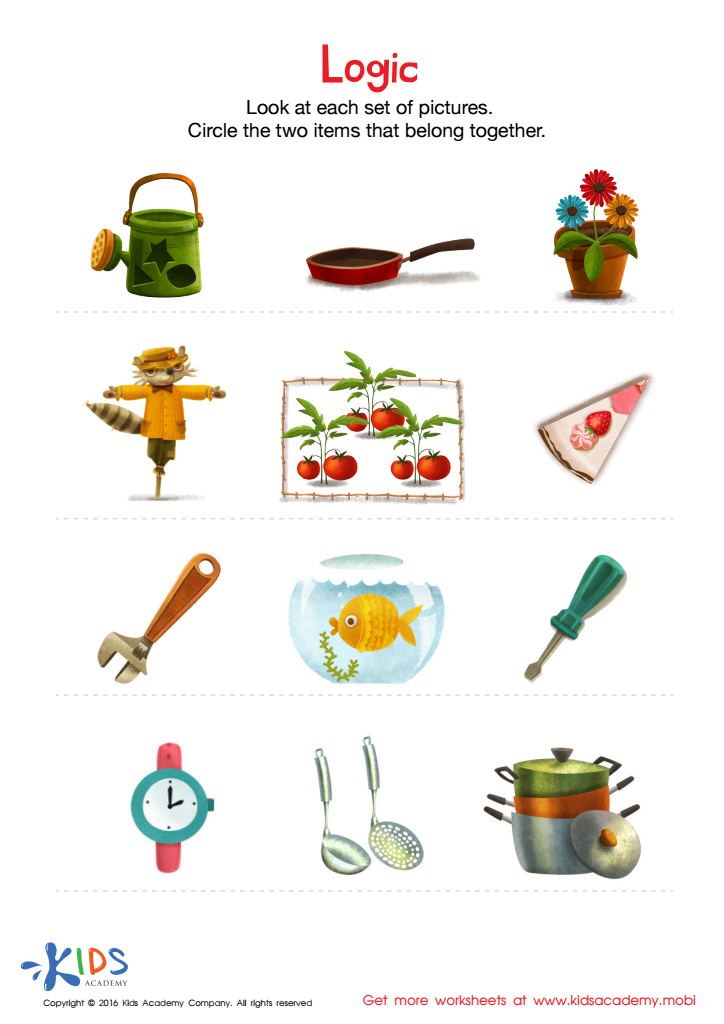
Logic Game Sorting Worksheet
Start your child's logic and reasoning development early with this fun matching worksheet! Through cute images and simple conversations, your little one can learn problem-solving, categorization, and matching skills. Plus, it's a great way for children to explore how items are used in real life. Try it and watch them boost skills with ease and fun!
Logic Game Sorting Worksheet
Worksheet
Join Kids Academy for Free
Who is primarily going to use this learning content?








Pattern recognition is a crucial mathematical skill for children aged 7-8, and both parents and teachers should prioritize its development. At this age, children are transitioning from concrete mathematical concepts to more abstract thinking, making pattern recognition an ideal gateway to enhance their cognitive abilities. Recognizing patterns helps children make connections among numbers, shapes, and sequences, fostering their overall mathematical understanding.
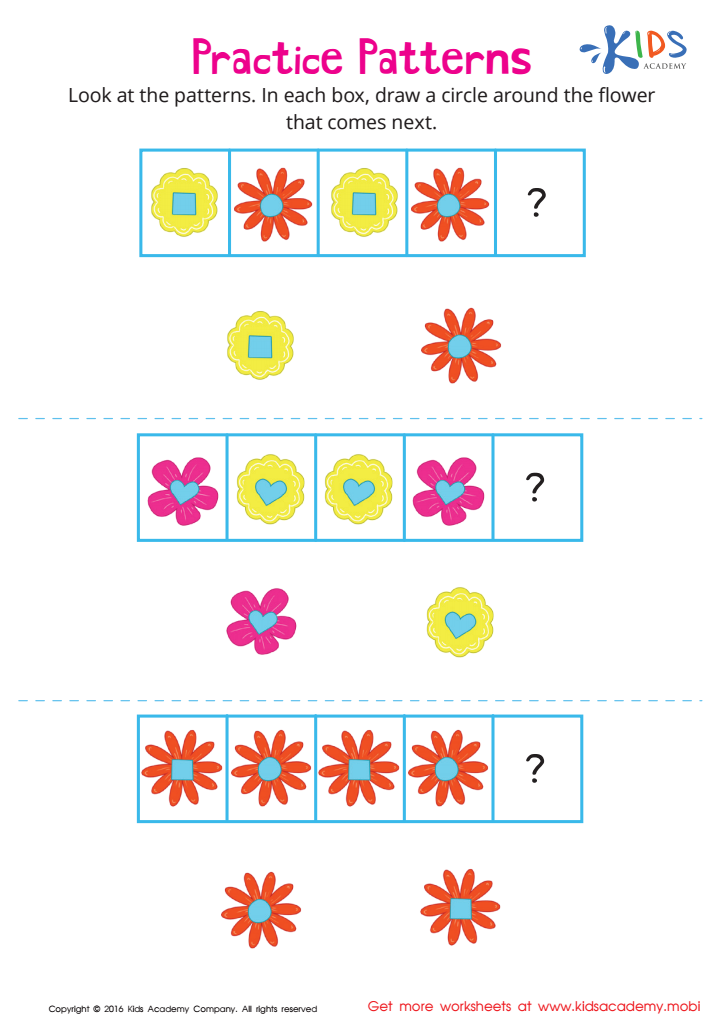
Engaging in pattern recognition activities cultivates critical thinking and problem-solving skills. Children learn to identify, predict, and extend patterns, which are foundational skills not only in mathematics but also in fields like science and art. These skills contribute to their cognitive development, allowing them to approach complex problems with confidence and creativity.
Moreover, identifying patterns enhances a child’s ability to understand the concept of variables in mathematics, preparing them for future algebraic concepts. It’s a stepping stone toward logical reasoning, which is essential for advanced mathematics and everyday life decisions.
By nurturing pattern recognition, teachers and parents not only help children master fundamental math skills but also instill a sense of curiosity and engagement with mathematics, creating lifelong learners who see the beauty and relevance of math in the world around them.








