
Reading analog clocks Normal Math Worksheets for Ages 7-8
3 filtered results
Difficulty Level
Grade
Age
-
From - To
Subject
Activity
Standards
Introduce your child to the skill of telling time with our "Reading Analog Clocks Normal Math Worksheets" designed specifically for ages 7-8. These engaging worksheets will help young learners master the basics of analog clocks, enhancing their understanding of hours and minutes. Through a variety of interactive exercises, children will improve their time-reading abilities while developing essential math skills. Each worksheet is crafted to ensure a fun and educational experience, perfect for reinforcing classroom lessons or practicing at home. Get started today and watch your child gain confidence in their ability to tell time like a pro!
Favorites
With answer key
Interactive
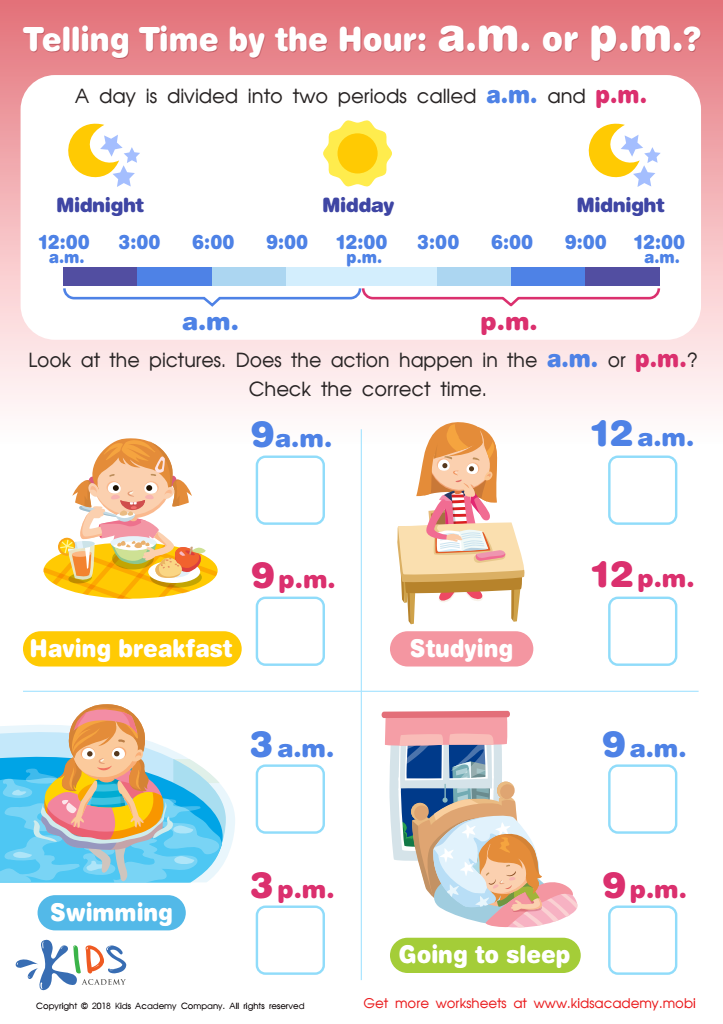
Tilling Time by the Hour: a.m. or p.m.? Worksheet
Can your child tell the time? This worksheet will help them learn. Explain a.m and p.m. and look at the pictures together. Ask your child if the activities happen in the a.m or p.m and help them check the correct time.
 Assign to My Students
Tilling Time by the Hour: a.m. or p.m.? Worksheet
Worksheet
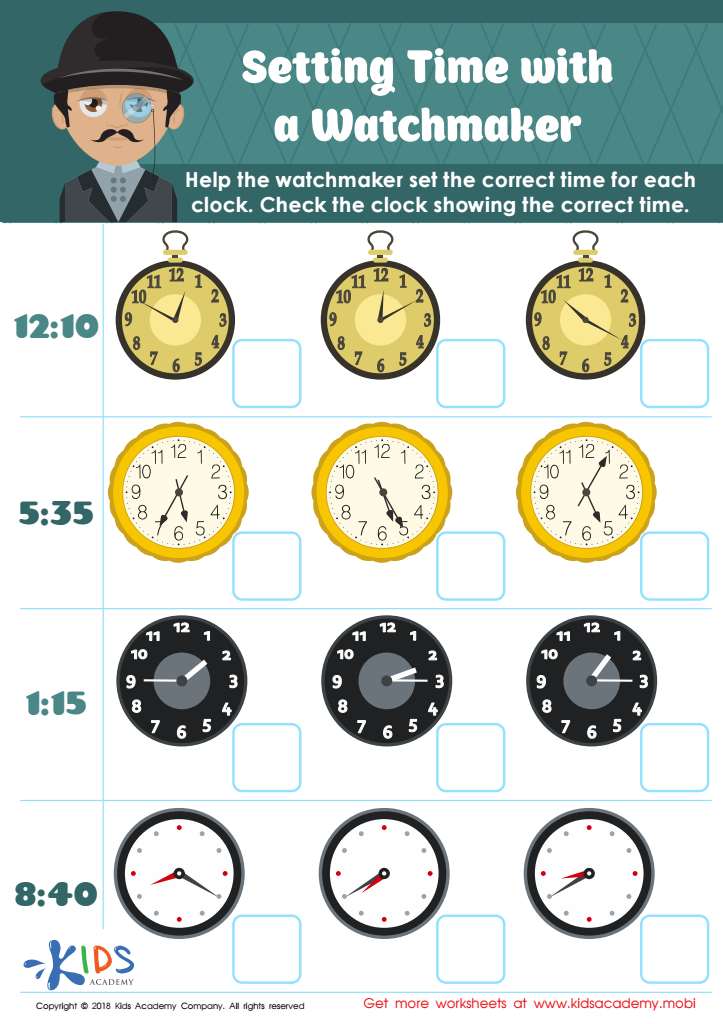
Setting Time with Watchmaker Worksheet
Can your kids tell the time? If so, this worksheet should be easy. Help them set the time for each clock: look at the time written on the left side and find the clock on the right side that matches.
Setting Time with Watchmaker Worksheet
Worksheet
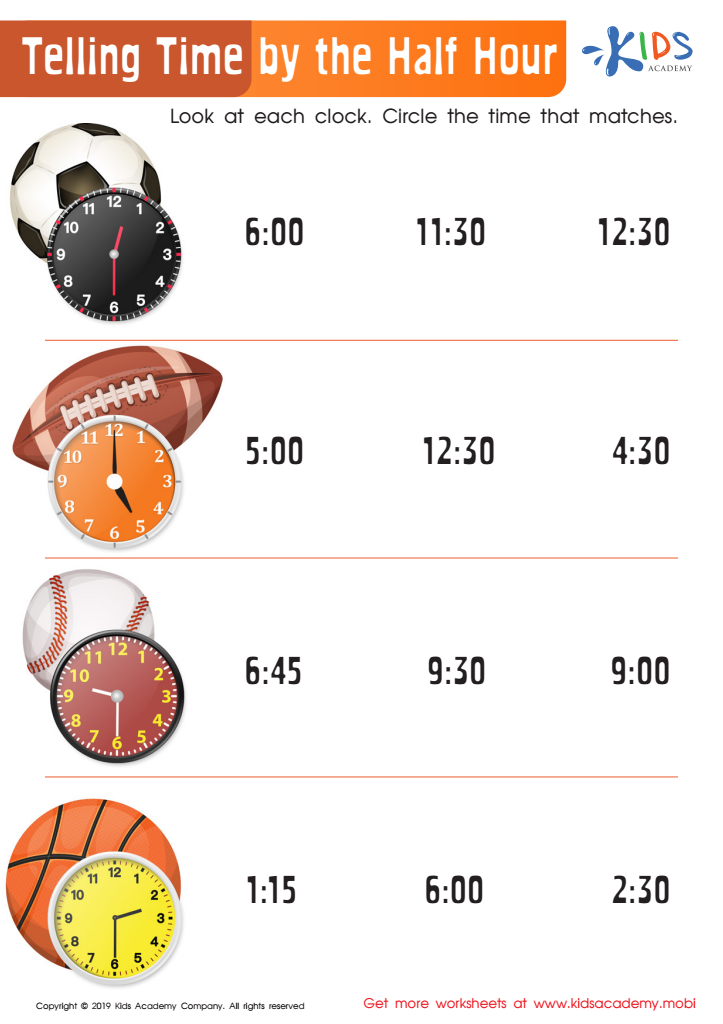
Telling Time by the Half Hour Worksheet
Teach kids to tell time with this worksheet! Four clocks are labeled with different times; help your child circle the right one. It's a great way to teach them to read analog and digital clocks, watches, and written times. Easy and fun learning!
Telling Time by the Half Hour Worksheet
Worksheet
Join Kids Academy for Free
Who is primarily going to use this learning content?







Parents and teachers should prioritize teaching children how to read analog clocks as part of their mathematical development for several key reasons. Firstly, understanding analog clocks enhances a child's ability to grasp time concepts, which are foundational to daily life and activities. Knowing how to tell time helps children develop critical time management skills, allowing them to structure their day effectively, adhere to schedules, and understand the importance of punctuality.
Secondly, reading analog clocks strengthens their numerical literacy and comprehension of mathematics. It introduces concepts such as fractions and division through the division of the clock face into halves and quarters, helping them to visualize and understand relationships between numbers in a practical context.
Moreover, this skill fosters independence and reinforces a sense of responsibility, as children play an active role in managing their time. With the prevalence of digital devices, some may argue that analog clocks are becoming obsolete; however, analog timepieces still exist in public spaces and remain relevant in various scenarios. Thus, equipping children with this skill enhances their adaptability and confidence, ensuring they are well-prepared for both academic settings and real-world applications.








