Understanding base ten Normal Numbers Worksheets for Ages 7-9
3 filtered results
-
From - To
Introduce young learners to the foundational concept of the base ten system with our engaging worksheets designed for ages 7-9. These fun and educational worksheets help children understand the importance of place values, from units to hundreds, fostering essential math skills. Through a variety of exercises, kids will practice counting, addition, and subtraction using base ten blocks, enhancing their numerical fluency and grasp of number composition. Perfect for classroom activities or additional home practice, our worksheets ensure that understanding base ten becomes an enjoyable and confident learning experience for your child. Promote better math comprehension today!
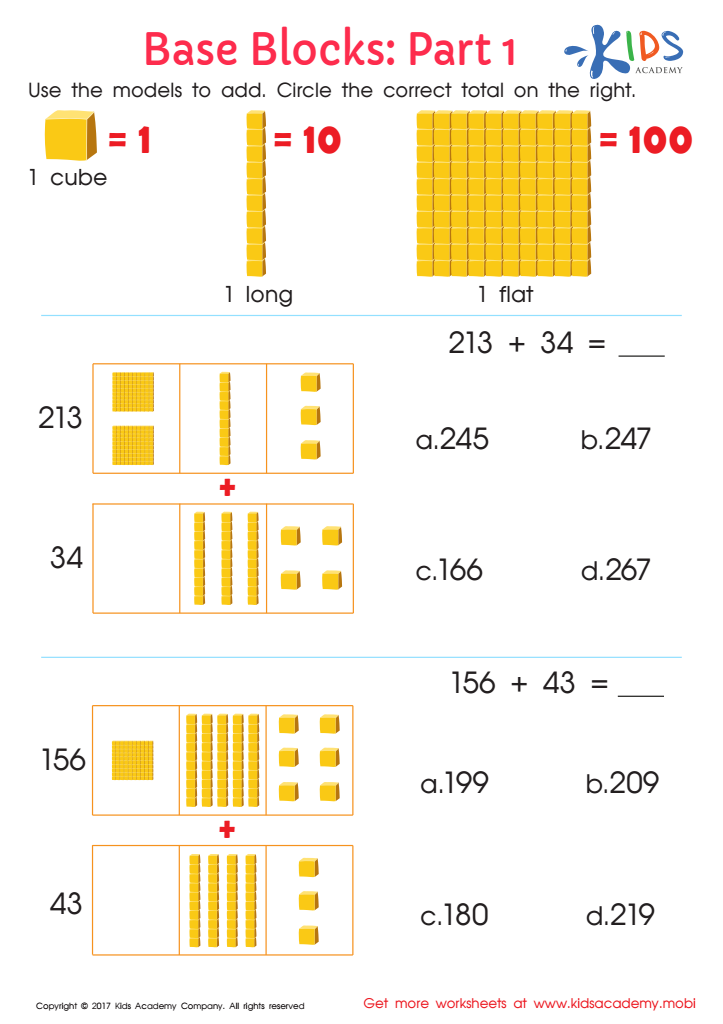
Base Ten Blocks Worksheet: Part 1
 Assign to My Students
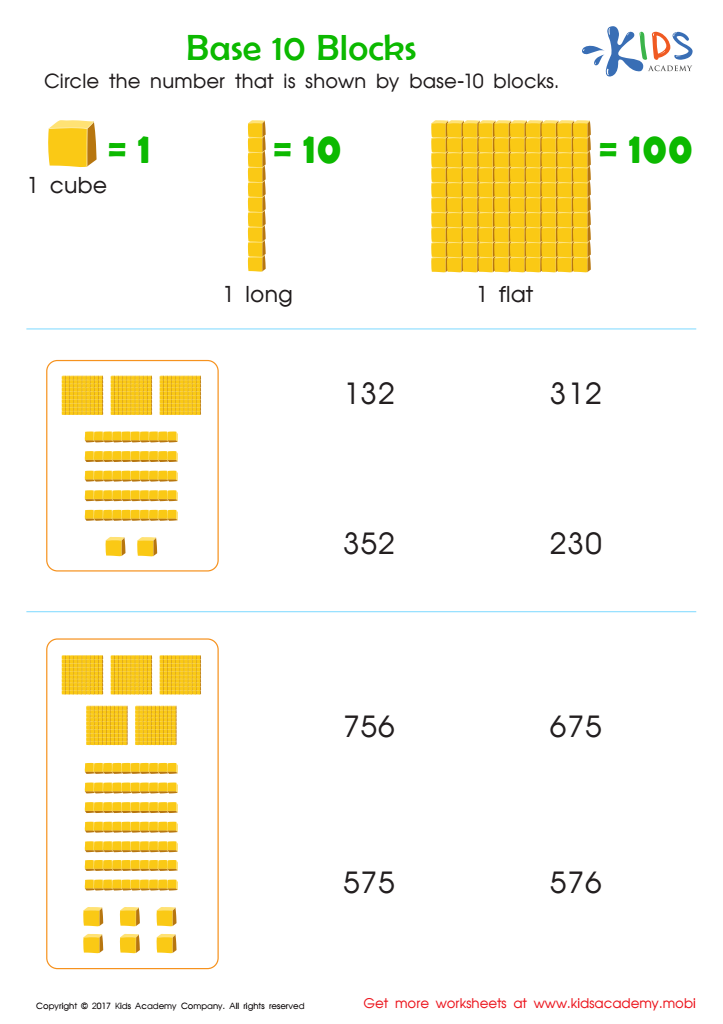
Base Ten Blocks Worksheet
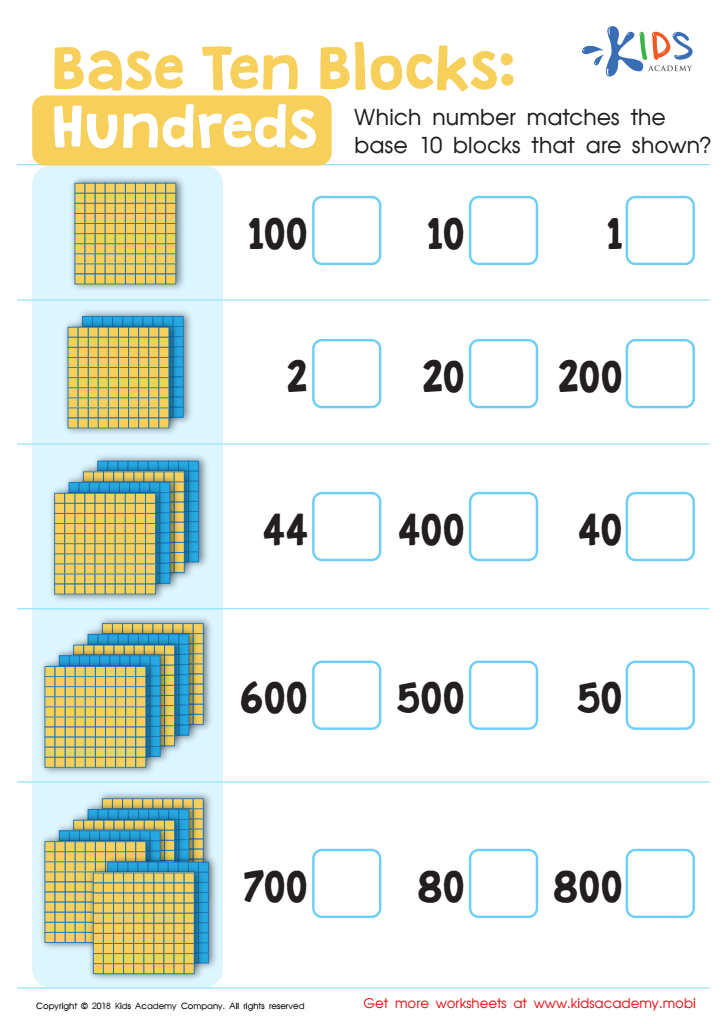
Base Ten Blocks: Hundreds Worksheet








Understanding base ten, or the decimal system, is fundamental for children ages 7-9 as it lays the groundwork for all future mathematics learning. Base ten is the numbering system most widely used around the world, and becoming proficient in it enables children to comprehend how numbers function, making arithmetic tasks more intuitive.
For parents and teachers, fostering a strong grasp of base ten at this stage accelerates children's math literacy. It helps kids make sense of place value, a critical concept where each digit in a number has a value depending on its position. For example, in the number 345, the '3' represents 300 (three hundreds), '4' represents 40 (four tens), and ‘5’ represents 5 units. This comprehension enhances their ability to perform addition, subtraction, multiplication, and division.
Moreover, a solid foundation in base ten supports children in understanding larger numerical concepts like money, measurement, and data representation. It also builds logical reasoning and problem-solving skills. When children can visualize numbers effectively, they become more confident and capable in math, reducing anxiety and fostering a positive attitude toward the subject. Early success and confidence in math can have lasting effects, influencing academic choices and opportunities in science, technology, engineering, and mathematics (STEM) fields.
Therefore, parents and teachers should prioritize activities and lessons that reinforce the base ten system to ensure children are well-prepared for future mathematical challenges.








