
Basic subtraction skills Normal Worksheets for 7-Year-Olds
3 filtered results
Difficulty Level
Grade
Age
-
From - To
Subject
Activity
Standards
Help your 7-year-old master basic subtraction skills with our expertly designed normal worksheets. Tailored to match their learning pace, these exercises cover essential subtraction techniques and improve problem-solving abilities. Each worksheet features engaging activities like fun math problems and colorful visuals to make subtraction simple and enjoyable for young learners. Ideal for both classroom and home use, these resources enable consistent practice to build confidence and proficiency in math. Empower your child with the foundational skills they need for more advanced mathematics. Download now and watch their subtraction skills flourish!
Favorites
With answer key
Interactive
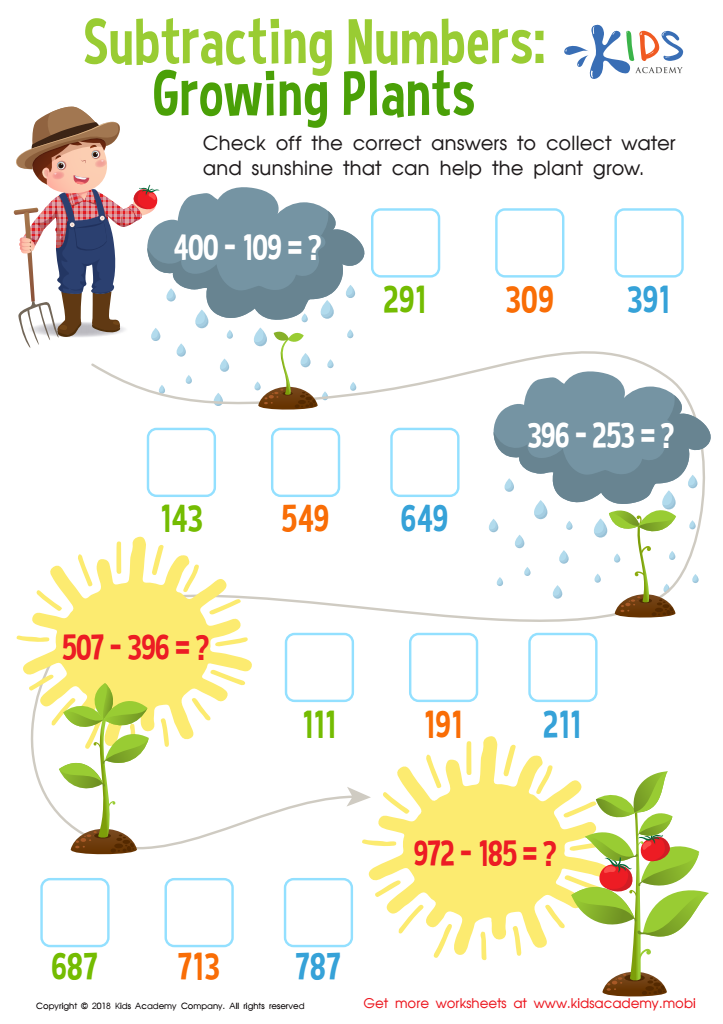
Subtracting Numbers: Growing Plants Worksheet
Farmers plant and nurture crops for us to eat. To help them, check off the items a plant needs to survive: water and sunshine. Ask your child to explain more!
 Assign to My Students
Subtracting Numbers: Growing Plants Worksheet
Worksheet
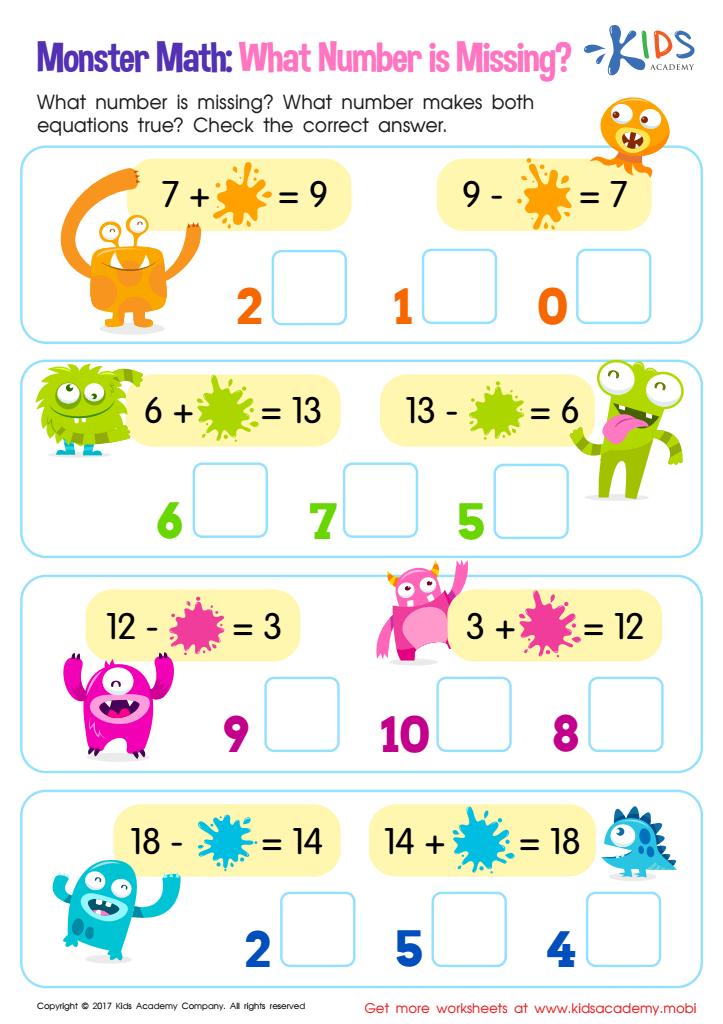
Missing Number: Monster Math Worksheet
Engage your child in monster math fun with a worksheet! They'll need to use their counting, addition and subtraction skills to solve equations on both sides. On the left side, they must complete an addition problem and on the right, the equation is in subtraction form. Assist them in selecting the right number out of the given options to make both equations true.
Missing Number: Monster Math Worksheet
Worksheet
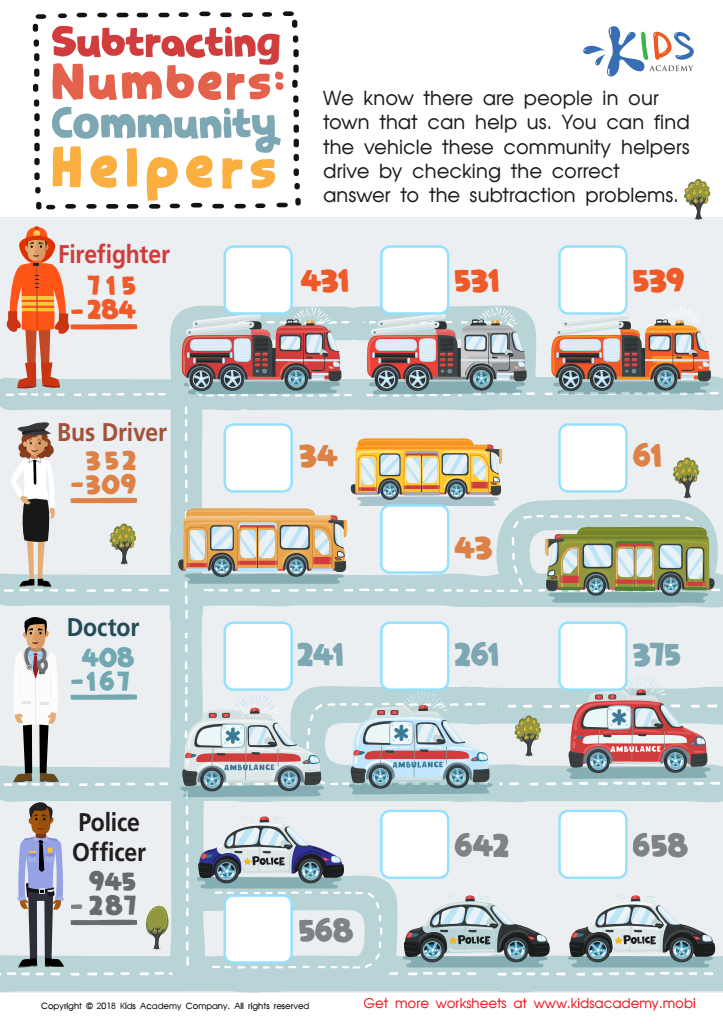
Subtracting Numbers: Community Helpers Worksheet
A community is an area of different people, buildings and other elements. People in a community have varied roles and work together to make it thrive. Ask your child what community helpers they know and how they help. Match the helpers to their vehicles by solving subtraction problems!
Subtracting Numbers: Community Helpers Worksheet
Worksheet
Join Kids Academy for Free
Who is primarily going to use this learning content?








Basic subtraction skills are fundamental building blocks in a child's mathematical development and are crucial for their overall academic success. At the age of 7, most children are in the first or second grade, where they are expected to grasp essential arithmetic operations, including addition and subtraction. Proficiency in subtraction not only facilitates the understanding of more complex math concepts but also supports their logical and analytical thinking skills.
Parents and teachers need to prioritize the mastery of basic subtraction, as it enhances problem-solving abilities that extend beyond mathematics, aiding in daily decision-making and critical thinking tasks. Understanding subtraction helps children visualize and understand numerical relationships, fostering a deeper comprehension of how numbers work. This foundational skill enables students to tackle more advanced topics in later grades, such as multiplication, division, and ultimately, algebra.
Furthermore, confidence in math builds self-esteem in academic settings and encourages a positive attitude towards learning other subjects. Children who struggle with basic subtraction may develop math anxiety, which can hinder their academic progression. By ensuring that children develop strong subtraction skills early on, parents and teachers set the stage for a lifetime of academic and intellectual success, making this an essential focus in early education.








