
Comparing lengths Normal Math Worksheets for 7-Year-Olds
4 filtered results
Difficulty Level
Grade
Age
-
From - To
Subject
Activity
Standards
Welcome to our engaging "Comparing Lengths" math worksheets designed specifically for 7-year-olds! These interactive resources will help young learners develop essential skills in comparing and measuring lengths using various objects. Our worksheets are filled with fun activities, realistic scenarios, and colorful illustrations to capture children's attention and reinforce their understanding of length concepts. Students will practice comparing the lengths of items, honing their critical thinking and analytical skills in a playful manner. Perfect for classroom use or home study, these worksheets promote foundational math skills while encouraging kids to explore the world around them. Download them today for an exciting learning experience!
Favorites
With answer key
Interactive
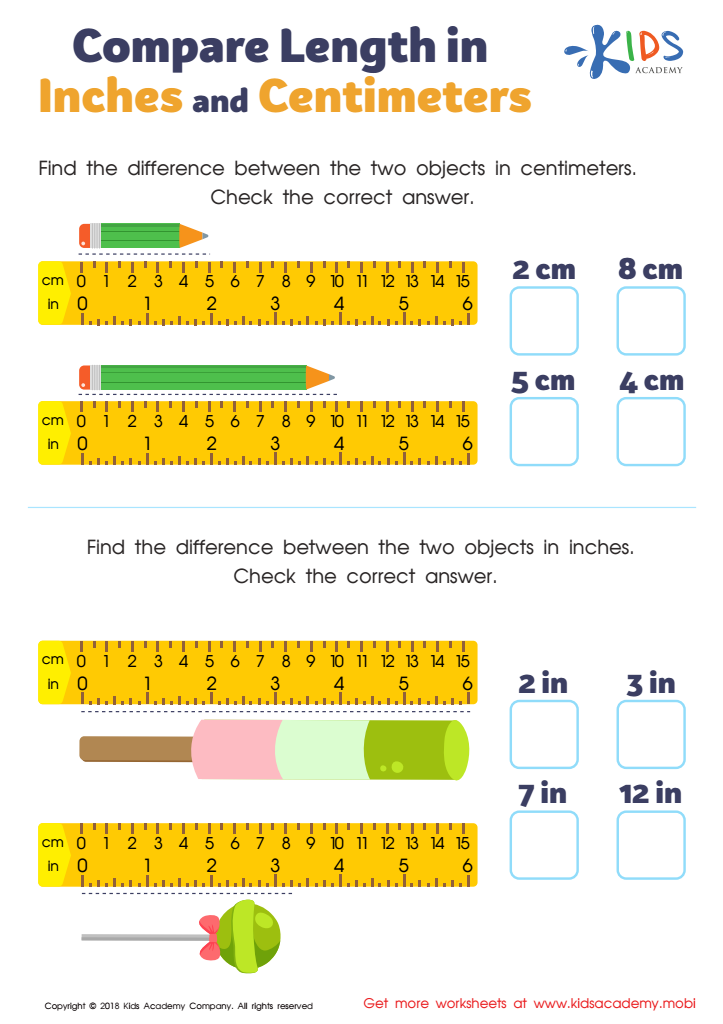
Compare Length in Inches and Centimeters Worksheet
This worksheet has your child measuring objects in both centimeters and inches. The first task requires measuring both objects in centimeters, then finding their difference. The second task is the same but in inches.
 Assign to My Students
Compare Length in Inches and Centimeters Worksheet
Worksheet
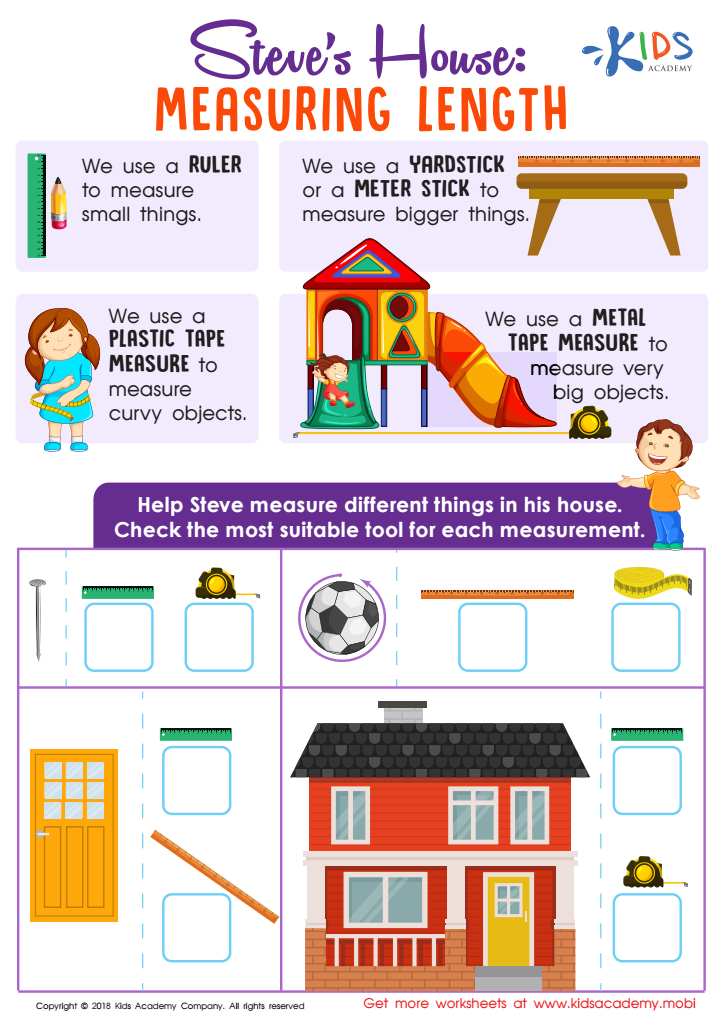
Steve's House: Measuring Length Worksheet
Introduce your kids to the various measuring tools and their uses. Explain how a ruler, plastic tape, yard stick, and metal tape measure are used to measure different objects. Guide them as they help Steve measure things in his home with the correct tool.
Steve's House: Measuring Length Worksheet
Worksheet
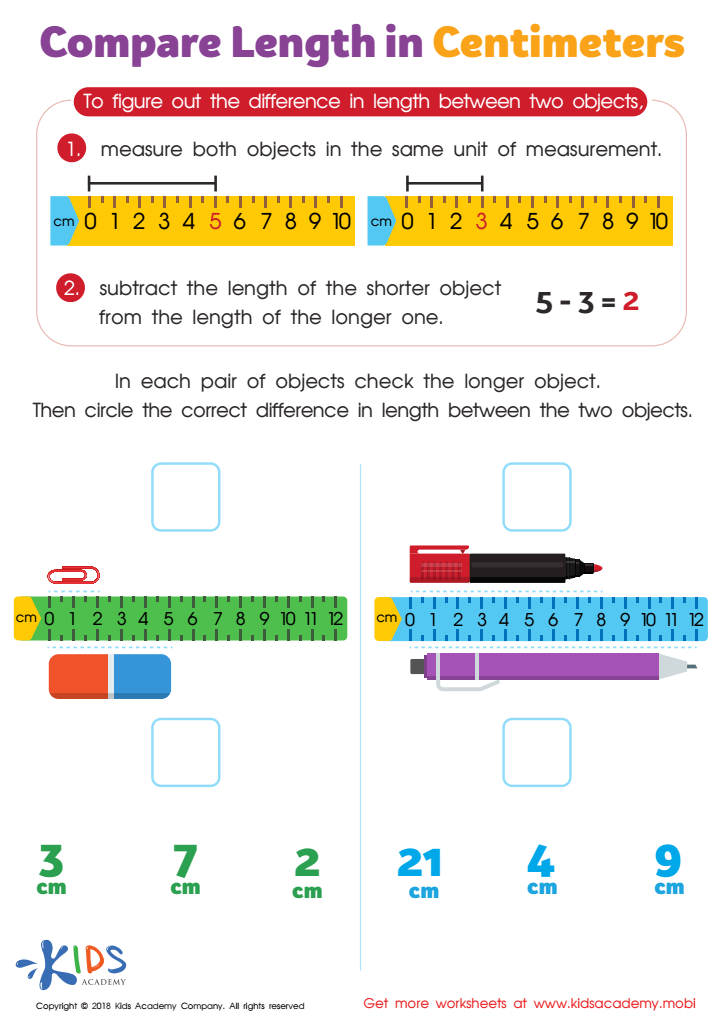
Compare Length in Centimeters Worksheet
To do this worksheet, your child needs to be able to measure accurately, add and subtract. They must measure both items and subtract the shorter from the longer to work out the difference in length.
Compare Length in Centimeters Worksheet
Worksheet
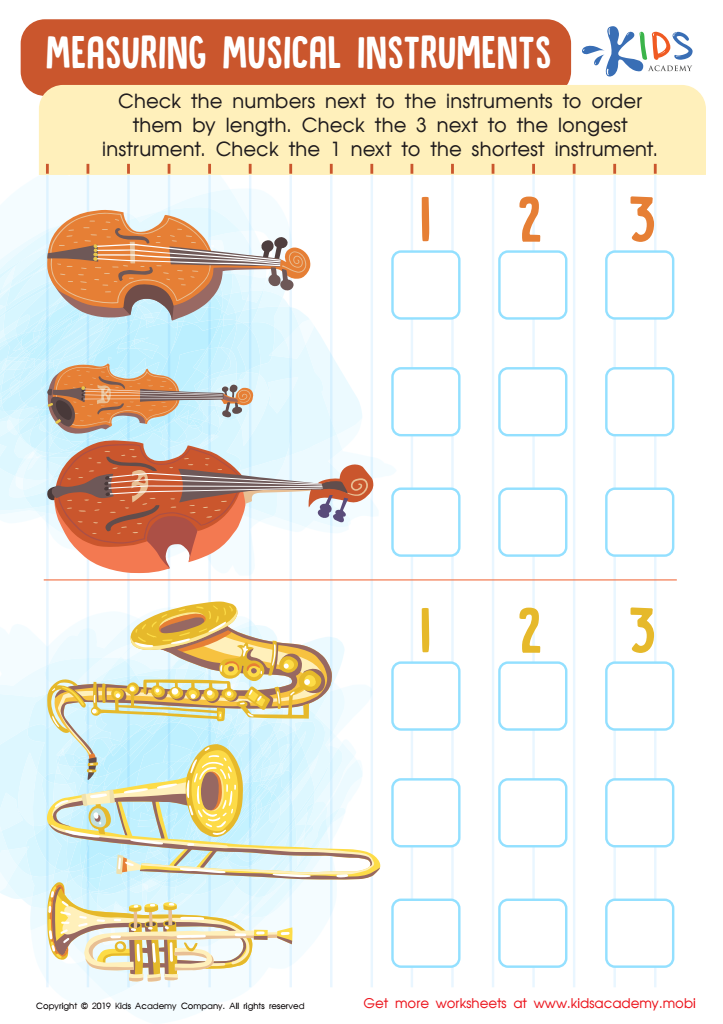
Measuring Musical Instruments Worksheet
Learning measurements can be tricky, but this worksheet makes it easy. Ask your child to identify the instruments in the pictures. Then, order them by length using the numbers. 3 is the longest, 1 is the shortest. Simple exercises like this will help them understand the different metric systems.
Measuring Musical Instruments Worksheet
Worksheet
Join Kids Academy for Free
Who is primarily going to use this learning content?





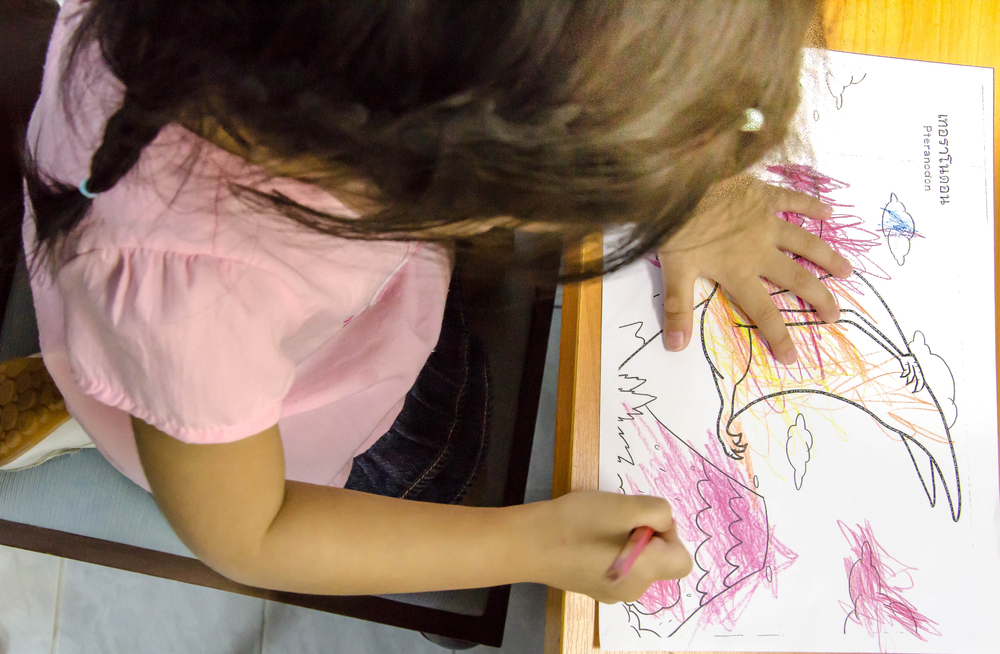


Teaching 7-year-old children to compare lengths is essential for several reasons that benefit both parents and teachers. First, understanding lengths lays a foundational mathematics skill that builds confidence and problem-solving abilities. At this age, children begin to think critically about the world around them, so engaging in comparative measurements helps them develop logical reasoning.
Secondly, comparing lengths fosters practical life skills. Children learn to make informed decisions based on size, which they encounter daily—from choosing the right shoes to understanding how much space a toy will take up. This hands-on application of math makes learning relevant and enjoyable.
Moreover, comparing lengths empowers kids to communicate effectively. They learn to use specific vocabulary, such as "taller," "shorter," "longer," and "smaller," which facilitates discussions and exchanges of ideas, whether at home or school.
For parents, being involved in this aspect of learning helps strengthen their child’s academic engagement. Encouraging exploration—be it through measuring objects in the home or outdoor play—can deepen children's understanding while building stronger parent-child bonds.
In summary, fostering skills in comparing lengths promotes cognitive development, practical application, and effective communication, making this concept vital for early education.








