Multiplication practice Normal Math Worksheets for Ages 8-9 - Page 2
30 filtered results
-
From - To



.jpg)


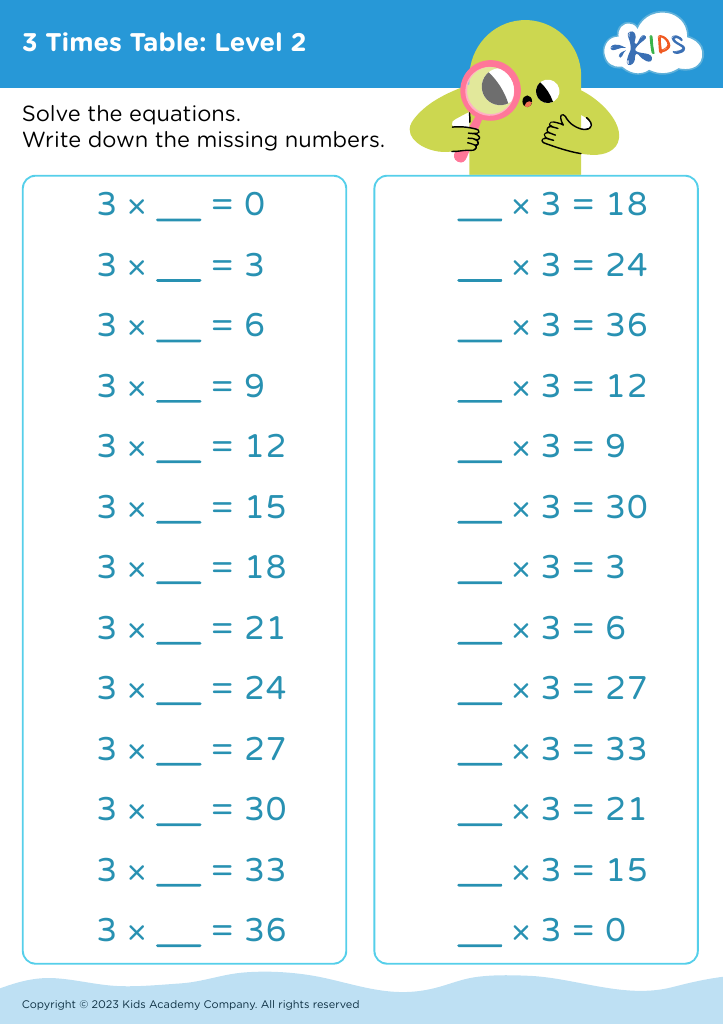
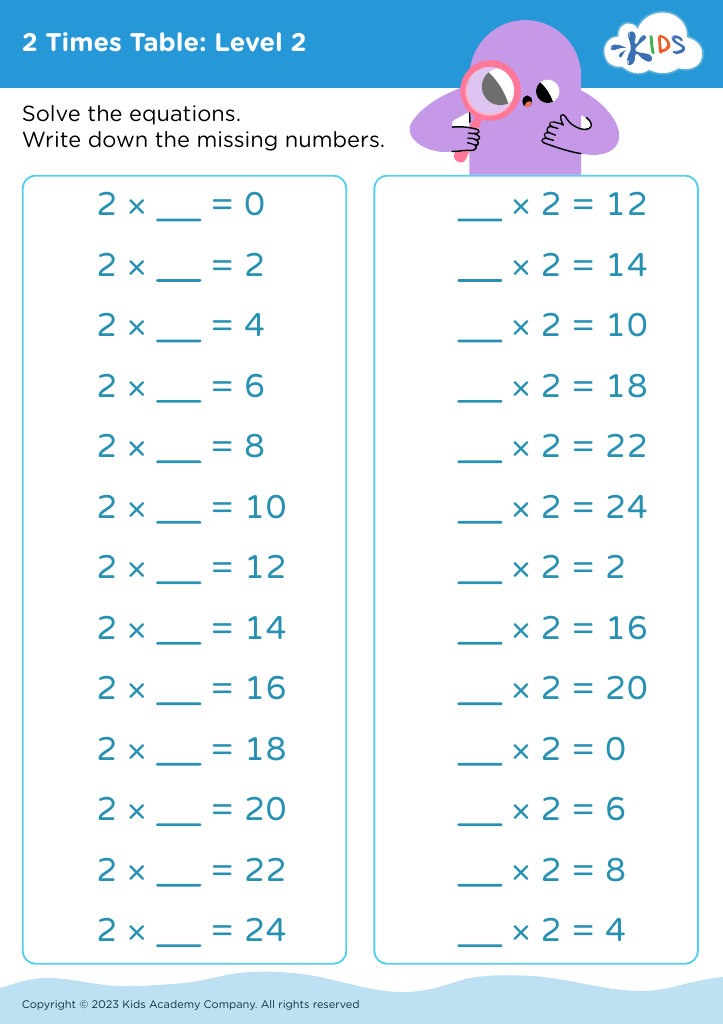
Parents and teachers should prioritize ensuring that children aged 8-9 master multiplication because it is a fundamental mathematical skill that serves as a building block for more advanced math concepts. Multiplication helps promote a deeper understanding of arithmetic by linking addition and the concept of grouping. By practicing multiplication, children develop critical thinking and problem-solving skills that are not only essential for math but for other subjects and life scenarios as well.
At this age, students are in a cognitive developmental stage where they can grasp abstract concepts with proper, consistent practice. Mastering multiplication sets the stage for learning division, fractions, and problem-solving strategies necessary in later grades. It also enhances numeracy, which is crucial in everyday situations such as understanding time, handling money, or calculating distances.
Furthermore, practicing multiplication boosts children's confidence in their mathematical abilities. As they become proficient in these basic operations, they build a strong foundation that makes learning advanced topics less intimidating. Engaging in regular multiplication practice instills discipline and helps children develop good study habits early on. In the long run, these skills contribute to academic success, opening doors to opportunities in fields that require strong numerical literacy. Thus, parents and teachers should regard multiplication proficiency as an essential priority in a child's early education.








