Understanding base ten Normal Worksheets for 8-Year-Olds
3 filtered results
-
From - To
Welcome to our Understanding Base Ten Normal Worksheets designed specifically for 8-year-olds! These engaging and interactive worksheets aim to build a strong foundation in place value and arithmetic by simplifying the concepts of base ten. With fun activities, children will master grouping and regrouping numbers, enhancing their addition and subtraction skills. Our resources encourage critical thinking, enabling kids to visualize number relationships while developing confidence in their mathematical abilities. Perfect for students in Grade 3, these worksheets are a valuable tool for teachers and parents alike. Dive in and help your child explore the world of base ten today!
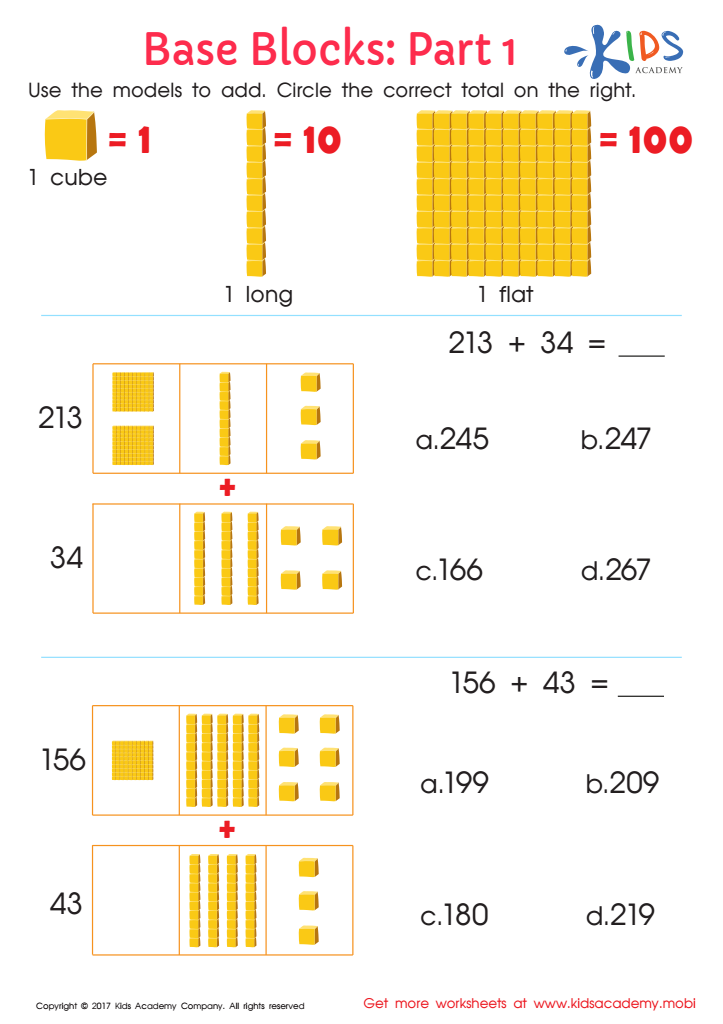
Base Ten Blocks Worksheet: Part 1
 Assign to My Students
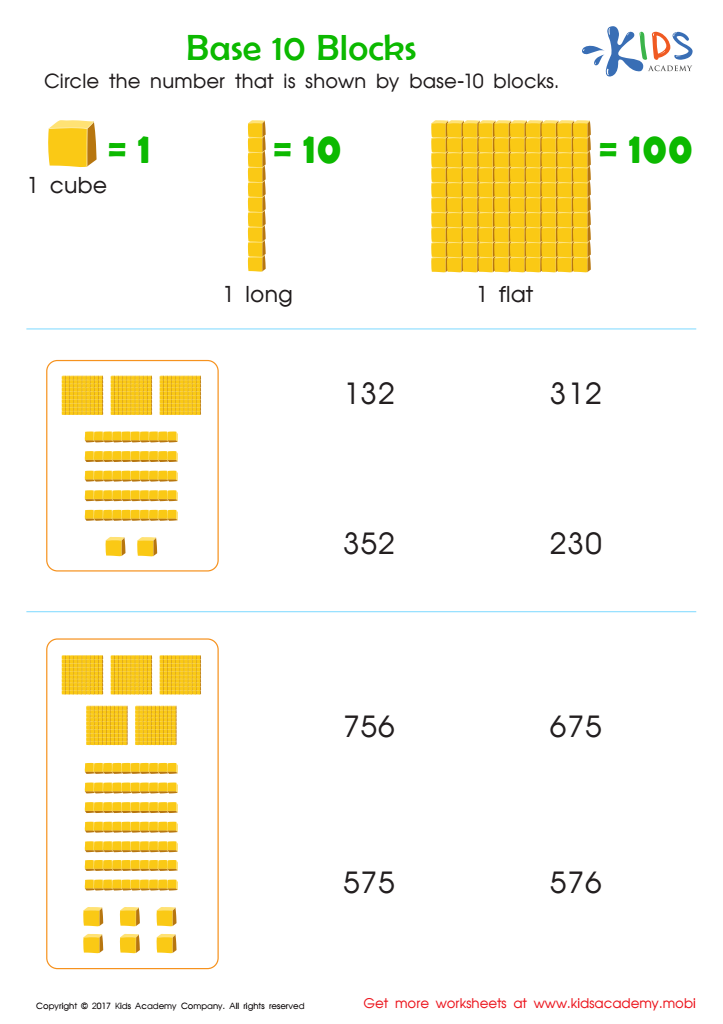
Base Ten Blocks Worksheet
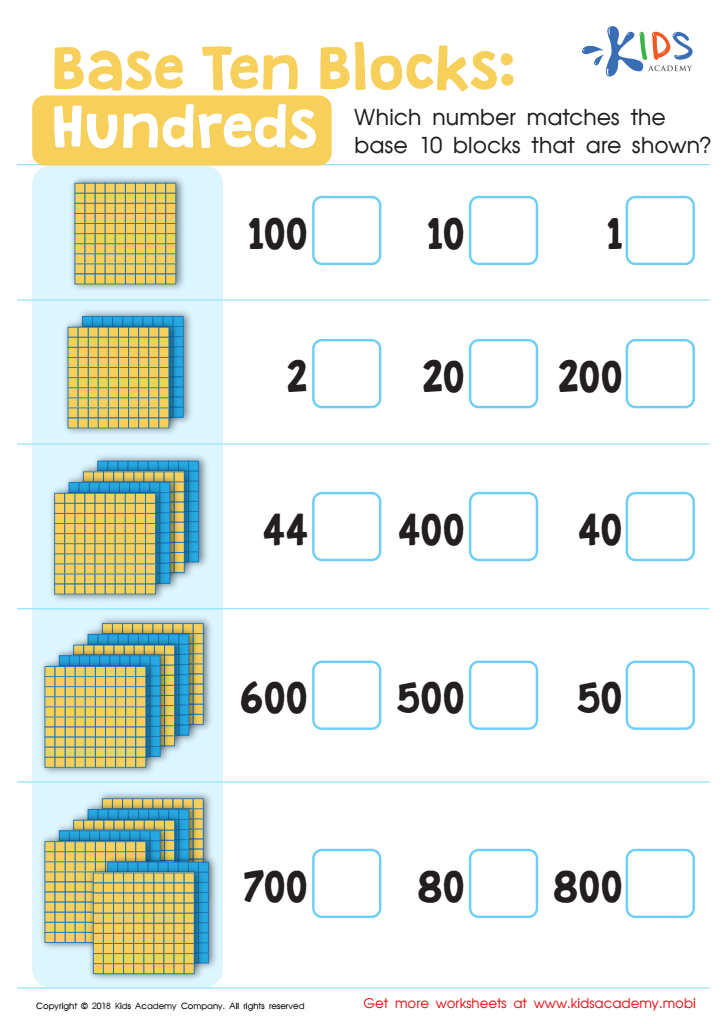
Base Ten Blocks: Hundreds Worksheet


.jpg)




Understanding base ten is crucial for 8-year-olds as it serves as the foundation for their mathematical development. At this age, children are transitioning from basic arithmetic to more complex concepts, and a solid grasp of the base ten system enables them to understand place value, which is essential for addition, subtraction, multiplication, and division.
Learning base ten helps children recognize the relationships between numbers and ultimately supports their ability to perform mental calculations and solve problems efficiently. For instance, understanding that the number 543 consists of five hundreds, four tens, and three ones allows them to decompose numbers, making operations easier.
Furthermore, familiarity with the base ten system fosters critical thinking and promotes logical reasoning. It contributes to a child's overall numeracy, which is vital for daily life, personal finance, and academic success in STEM subjects.
Parents and teachers play a pivotal role in reinforcing these concepts through engaging activities that promote hands-on learning. By encouraging children to explore base ten through manipulatives and games, they can make learning enjoyable and meaningful, setting the stage for lifelong mathematical understanding. Emphasizing base ten nurtures confidence and enthusiasm in young learners, crucial for their future educational journeys.








