
Understanding place values Normal Worksheets for 8-Year-Olds
5 filtered results
Difficulty Level
Grade
Age
-
From - To
Subject
Activity
Standards
Welcome to our "Understanding Place Values" worksheets, specially designed for 8-year-olds! These engaging and interactive worksheets help young learners grasp the concept of place values confidently, laying a strong foundation for their math skills. Each worksheet is thoughtfully crafted to challenge students while making learning enjoyable. Children will explore units, tens, hundreds, and beyond through a variety of exercises, including recognition, comparison, and value representation. Perfect for classroom use or at-home practice, these worksheets cater to different learning styles, ensuring every child can succeed. Unlock your child’s potential in math today with our fun and educational place values resources!
Favorites
With answer key
Interactive
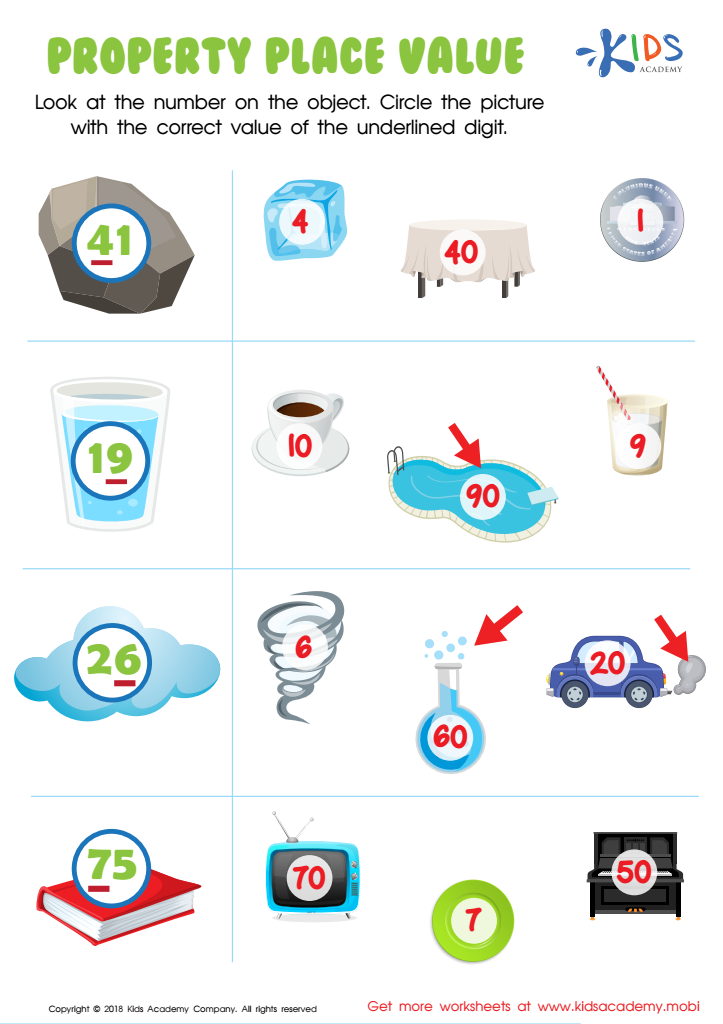
Property Place Value Worksheet
Help your child learn place value with this engaging worksheet! Kids Academy knows that colorful pictures motivate learners. Instruct them to name the place value of the underlined numbers on the left. Then, look through the images on the right to find the numbers that represent the indicated place value.
 Assign to My Students
Property Place Value Worksheet
Worksheet
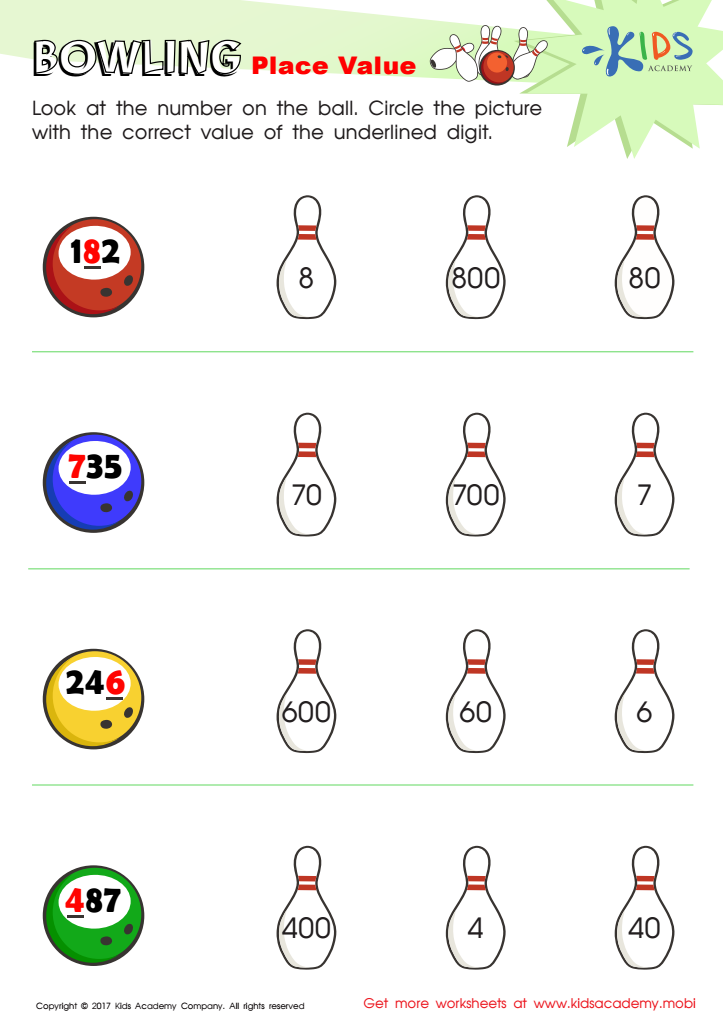
Place Value Worksheet
Try this place value worksheet to help your 2nd grader understand place value in a more meaningful way.
Place Value Worksheet
Worksheet
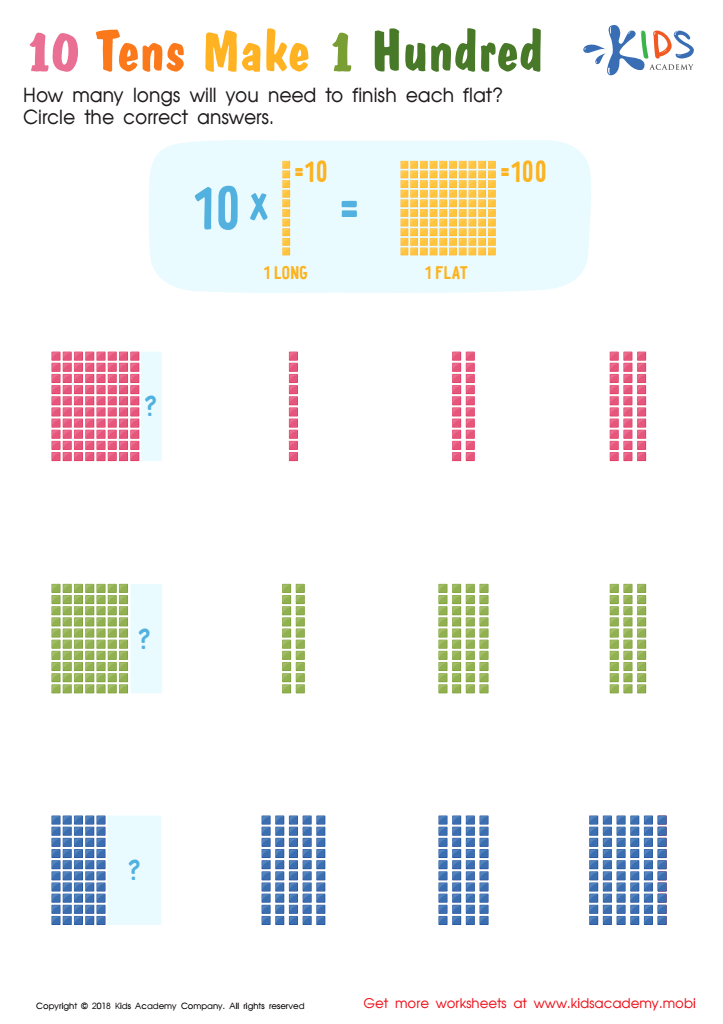
10 Tens Make 1 Hundred Worksheet
Help your child understand multiplication with this worksheet. Ask them how many 'longs' will be needed to complete each flat, then have them circle the correct answer from the options. With this exercise, your child will learn that 10 'tens' make 1 'hundred'!
10 Tens Make 1 Hundred Worksheet
Worksheet
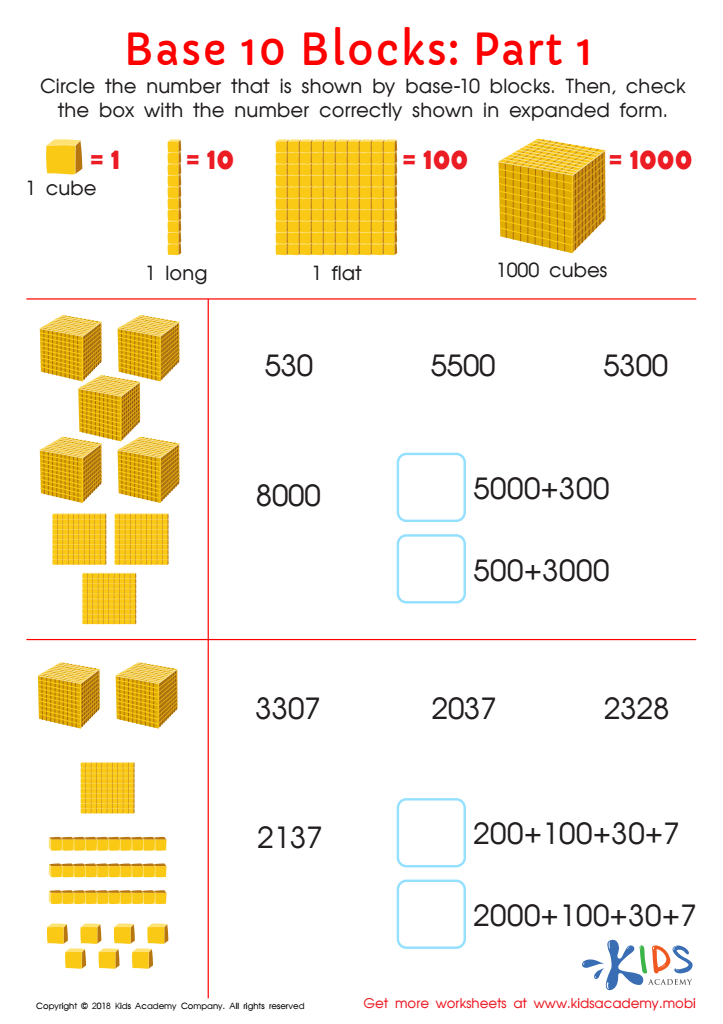
Base 10 Blocks Worksheet: Part 1
Need help teaching place value without manipulatives? Kids Academy has you covered! Our printable worksheet will help learners review the language like cubes, longs and flats. Just use the images at the top as a reference and have learners circle the answers and select its expanded form. Kids will master one to four-digit numbers without needing manipulatives.
Base 10 Blocks Worksheet: Part 1
Worksheet
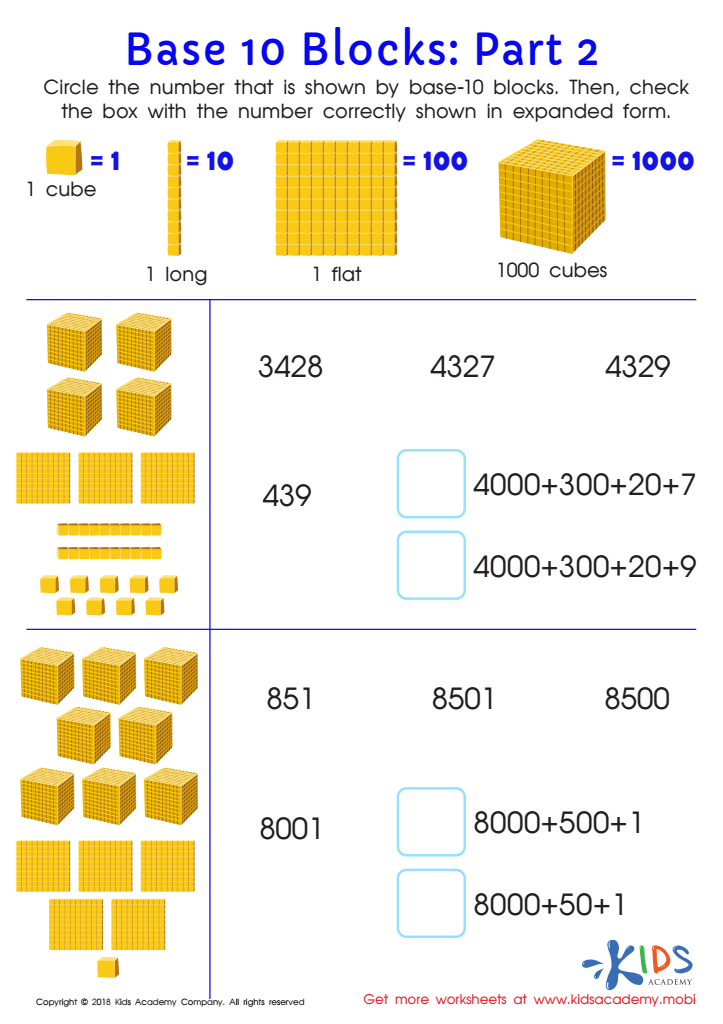
Base 10 Blocks Worksheet: Part 2
Need practice with one- to four-digit numbers using base blocks? This worksheet is perfect! Review the cubes and language to ensure understanding. View the images and select the correct number. Check the expanded form to finish this free printable math practice!
Base 10 Blocks Worksheet: Part 2
Worksheet
Join Kids Academy for Free
Who is primarily going to use this learning content?





Understanding place value is crucial for 8-year-olds as it forms the foundation for their mathematical literacy. When children grasp place value, they learn that the position of a digit in a number determines its worth. For example, in the number 543, the ‘5’ represents 500, not just 5. This comprehension aids in critical mathematical operations, including addition, subtraction, multiplication, and division.
Parents and teachers should prioritize this concept because it enhances a child's number sense and helps them tackle more advanced arithmetic with confidence. Mastering place value is linked to improved problem-solving skills and enables children to break down complex numbers into manageable parts. This skill is invaluable not only in math but also in real-life situations like budgeting, telling time, or understanding data.
Additionally, a solid grasp of place value fosters a child’s ability to interpret mathematical concepts and enhances their analytical thinking. As they progress in their education, these foundational skills will support their success in topics such as fractions, decimals, and algebra. Engaging with place value benefits children academically and empowers them for future learning, making it an essential focus for parents and educators alike.








