
Extra Challenge Phonics worksheets activities for Ages 3-6
3 filtered results
Difficulty Level
Grade
Age
-
From - To
Subject
Activity
Standards
Explore our Extra Challenge Phonics Worksheets designed for young learners aged 3-6! These engaging activities enhance phonetic awareness and improve early reading skills in a fun and interactive way. Each worksheet is thoughtfully crafted to challenge children, encouraging them to recognize sounds, blend letters, and develop a strong foundation in literacy. With colorful illustrations and age-appropriate tasks, kids will enjoy learning as they complete puzzles, matching games, and sound identification exercises. Perfect for teachers and parents, these worksheets promote independent learning and are an excellent supplement to any phonics curriculum. Unlock your child's potential in reading today!
Favorites
With answer key
Interactive
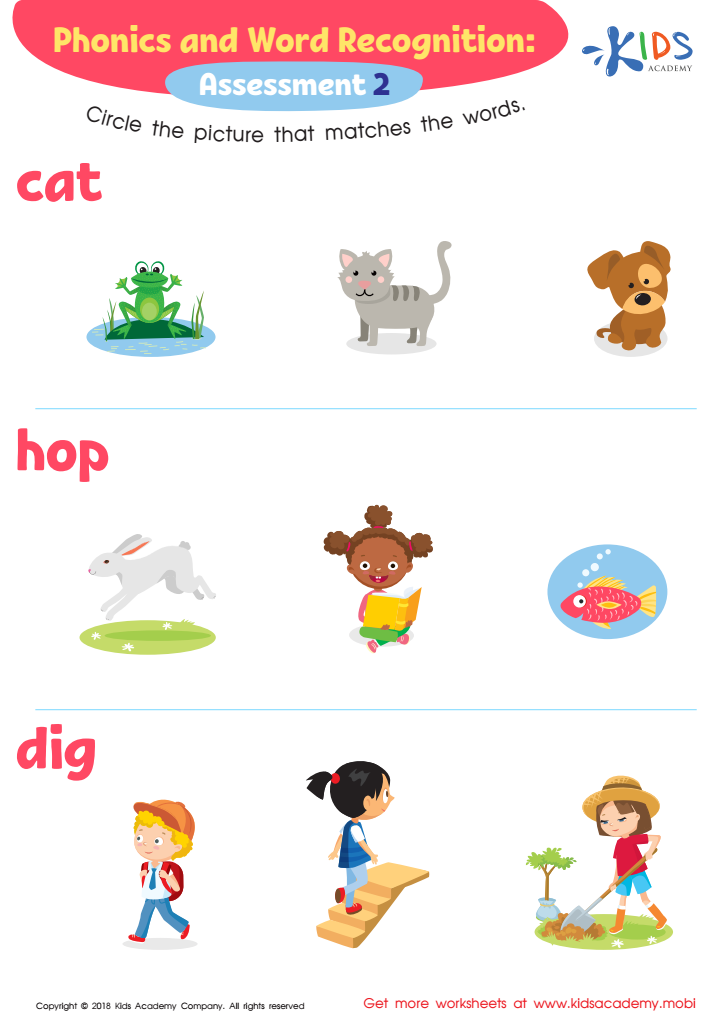
Phonological Awareness: Assessment 2 ELA Worksheet
This free worksheet assesses your emerging reader's ability to decode and match closed-syllable high-frequency words to the appropriate picture. The pictures are cheery and easy to identify, so your child will have fun and find success with decoding and matching.
 Assign to My Students
Phonological Awareness: Assessment 2 ELA Worksheet
Worksheet
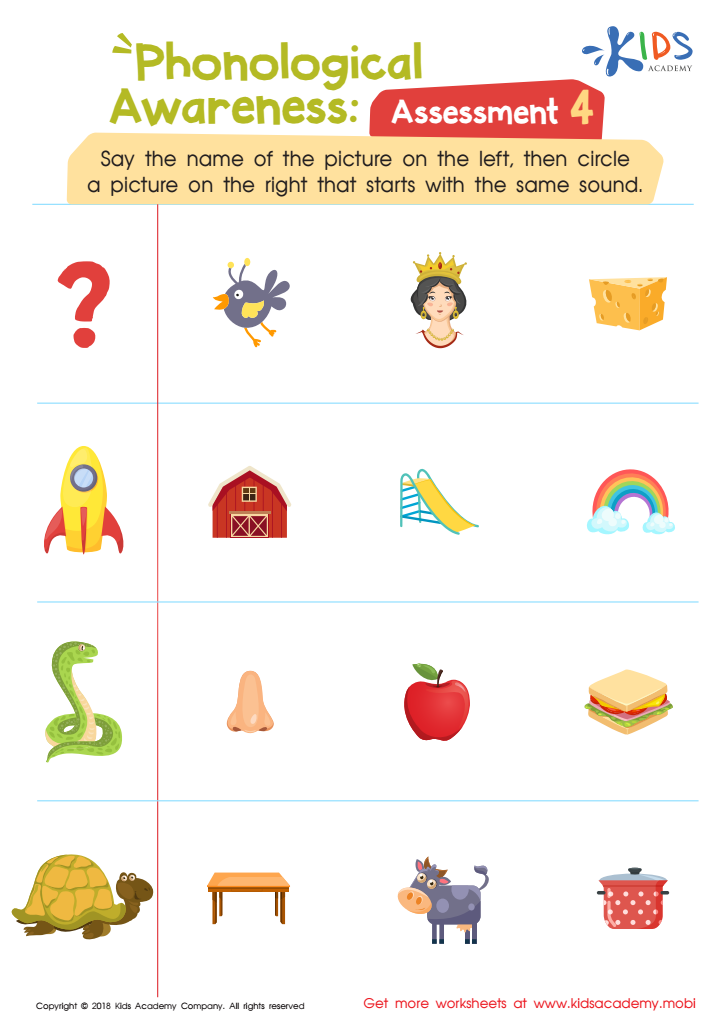
Phonological Awareness: Assessment 4 Worksheet
It can be tricky for young readers to differentiate between sounds in words. Make it fun with this downloadable worksheet! Ask your child to name each picture on the left and match the starting sound with an image on the right. This helps assess their phonics skills and make learning enjoyable.
Phonological Awareness: Assessment 4 Worksheet
Worksheet
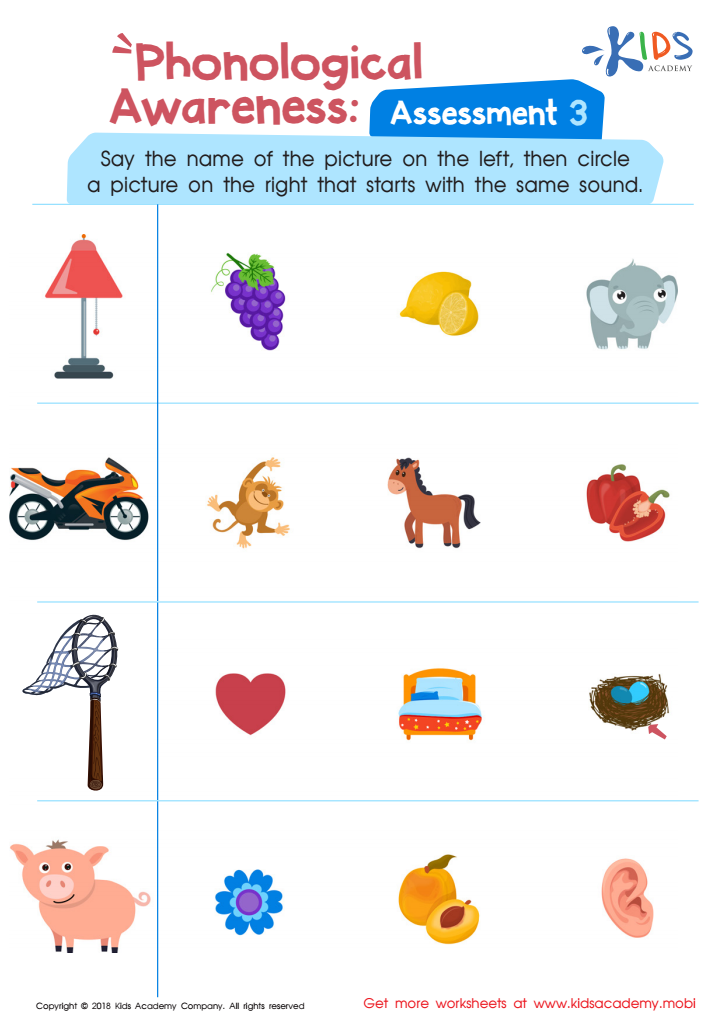
Phonological Awareness: Assessment 3 Worksheet
Test kids' reading readiness with a phonological awareness worksheet! With this PDF exercise, encourage children to name each picture aloud and match left to right. Help them learn to recognize word sounds at the start, middle and end of words. They'll be sure to remember that lamp doesn't sound like elephant!
Phonological Awareness: Assessment 3 Worksheet
Worksheet
Join Kids Academy for Free
Who is primarily going to use this learning content?








Parents and teachers should prioritize Extra Challenge Phonics activities for children aged 3-6 because they play a crucial role in early literacy development. At this age, children are particularly receptive to learning sounds and letters, forming the foundation for reading and writing. Phonics activities enhance phonemic awareness, enabling children to recognize and manipulate sounds in words, which is essential for decoding skills.
Engaging in Extra Challenge Phonics not only boosts language skills but also nurtures cognitive development. These activities foster critical thinking and problem-solving abilities as children learn to associate sounds with letters and words. Additionally, they enhance vocabulary, empowering children to express themselves more effectively.
Moreover, Extra Challenge Phonics provides an excellent opportunity for parents and teachers to bond with children. Incorporating fun, interactive elements—like games and songs—can make learning enjoyable, thereby increasing motivation and curiosity.
Ultimately, consistent engagement with phonics activities lays the groundwork for lifelong literacy skills, impacting academic success and future learning. As children master these foundational skills, they build confidence in their abilities, fostering a love for reading that can last a lifetime. Therefore, parents and teachers should actively support these activities during early developmental stages.








