
Normal Phonics worksheets activities for 3-Year-Olds
2 filtered results
Difficulty Level
Grade
Age
-
From - To
Subject
Activity
Standards
Unlock the world of reading with our captivating Normal Phonics worksheets activities! Designed to engage young learners, our collection systematically strengthens phonemic awareness, decoding skills, and word recognition. Perfect for educators and parents, these activities offer a structured path to literacy through fun and interactive worksheets. From mastering simple letter sounds to blending complex syllables, our Normal Phonics worksheets activities pave the way for confident reading and a lifelong love for learning. Dive into our resource today and watch your child's reading abilities flourish!
Favorites
With answer key
Interactive
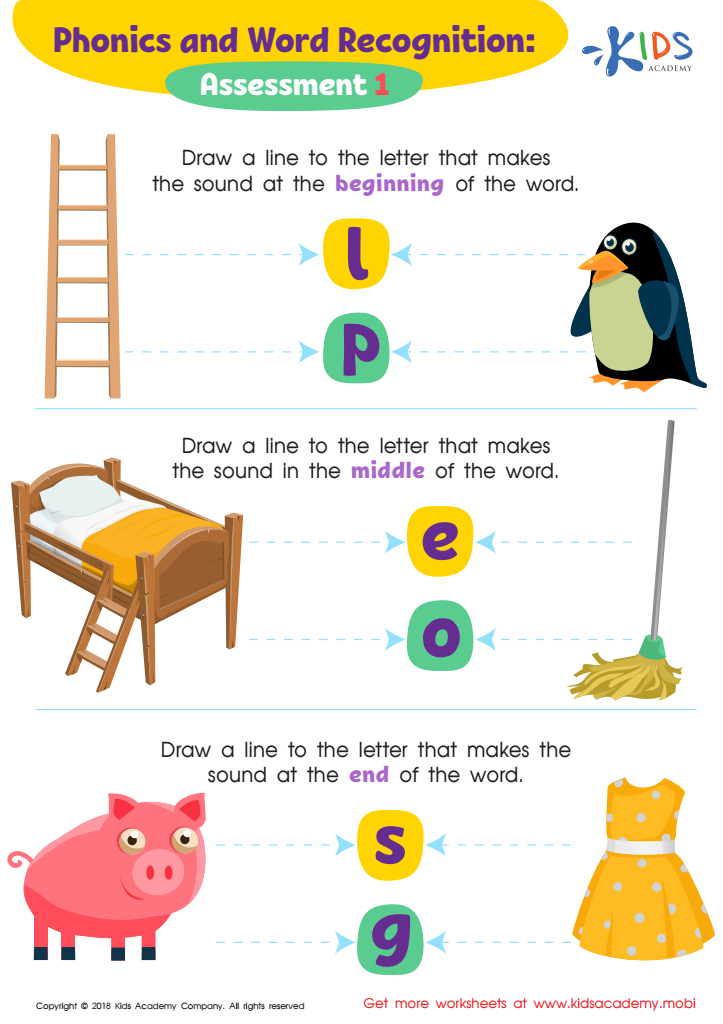
Phonics and Word Recognition: Assessment 1 ELA Worksheet
This fun worksheet tests your child's sound recognition skills for each part of a word. Ask your child to name each image and trace the line to match it with the corresponding letter. Listen for beginning sounds on 1st, middle sounds on 2nd, and ending sounds on 3rd. Encourage learning with this colorful and interactive activity!
 Assign to My Students
Phonics and Word Recognition: Assessment 1 ELA Worksheet
Worksheet
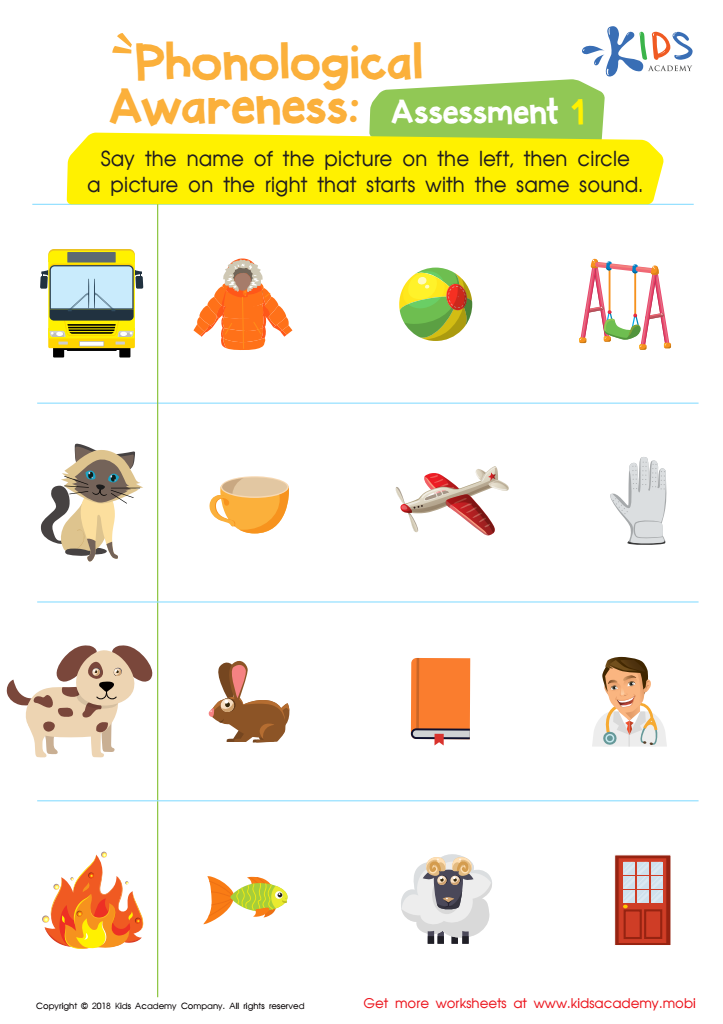
Phonological Awareness: Assessment 1 Worksheet
This worksheet helps kids build key phonics skills for pre-reading. They say each picture name aloud, focusing on the starting sound. Then, they match the sound with an image in the same row. Use as a checkpoint for kindergarten or grade 1 phonics readiness.
Phonological Awareness: Assessment 1 Worksheet
Worksheet
Join Kids Academy for Free
Who is primarily going to use this learning content?








Normal Phonics worksheets activities are a cornerstone in the language learning process, especially for young learners or those embarking on the journey of mastering English. These activities, meticulously designed to blend learning with fun, are instrumental in laying a robust foundation for reading and writing skills. Let us delve into why Normal Phonics worksheets activities are so beneficial.
Firstly, phonics is the method of teaching reading by developing learners' phonemic awareness—the ability to hear, identify, and manipulate phonemes—in order to teach the correspondence between these sounds and the spelling patterns (graphemes) that represent them. Normal Phonics worksheets activities make this complex process more approachable and digestible for learners. Through engaging exercises, learners can gradually progress from recognizing sounds to understanding how these sounds form words.
Secondly, these worksheets offer structured learning. Each activity is designed with a particular phonetic focus in mind, allowing learners to concentrate on mastering one phonetic element at a time. This step-by-step approach ensures a solid and thorough understanding of phonics, building learners' confidence as they move from simple to more complex tasks.
Moreover, Normal Phonics worksheets activities cater to a variety of learning styles. Whether a learner is more responsive to visual, auditory, or kinesthetic learning methods, these activities can be adapted to meet their needs. Visual learners, for instance, can benefit from worksheets that include colorful images corresponding to words, while auditory learners might repeat sounds or words written on the worksheets.
Additionally, these worksheets provide immediate feedback. As learners work through the activities, they can quickly ascertain whether their understanding and application of the phonetic rule is correct, allowing for instant correction and learning. This immediate feedback mechanism is crucial for reinforcing learning and ensuring retention.
Lastly, Normal Phonics worksheets activities encourage independent learning. Learners can engage with these activities at their own pace, revisiting challenging areas until mastery is achieved. This autonomy in learning fosters self-confidence and a love for reading and writing that will benefit learners throughout their educational journey and beyond.
In conclusion, Normal Phonics worksheets activities are invaluable for their structured, adaptable, and learner-centered approach to teaching phonics. They not only make learning more accessible and enjoyable but also lay the groundwork for successful literacy development.








