
Normal Phonics worksheets activities for Ages 8-9
3 filtered results
Difficulty Level
Grade
Age
-
From - To
Subject
Activity
Standards
Introducing our meticulously crafted Normal Phonics worksheets activities, designed to revolutionize the way young learners engage with phonics! Our collection provides an extensive range of exercises aimed at enhancing children's understanding of sounds and letters in an engaging and interactive manner. Ideal for both classroom and home use, our Normal Phonics worksheets activities cater to various learning styles, ensuring a comprehensive phonetic foundation. From beginners to more advanced learners, these activities support progression at every stage, making phonics learning enjoyable and effective. Dive into our exceptional resources today and witness the remarkable improvement in reading and spelling skills!
Favorites
With answer key
Interactive
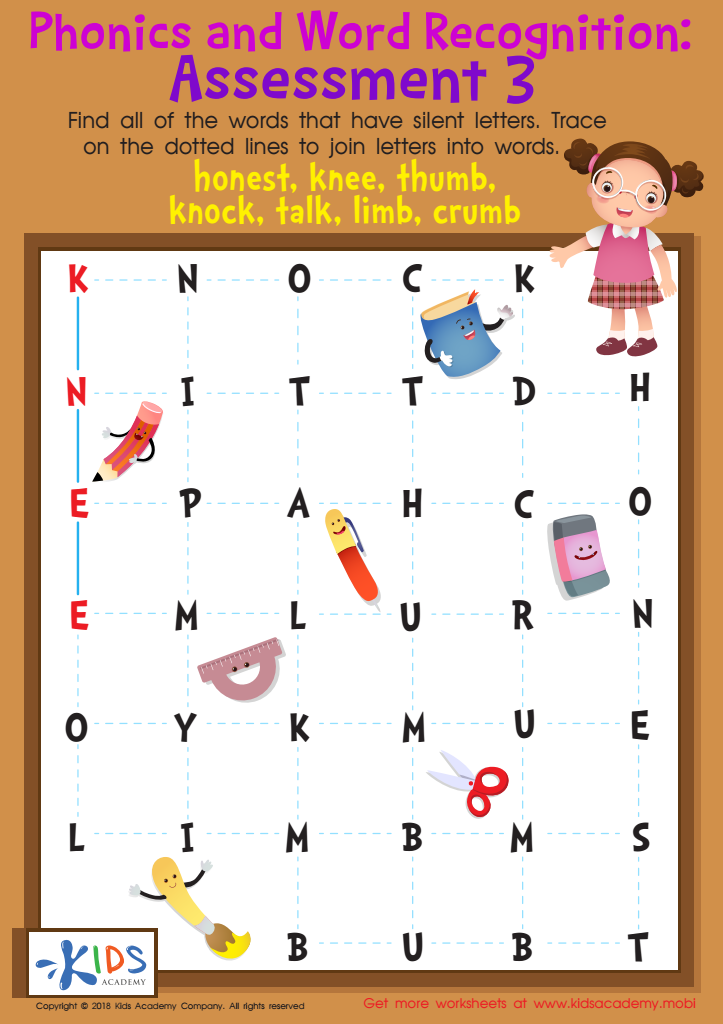
Phonics and Word Recognition: Assessment 3 Worksheet
Silent letters can be tricky for kids learning to read and write. Show them how they work with words like 'knee' and 'dumb'. Then, challenge them to come up with their own. Give them a worksheet with silent letters and trace the lines to join the letters into words.
 Assign to My Students
Phonics and Word Recognition: Assessment 3 Worksheet
Worksheet
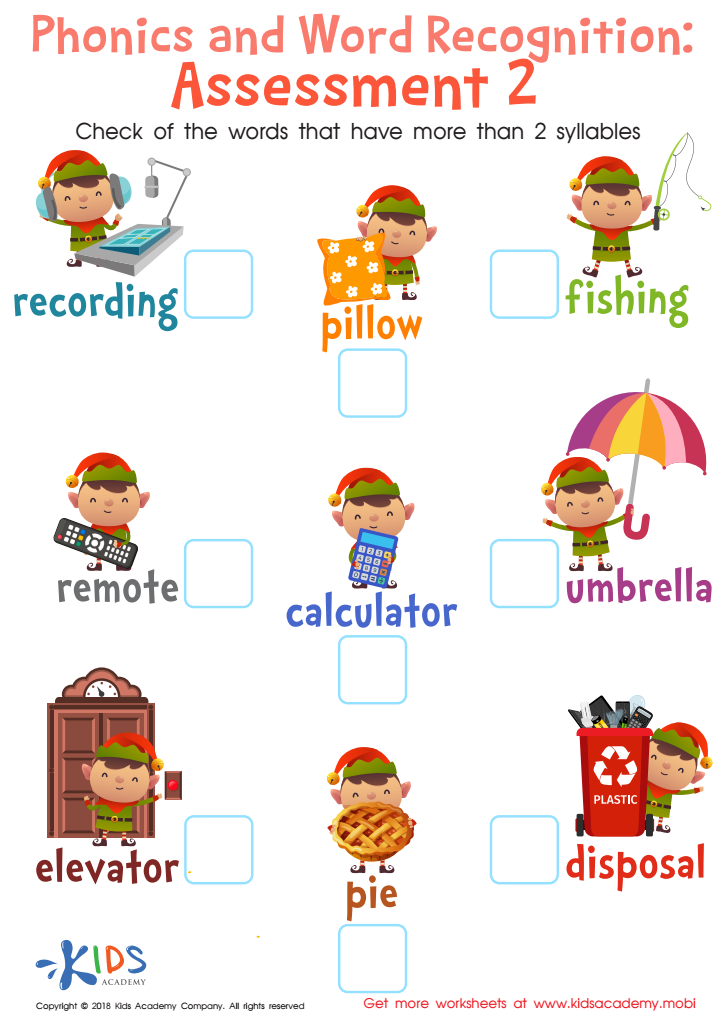
Phonics and Word Recognition: Assessment 2 Worksheet
Help your kids learn proper pronunciation by counting syllables. Most words they'll encounter have 1-3 syllables, making them simple to say. Have them repeat the words in your worksheet after you. Focus on longer words with more than two syllables.
Phonics and Word Recognition: Assessment 2 Worksheet
Worksheet
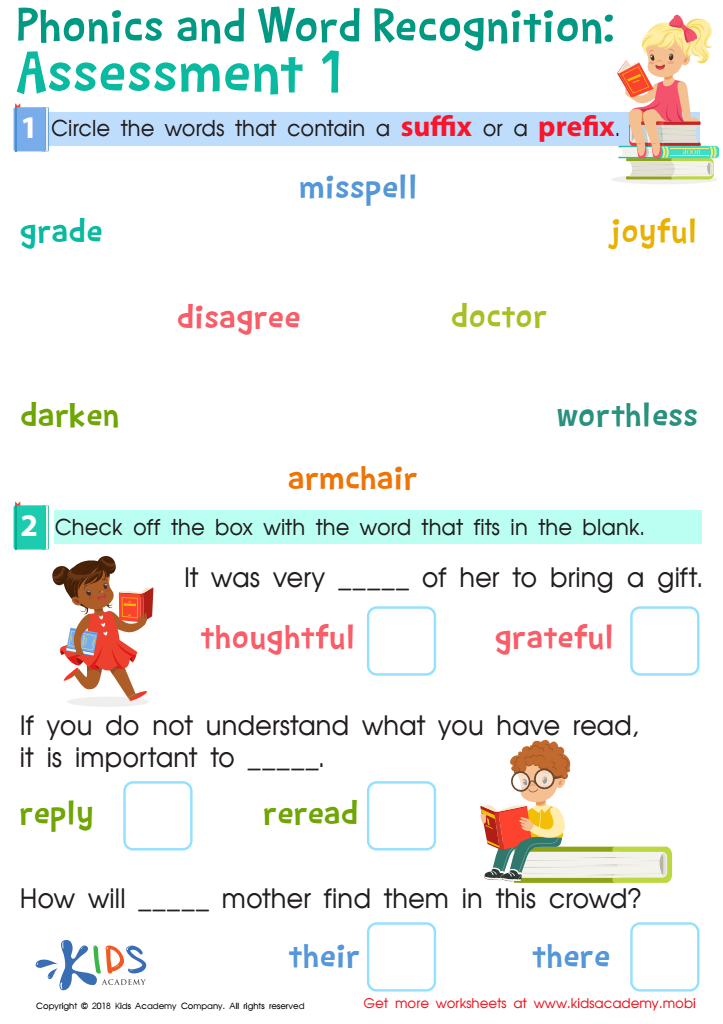
Phonics and Word Recognition: Assessment 1 Worksheet
Explain prefixes (words added to start of another word to give it a new meaning) and suffixes (added to end of word to change its meaning) to your kids with examples like 'unhappy' (prefix) and 'forgetful' (suffix). Now, help your child complete this worksheet, including circling words and checking boxes.
Phonics and Word Recognition: Assessment 1 Worksheet
Worksheet
Join Kids Academy for Free
Who is primarily going to use this learning content?







.jpg)
Normal Phonics worksheets activities stand as a cornerstone in the realm of early literacy education, providing an array of benefits that foster not just reading and writing proficiency but also a deep-rooted understanding and appreciation of language. These carefully designed activities are more than just mundane tasks; they are gateways to unlocking the complex code of English phonetics and phonology, essential for budding readers and writers.
Firstly, Normal Phonics worksheets activities are exceptionally useful because they offer structured learning. This structure is pivotal as it guides learners through the intricate layers of sounds, from simple phonemes to complex blends and digraphs, in a systematic way. Such an approach ensures that no critical element of phonics learning is overlooked, paving the way for a solid foundation in reading skills.
Moreover, these activities are designed to enhance phonemic awareness—one of the key predictors of reading success. Through engaging tasks, learners become adept at identifying, matching, and manipulating sounds, which significantly boosts their ability to decode words. This skill is crucial, as it directly impacts a child's ability to read fluently and with comprehension.
Additionally, Normal Phonics worksheets activities cater to a variety of learning styles. Whether a child is a visual, auditory, or kinesthetic learner, these worksheets provide diverse approaches to suit different preferences. Whether it's through coloring, tracing, matching, or writing, each activity is tailored to make learning not only effective but also enjoyable.
Furthermore, these activities foster independence in learners. As children become more comfortable with phonics concepts, they gain confidence in their ability to tackle unfamiliar words, reducing reliance on rote memorization. This independence is empowering, instilling a love for reading and exploration of text.
In conclusion, Normal Phonics worksheets activities are invaluable tools in the journey towards literacy. They offer structured, comprehensive, and enjoyable learning experiences that not only build foundational reading and writing skills but also cultivate a lifelong passion for learning. Their role in early education cannot be overstated, making them a staple in classrooms and homes worldwide.








