
Normal Phonics worksheets activities for 8-Year-Olds
3 filtered results
Difficulty Level
Grade
Age
-
From - To
Subject
Activity
Standards
Unlock the world of reading with our engaging Normal Phonics worksheets activities! Designed to lay a solid foundation in phonics, these worksheets offer a systematic approach to understanding the sounds that letters make, blending them together, and mastering word recognition. Perfect for young learners, our activities are crafted to boost confidence and foster a love for reading through fun and interactive tasks. From colorful matching exercises to captivating fill-in-the-blanks, our Normal Phonics worksheets activities cater to different learning styles, ensuring a comprehensive phonetic understanding. Embark on a phonetic adventure and watch your child's reading skills blossom!
Favorites
With answer key
Interactive
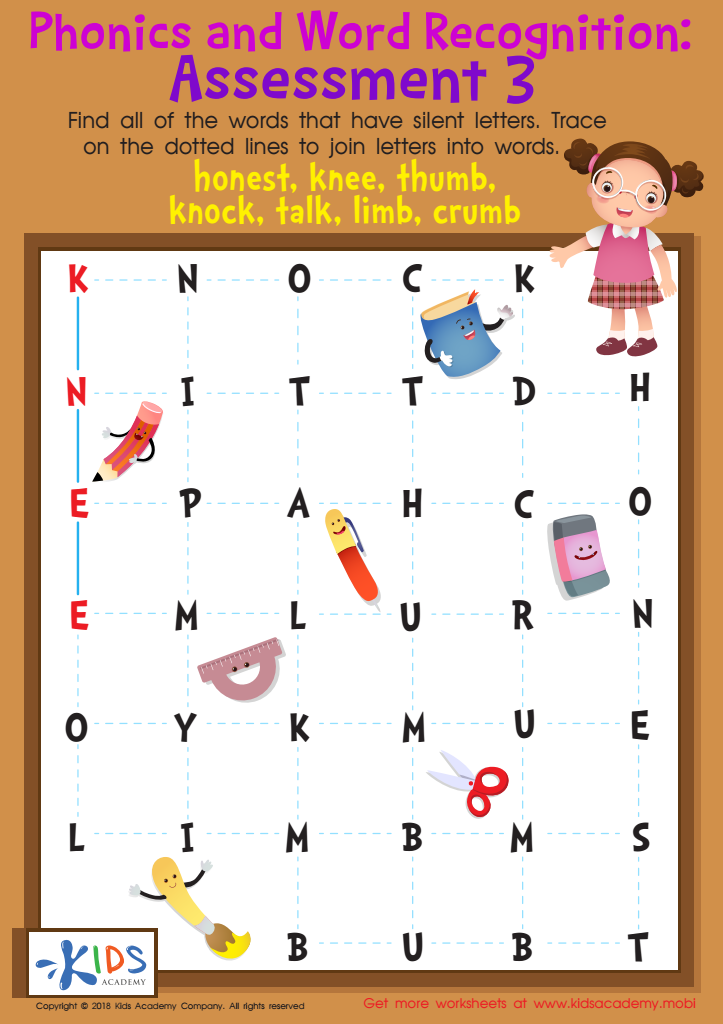
Phonics and Word Recognition: Assessment 3 Worksheet
Silent letters can be tricky for kids learning to read and write. Show them how they work with words like 'knee' and 'dumb'. Then, challenge them to come up with their own. Give them a worksheet with silent letters and trace the lines to join the letters into words.
 Assign to My Students
Phonics and Word Recognition: Assessment 3 Worksheet
Worksheet
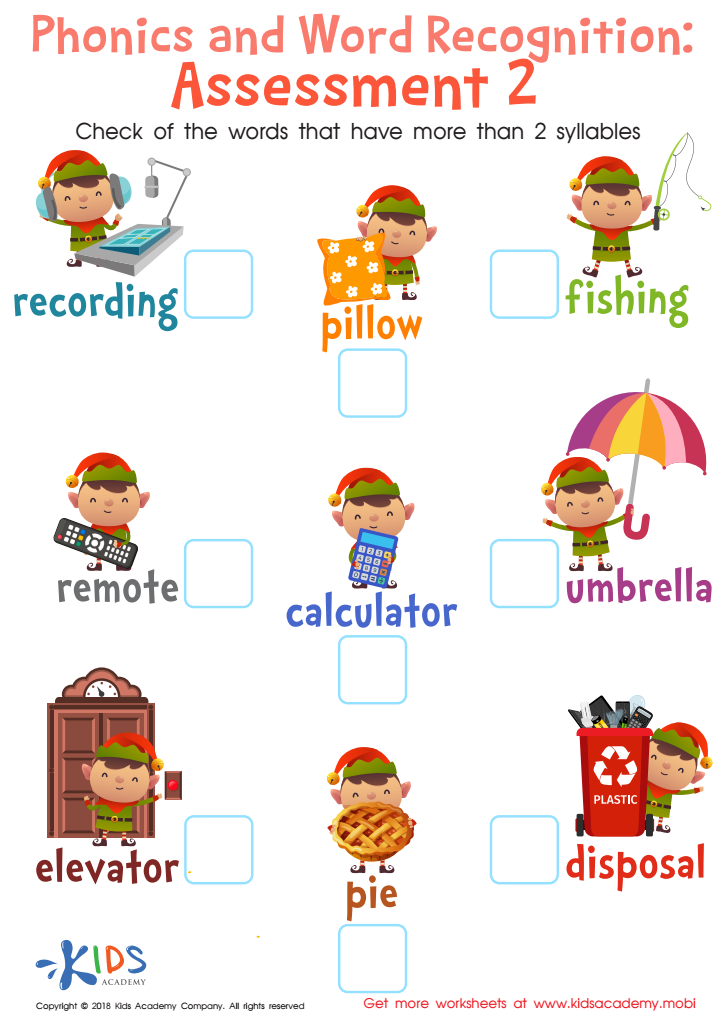
Phonics and Word Recognition: Assessment 2 Worksheet
Help your kids learn proper pronunciation by counting syllables. Most words they'll encounter have 1-3 syllables, making them simple to say. Have them repeat the words in your worksheet after you. Focus on longer words with more than two syllables.
Phonics and Word Recognition: Assessment 2 Worksheet
Worksheet
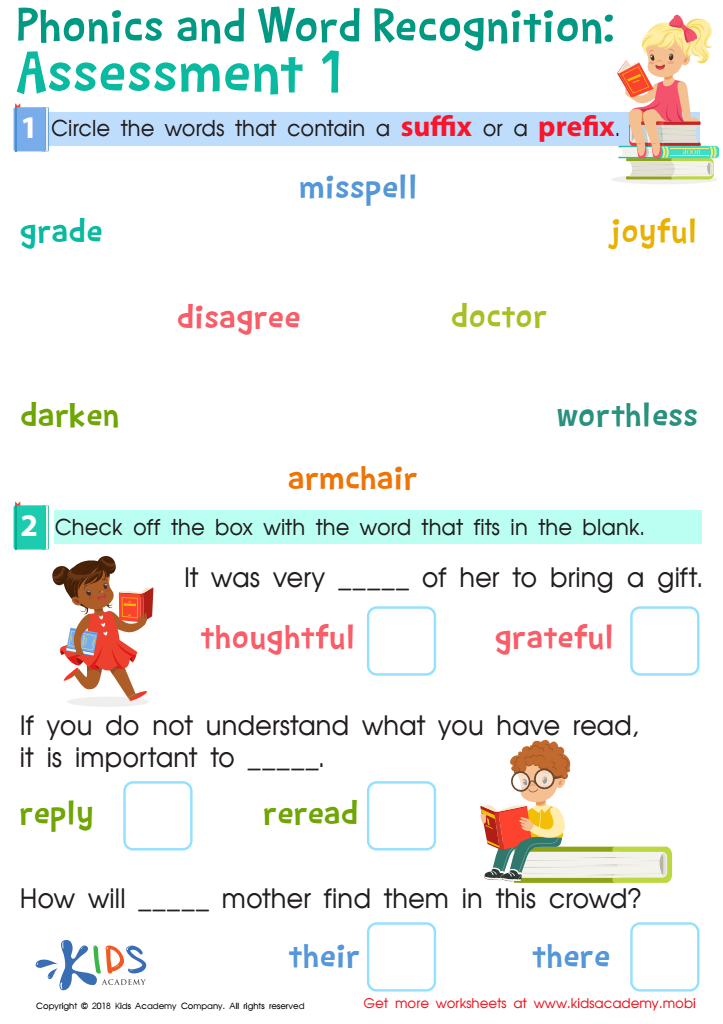
Phonics and Word Recognition: Assessment 1 Worksheet
Explain prefixes (words added to start of another word to give it a new meaning) and suffixes (added to end of word to change its meaning) to your kids with examples like 'unhappy' (prefix) and 'forgetful' (suffix). Now, help your child complete this worksheet, including circling words and checking boxes.
Phonics and Word Recognition: Assessment 1 Worksheet
Worksheet
Join Kids Academy for Free
Who is primarily going to use this learning content?







Normal Phonics worksheets activities play a pivotal role in the foundational stages of a child’s literacy development. These structured exercises are not just another task for young learners to complete; they are an invaluable tool designed to build and reinforce the essential skills of reading and writing. Let's delve into why these activities are so beneficial.
First and foremost, Normal Phonics worksheets activities provide a systematic approach to learning. Phonics, the method of teaching reading by correlating sounds with symbols in an alphabetic writing system, is all about patterns. Through these worksheets, children are exposed to these patterns in a consistent and gradual manner, allowing them to understand and apply the rules of phonics effectively. This structured learning ensures that learners can progress at their own pace, mastering one concept before moving on to the next.
Moreover, engagement is key in any learning process, and Normal Phonics worksheets activities are designed to be both educational and entertaining. These activities come in various forms, from matching games and puzzles to fill-in-the-blanks and word finds. Such variety sustains children's interest and makes the learning process enjoyable, thereby enhancing their motivation to learn.
Furthermore, these worksheets offer invaluable practice and reinforcement. Mastery in phonics requires repetition and application. By consistently working through these phonics exercises, students can internalize the sounds and patterns of the language, improving their reading fluency and spelling accuracy. This repeated exposure helps to solidify their knowledge and skills, making reading more automatic and less laborious.
In addition, Normal Phonics worksheets activities provide immediate feedback. Whether in a classroom setting, where a teacher can offer direct responses, or at home, where worksheets often include keys or are part of a guided learning system, learners can quickly identify their mistakes and learn from them. This instant feedback loop is crucial for building confidence and ensuring continuous progress.
In conclusion, Normal Phonics worksheets activities are a fundamental component of literacy education. They offer a structured, engaging, and effective method of learning the phonetic foundations of reading and writing, making them an indispensable resource for educators and learners alike.








