Normal Area and Perimeter Word Problems Worksheets for 9-Year-Olds
1 filtered results
-
From - To
Introduce your nine-year-old to the fascinating world of geometry with our Normal Area and Perimeter Word Problems worksheets! Tailored specifically for young learners, these school downloadable worksheets combine fun, engaging problems with real-world applications. Watch as your child masterfully calculates areas and perimeters, enhancing their mathematical skills and understanding. Perfect for both classroom and home use, these worksheets are designed to build confidence and proficiency in a critical aspect of math. Give your child the tools to succeed and enjoy the thrill of solving each challenge. Dive into our worksheets today and make learning an exciting adventure!
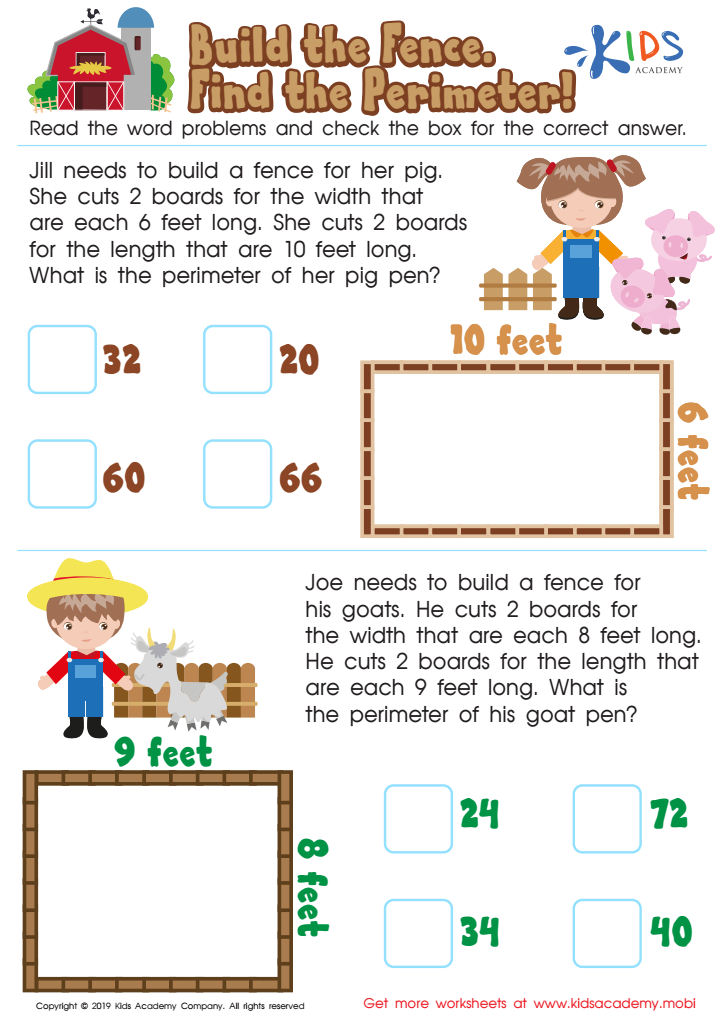
Build the Fence, Find the Perimeter Worksheet
 Assign to My Students



The Benefits of Using School Homework Sheets on Area and Perimeter Word Problems for Nine-Year-Olds
Mastering the concepts of area and perimeter forms a fundamental part of a child’s mathematical education. For nine-year-old students, who are typically in the 3rd or 4th grade, grasping these concepts not only enhances their geometrical understanding but also boosts their problem-solving and logical thinking skills. This is where school homework sheets focused on area and perimeter word problems play an invaluable role. Let’s explore why these worksheets are particularly beneficial for young learners.
1. Building a Practical Understanding of Math Concepts
Area and perimeter are not just theoretical concepts; they have numerous practical applications in everyday life. School homework sheets that contain word problems help children understand how these mathematical ideas apply in real-world scenarios, such as finding the amount of paint needed to cover a wall or calculating the fencing required for a garden. This real-world application helps solidify abstract mathematical concepts, making them more tangible and understandable for young minds.
2. Enhancing Problem-Solving Skills
Word problems require a bit more cognitive effort than straightforward calculation questions. They challenge students to read, comprehend, and then apply the correct operations to find a solution. This process is crucial in developing critical thinking and problem-solving skills. By regularly working through these problems on homework sheets, children learn to identify the key information and the steps needed to solve complex problems, a skill that is valuable beyond mathematics.
3. Encouraging Independent Learning
School homework sheets allow children to work at their own pace, which is vital for building confidence and independence in learning. When working on area and perimeter problems at home, students can take the time to wrestle with the concepts, explore different solutions, and learn from their mistakes without the immediate pressure of a classroom environment. This kind of practice encourages self-reliance and resilience, as students learn to tackle challenges independently.
4. Facilitating Immediate Feedback and Correction
One of the great advantages of using worksheets is the opportunity they provide for immediate feedback. Parents and teachers can quickly check the answers, allowing for immediate correction and explanation. This timely feedback helps prevent misconceptions from taking root and allows students to learn from their errors effectively. Consistent practice and correction ensure that students truly understand the concepts of area and perimeter, paving the way for more advanced mathematical learning.
5. Preparing for Standardized Tests
Standardized testing often includes questions about area and perimeter. Regular practice with school homework sheets equips students with the skills and confidence needed to tackle these questions effectively. By solving a variety of word problems, students become familiar with the formats and types of questions that might appear on these tests. This familiarity reduces test anxiety and improves performance, as students feel prepared to face similar challenges under test conditions.
6. Supporting Curriculum Goals and Classroom Learning
School homework sheets are typically designed to align with the curriculum standards and complement what is being taught in the classroom. By using these worksheets for homework, teachers can reinforce and extend the learning that takes place at school. This consistent practice helps ensure that all students are on the same page and have mastered the necessary skills to progress in their mathematical education. Moreover, it allows teachers to identify areas where the class might need additional support or advanced challenges.
7. Promoting Collaborative Learning
While school homework sheets are often completed individually, they also offer opportunities for collaborative learning. Parents can engage with their children over homework, discussing the problems and finding solutions together, which enhances the child’s learning experience. Similarly, students might discuss assignments with their peers, explaining their reasoning and learning from each other. This collaboration fosters a deeper understanding and appreciation of the concepts, as students articulate and rationalize their thoughts.
8. Diverse Learning Styles
Worksheets on area and perimeter can be designed with a variety of problem types and difficulties to cater to different learning styles. They might include diagrams, real-life pictures, or scenarios that require visual spatial understanding, supporting visual learners. For those who learn better through practice and repetition, the consistent format of worksheets provides ample opportunities to reinforce learning. This adaptability makes school homework sheets an excellent tool for addressing the diverse needs of a classroom full of young learners.
In conclusion, school homework sheets on area and perimeter word problems are not just a method for practicing math; they are a multifaceted educational tool that enhances understanding, builds vital skills, and supports overall academic growth. By integrating these worksheets into the learning process, educators and parents can provide children with a robust foundation in mathematics that will serve them well throughout their educational journey and beyond.