Normal Online Money Word Problems Worksheets for Preschool
1 filtered results
-
From - To
Introduce your preschoolers to the basics of financial literacy with our engaging "Normal Money Word Problems" worksheets. Specifically designed for young learners, these school worksheets provide a gentle introduction to concepts of money through simple, relatable problems that capture children's interest. Each worksheet is crafted to enhance counting skills and basic arithmetic, using colorful images and easy-to-follow questions. Perfect for both classroom and home use, these worksheets help lay the foundation for real-world math skills in a fun and accessible way. Start your child on the path to financial understanding today!
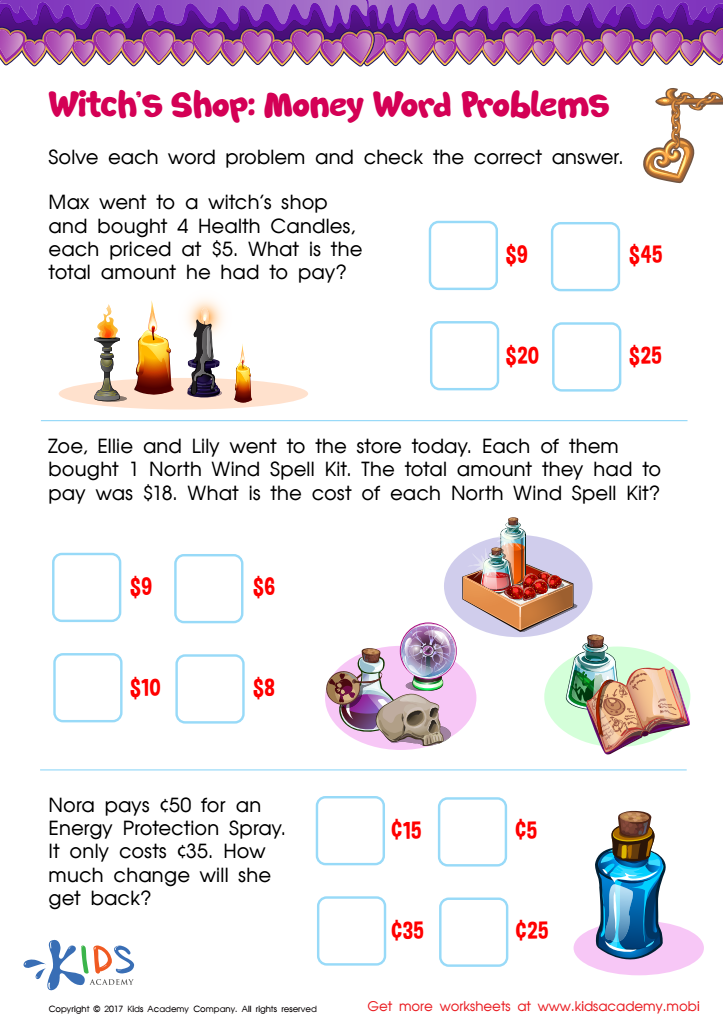
Money Word Problems Printable
 Assign to My Students




The Importance of Normal Worksheets on Money Word Problems in Preschool Education
When it comes to early childhood education, one of the most valuable tools at a teacher's disposal is the use of school printables, particularly those focused on money word problems. Preschool is a critical period in a child’s development where foundational skills are built, and introducing basic financial concepts through worksheets can provide significant educational benefits. Here’s why normal worksheets on money word problems are especially useful in fostering these skills in preschool-aged children.
1. Developing Numeracy Skills
Money word problems are an excellent way for children to practice and improve their numeracy skills. These school printables typically involve simple addition and subtraction tasks that help children learn to count, add, and subtract using real-world contexts. This practical application ensures that children are not just learning numbers in abstraction but are seeing how these numbers can be used in everyday situations.
2. Introducing Basic Financial Concepts
It is never too early to start learning about money management, and these worksheets serve as an introductory course to basic financial literacy. By using terms such as "buy," "sell," "price," and "change," children learn the value of money and begin to understand the basics of economic exchange. This foundational knowledge is crucial as they grow older and start making small financial decisions, like buying a snack or saving pocket money.
3. Enhancing Problem-Solving Skills
Money word problems require children to read a scenario, understand what is being asked, and figure out how to solve it. This process enhances critical thinking and problem-solving skills. Each worksheet presents a unique problem to solve, which can help in developing a child’s ability to think independently and apply learned concepts to new challenges—a skill that will benefit them across all areas of life.
4. Boosting Confidence Through Practical Learning
Confidence in academic abilities starts with mastery of basic skills. School printables that focus on money word problems allow children to practice and master these skills in a controlled, measurable way. As they complete each worksheet and see their progress, their academic confidence grows. This confidence can encourage a more positive attitude towards learning and education in general.
5. Supporting Cognitive Development
The act of working through a worksheet involves various cognitive processes such as comprehension (understanding the problem), application (using learned skills to solve the problem), and analysis (figuring out why their answer is correct or incorrect). Engaging in these processes regularly through school printables promotes enhanced cognitive development. It helps children organize their thoughts, manage tasks, and apply logic, all of which are essential skills not only in math but in all learning areas.
6. Encouraging Independent Learning
Worksheets on money word problems also foster a sense of independence in young learners. While teachers and parents can guide and assist, the child is ultimately responsible for completing the worksheet. This encourages self-study habits, where children learn to sit, concentrate, and work through problems on their own, developing self-reliance that will benefit them throughout their educational journey.
7. Providing a Tangible Record of Learning
One of the benefits of using school printables is that they provide a tangible record of a child’s learning progress. Teachers and parents can easily track how the child is developing in terms of their understanding of money, arithmetic, and problem-solving skills. This can help in providing targeted help where needed and in celebrating achievements, which is crucial for young learners' motivation.
8. Facilitating Fun and Engagement
Finally, the design of these worksheets is often colorful and engaging, incorporating elements that appeal to preschoolers, such as cartoons, animals, and fun scenarios. This makes learning about money not just educational but also enjoyable. Engaging children in a fun way ensures that they stay interested and absorb more of the information being taught, turning learning into a pleasant experience rather than a chore.
Conclusion
Normal worksheets on money word problems are much more than simple school printables; they are a comprehensive educational tool that aids in the development of a range of essential skills in preschool children. By integrating these worksheets into early childhood education, teachers and parents can provide a strong foundation in numeracy, problem-solving, and financial literacy. This early start not only prepares children for their future educational endeavors but also equips them with the knowledge to make wise financial decisions from a young age.