Identify shapes Grade 2 Worksheets
12 filtered results
-
From - To
Explore our engaging "Identify Shapes Grade 2 Worksheets," designed to enhance students' understanding of geometric shapes in a fun and interactive way. These worksheets help young learners recognize, categorize, and describe various shapes, from circles to triangles and squares. Each activity is tailored to align with second-grade math standards, fostering spatial awareness and critical thinking skills. With colorful illustrations and clear instructions, these worksheets make learning enjoyable and accessible. Perfect for classroom or at-home learning, our resources provide teachers and parents with the tools needed to support children's developmental milestones in geometry. Download today and watch your child's confidence soar!
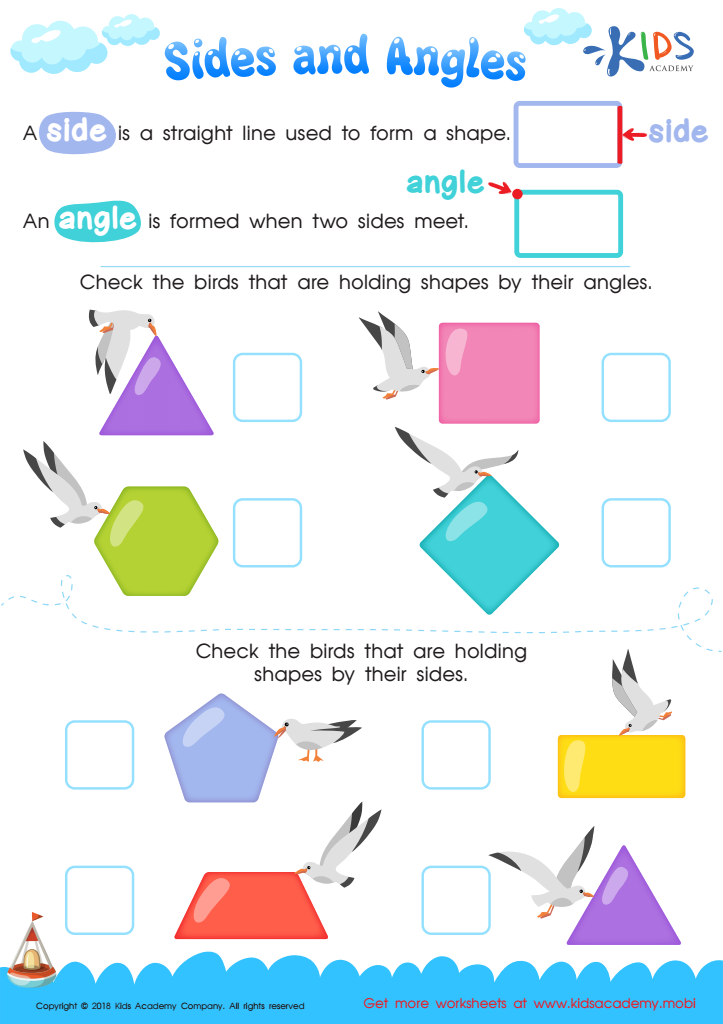
Sides and Angles Worksheet
 Assign to My Students






Identifying shapes is a fundamental skill that serves as a building block for various mathematical concepts. For parents and teachers, fostering shape recognition in Grade 2 is essential for several reasons. Firstly, understanding shapes enhances spatial awareness, helping children recognize and navigate their environment more effectively. It forms the basis for geometric reasoning, which is vital as students progress in their math education.
Moreover, shape recognition is directly linked to problem-solving skills. When children can identify, compare, and manipulate shapes, they develop analytical abilities that apply to more complex mathematical concepts. For example, learning about angles, symmetry, and area all stem from a strong foundation in shape identification.
In addition, integrating shapes into everyday activities encourages hands-on learning. Teachers and parents can create engaging learning experiences, such as using building blocks or drawing, which not only make learning enjoyable but also cater to various learning styles.
Finally, recognizing shapes boosts confidence and curiosity in young learners, paving the way for a positive attitude toward mathematics. By emphasizing shape identification, parents and teachers contribute significantly to their children's cognitive development, critical thinking skills, and lifelong learning.