Understand number relationships Grade 2 Math Worksheets
3 filtered results
Difficulty Level
Grade
Age
-
From - To
Subject
Activity
Standards
Discover our engaging Grade 2 Math Worksheets designed to help students understand number relationships! These worksheets focus on essential skills such as identifying, comparing, and ordering numbers, enhancing students’ mathematical reasoning. Through fun and interactive activities, children will better grasp concepts like greater than, less than, and equality. Perfect for homeschoolers or classroom settings, these worksheets support learning in a visually appealing format that maintains student interest. By practicing with these resources, students will build a solid foundation in math that prepares them for future success. Explore our collection now and watch your child's confidence in math soar!
Favorites
With answer key
Interactive
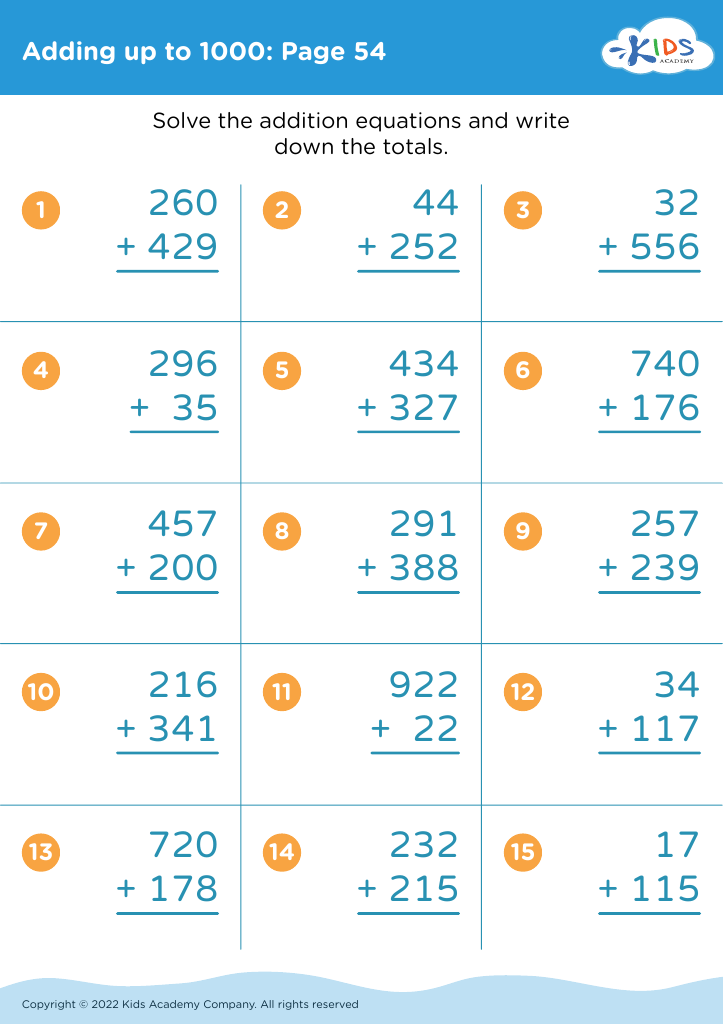
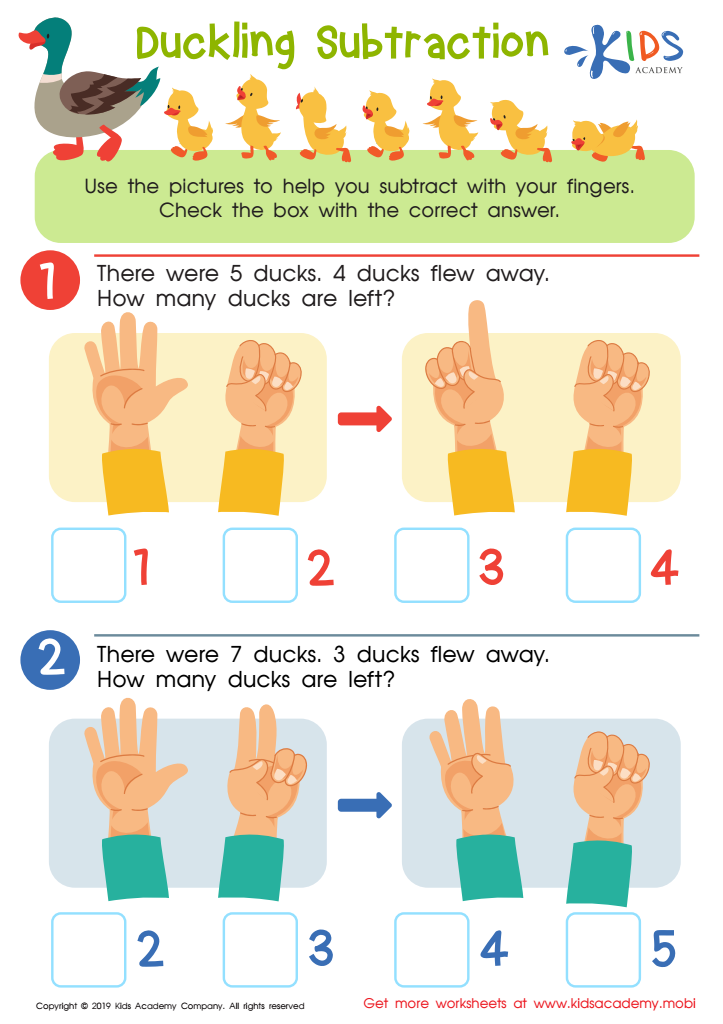
Duckling Subtraction Worksheet
Help your students learn equations and math with this fun worksheet. There are two questions to solve with the help of the pictures. Ask them to subtract with their fingers and check the box with the correct answer. This makes math easier and more enjoyable!
 Assign to My Students
Duckling Subtraction Worksheet
Worksheet
Join Kids Academy for Free
Who is primarily going to use this learning content?







Understanding number relationships is crucial for second graders as it lays the foundation for their mathematical thinking and problem-solving skills. At this stage, children begin to make sense of numbers not just as isolated entities, but as part of a system of relationships. This concept encompasses various mathematical skills, including addition, subtraction, and the ability to perceive patterns.
When parents and teachers prioritize number relationships, students develop a deeper understanding of the "why" behind mathematical operations. For example, recognizing that adding two numbers can also be viewed as the difference between two other numbers enhances their cognitive flexibility. This understanding not only supports current math curriculum but also instills confidence as they tackle more complex concepts in later grades.
Moreover, fostering a strong grasp of number relationships encourages critical thinking and collaboration when students work together to solve problems. It empowers children to become independent learners, as they learn to approach numbers with curiosity rather than fear. In academic performance and everyday life, a solid foundation in number relationships leads to better decision-making skills regarding quantities, measurements, and finances. Overall, this foundational competency is vital for robust mathematical proficiency that impacts future learning and real-life applications.