Develop critical thinking Grade 3 Worksheets
4 filtered results
Difficulty Level
Grade
Age
-
From - To
Subject
Activity
Standards
Enhance your third grader's critical thinking skills with our comprehensive worksheets designed specifically for Grade 3 learners. These engaging and interactive printables challenge students to analyze information, make connections, and solve problems creatively. Featuring a variety of exercises like logic puzzles, reasoning tasks, and analytical questions, our worksheets encourage independent thinking and foster an inquisitive mindset. As students work through fun scenarios, they develop essential skills that will benefit them throughout their education. Perfect for classroom use or homework assignments, our Grade 3 critical thinking worksheets make learning enjoyable while helping children build a solid foundation in this vital skill set.
Favorites
With answer key
Interactive
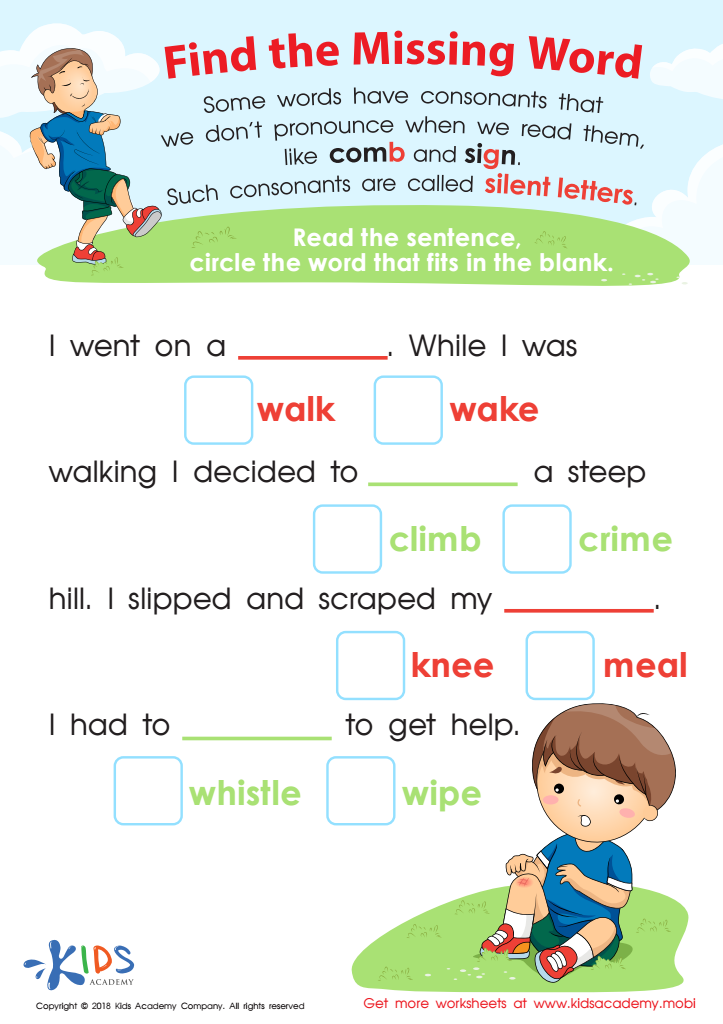
Find The Missing Word Worksheet
Master silent letters like "b" and "k" with this illustrated worksheet! Read the sentences and fill in the blanks with the correct word, checking the box. Read all the way to the bottom and review words containing silent letters. A great way to help your little learner tackle a tough topic!
 Assign to My Students
Find The Missing Word Worksheet
Worksheet
Join Kids Academy for Free
Who is primarily going to use this learning content?








Developing critical thinking skills in third graders is crucial for their overall academic and personal growth. At this stage, children are beginning to formulate their thoughts and opinions, and fostering critical thinking helps them become more analytical and open-minded. Engaging in critical thinking activities encourages students to question information, evaluate different perspectives, and make reasoned decisions.
For parents and teachers, emphasizing critical thinking equips children with tools they need to tackle complex problems in the future. It strengthens their ability to assess situations and think independently, which is essential in today’s rapidly changing world. Critical thinkers are better prepared to confront challenges, both academically and in real life.
Additionally, integrating critical thinking into learning nurtures creativity and fosters effective communication skills. Children learn to articulate their ideas clearly, collaborate with others, and present logical arguments. This collaborative mind-set is particularly valuable as they work in teams and participate in discussions.
Moreover, as education increasingly emphasizes STEM (Science, Technology, Engineering, and Mathematics), critical thinking becomes a key component of success in these fields. By investing in critical thinking development, parents and teachers lay the groundwork for students to become lifelong learners and empowered individuals who can contribute positively to society.