Understanding division Grade 3 Worksheets
4 filtered results
-
From - To
Unlock the secrets of division with our "Understanding Division: Grade 3 Worksheets!" Designed specifically for third graders, these worksheets make mastering division enjoyable and accessible. Each activity incorporates fun, engaging exercises to help young learners grasp the concepts of sharing, grouping, and interpreting division problems. With easy-to-follow instructions and varied, colorful problems, students develop strong foundational skills that support further math learning. Parents and teachers will find these resources valuable in providing additional practice and reinforcing classroom lessons. Transform division from daunting to doable with our expertly crafted worksheets, designed to build confidence and competence in every child.
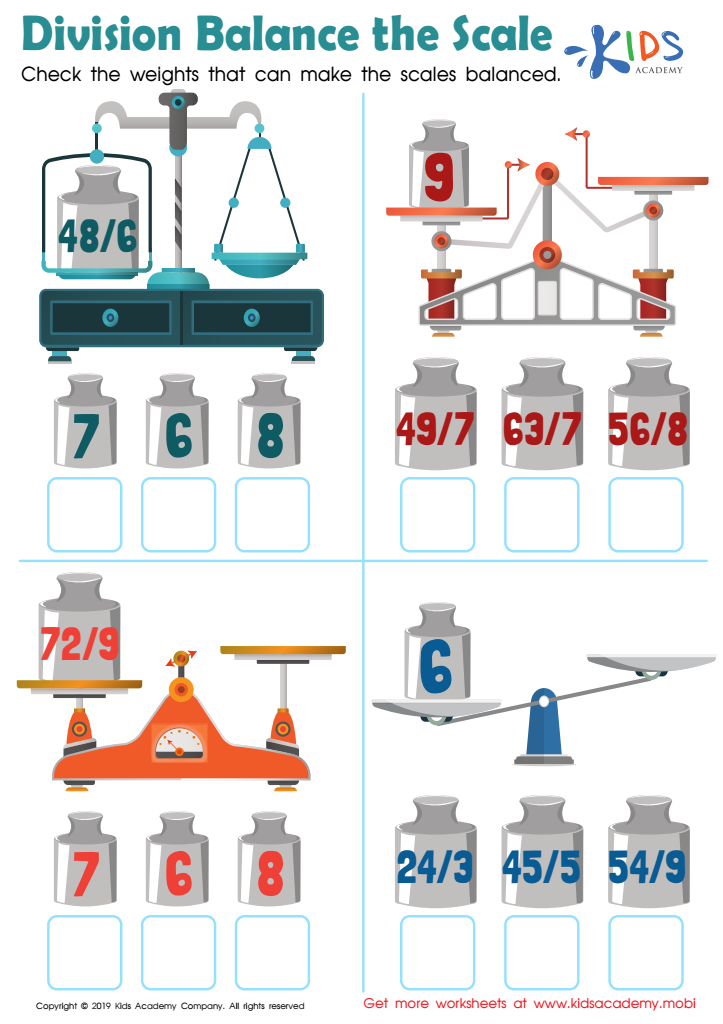
Division Balance the Scale Worksheet
 Assign to My Students






Understanding division in Grade 3 is a critical milestone for several reasons, both for academic development and real-world applications. In mathematics, division is one of the fundamental operations and serves as a building block for more advanced concepts like fractions, ratios, and algebra. Mastering division at an early age promotes mathematical literacy and problem-solving skills, which are essential for higher-order thinking and complex calculations required in later grades.
Moreover, learning division enhances computational fluency. When children understand how and why division works, they become more skilled in addition, subtraction, and multiplication as well. This comprehensive arithmetic foundation is important for standardized tests and everyday life tasks such as managing money, sharing items, and measuring quantities.
From a cognitive perspective, grappling with the concept of division fosters critical thinking. It encourages students to analyze, reason, and break problems into manageable parts. These skills transcend mathematics, aiding students in other academic subjects and real-life scenarios.
By focusing on division in Grade 3, parents and teachers support a child’s overall cognitive development. This understanding also cultivates a positive attitude toward mathematics, reducing anxiety and building confidence that will benefit students in their ongoing educational journey. Hence, emphasizing the importance of learning division at this grade level is undeniable and beneficial for a child's holistic intellectual growth.