Improves counting skills Grade 3 Math Worksheets
3 filtered results
Difficulty Level
Grade
Age
-
From - To
Subject
Activity
Standards
Enhance your child's counting abilities with our Grade 3 Math Worksheets designed to improve counting skills. These worksheets provide engaging and interactive exercises that help students grasp counting principles, understand numerical sequences, and improve their arithmetic fluency. With a variety of activities, from counting objects to advanced skip counting, these worksheets are tailor-made to support third graders in mastering this fundamental math skill. Ideal for both classroom use and at-home practice, our worksheets make learning fun and effective, ensuring your child’s success in math. Visit our page to download these valuable resources and watch your child's confidence grow.
Favorites
With answer key
Interactive
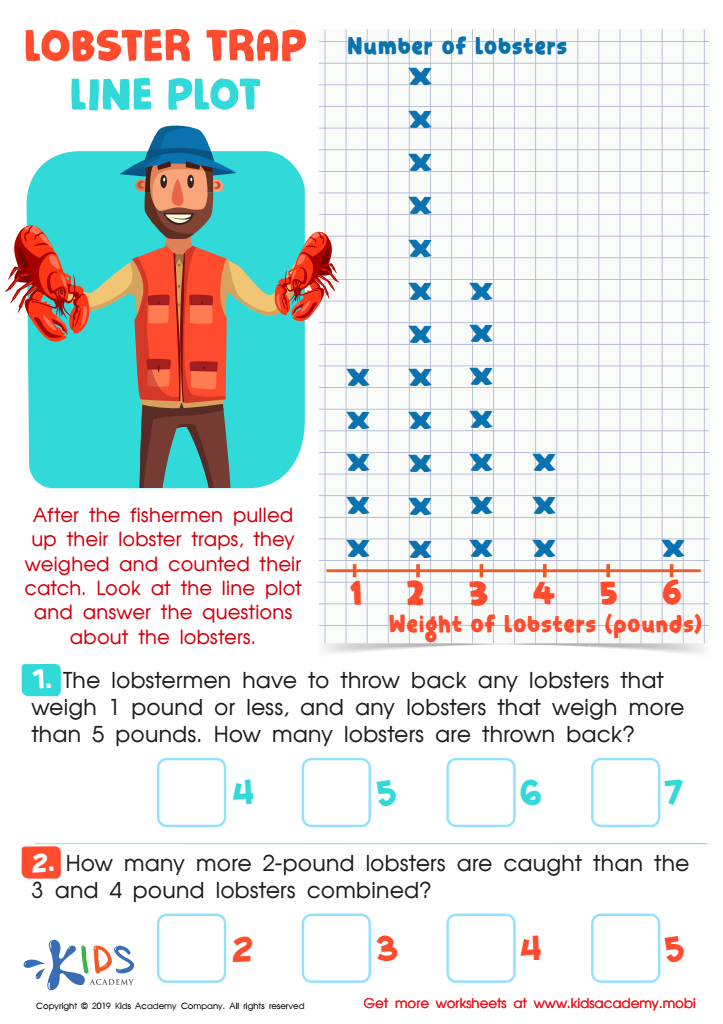
Lobster Trap Line Plot Worksheet
If your kids are working on line plots, this worksheet is perfect for them! Show them the picture and read the instructions. Help them look at the line plot and answer the questions at the bottom. Learning math can be fun, so make it enjoyable together!
 Assign to My Students
Lobster Trap Line Plot Worksheet
Worksheet
Join Kids Academy for Free
Who is primarily going to use this learning content?








Counting skills are foundational to children's mathematical development and for Grade 3 Math, enhancing these abilities is crucial. When parents and teachers prioritize the improvement of counting skills, they are setting the stage for their children's future academic success and everyday life proficiency.
Firstly, counting skills serve as the building blocks for more complex mathematical concepts, such as addition, subtraction, multiplication, and division. A solid grasp of counting can boost a child's confidence in tackling these advanced topics, leading to better overall math performance. Additionally, proficient counting skills can enhance problem-solving abilities, making it easier for children to approach and solve mathematical problems systematically.
Secondly, counting goes beyond the classroom and is a fundamental skill in daily activities. Whether it's managing money, measuring ingredients for a recipe, or playing games that require numerical understanding, practical counting remains indispensable. Children who excel in these real-life applications are likely to feel competent and self-assured in a variety of settings.
In conclusion, improving counting skills not only promotes academic achievement but also equips children with essential life skills. When parents and teachers invest in strengthening these abilities, they foster a well-rounded, confident, and mathematically literate individual, prepared to navigate both educational and everyday challenges with ease.