Fine motor skills (drawing lines) Math Worksheets for Ages 3-4
7 filtered results
-
From - To
Help your little learners boost their fine motor skills with our engaging Math Worksheets for Ages 3-4! Specifically designed to enhance hand-eye coordination and precision, these activities focus on drawing lines and patterns. As children trace and draw, they also build foundational math skills in a fun, interactive way. Perfect for preschoolers, these worksheets provide a hands-on approach to learning that supports cognitive and fine motor development. Download now to give your kids the head start they need in math, all while having fun improving their drawing abilities! Get your free worksheet today at Kids Academy.

Count and Match Vegetables 1 – 7 Math Worksheet
 Assign to My Students

Counting Eggs Worksheet

Count and Match Vegetables 2 – 8 Math Worksheet
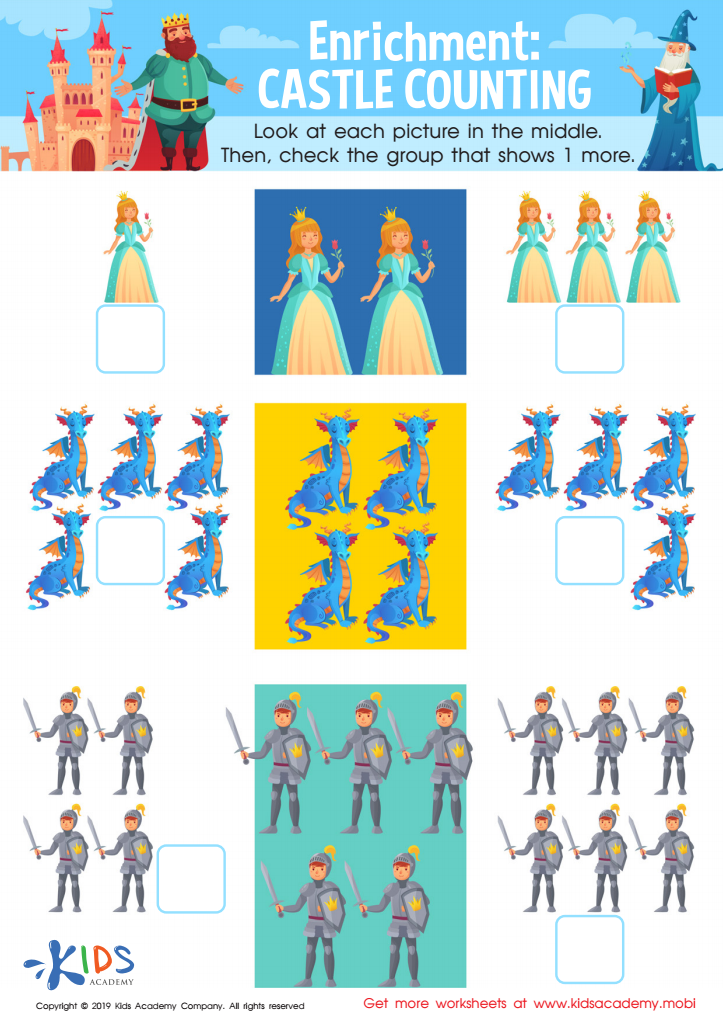
Enrichment: Castle Counting Worksheet








Parents and teachers should care about the development of fine motor skills, especially tasks such as drawing lines, for children ages 3-4 because these skills lay the foundation for future academic success and overall development. Fine motor skills involve the coordination of small muscles, particularly in the fingers and hands, with the eyes.
For young children, drawing lines is not just about creating art; it is a critical pre-writing skill. Practicing this helps children develop the dexterity and hand-eye coordination necessary for writing letters and numbers later on. These early drawing activities enhance their ability to hold and manipulate writing tools, which directly impacts their proficiency in handwriting as they grow.
Moreover, math for young children often includes recognizing shapes, patterns, and spatial awareness, all of which can be introduced through fine motor skill activities. For example, drawing shapes or tracing lines helps children understand different mathematical concepts such as size, shape, and position. Engaging in these activities also enhances cognitive development by improving focus, memory, and problem-solving skills.
Ultimately, investing time in developing fine motor skills such as drawing lines equips children with essential tools for both academic challenges and day-to-day tasks, setting them up for success in school and life.








