Problem-Solving Skills Tracing Shapes Worksheets for Ages 3-4
4 filtered results
-
From - To
Enhance your child's problem-solving skills with our engaging Tracing Shapes Worksheets designed for ages 3-4. These worksheets provide a fun and interactive way for young learners to explore geometry by following lines and tracing various shapes. As toddlers navigate through each activity, they strengthen their fine motor skills, hand-eye coordination, and spatial awareness. Our tracing sheets are crafted to encourage creative thinking and build the foundational skills necessary for math readiness. Perfect for at-home learning or preschool activities, these worksheets make learning shapes enjoyable while helping children develop critical problem-solving abilities. Start creating confident learners today!

Using Triangles to Make Squares and Rhombuses Worksheet
 Assign to My Students

Let's Look! Part 2 Worksheet
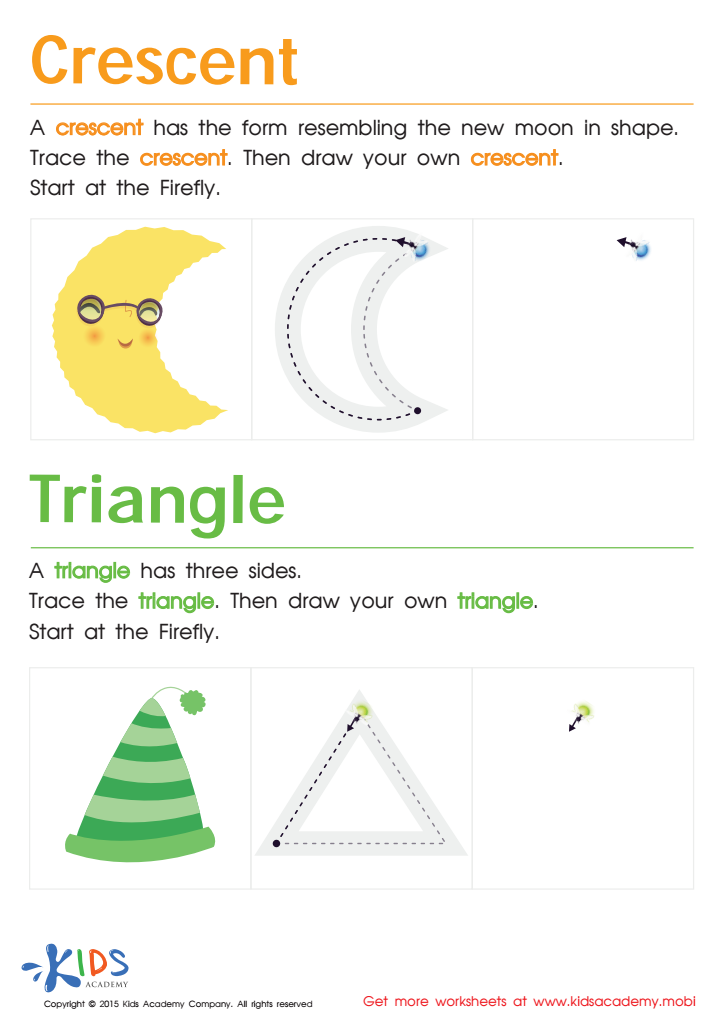
Learning to Draw Crescents And Triangles Worksheet

Matching 2D and 3D Shapes Worksheet








Problem-solving skills are essential for children, especially at the ages of 3-4, as they lay the foundation for critical thinking, creativity, and cognitive development. One effective way to cultivate these skills is through activities like tracing shapes. These tasks not only improve fine motor skills but also encourage recognition of patterns and spatial awareness.
When parents and teachers engage children in shape tracing, they promote an understanding of geometry and spatial relationships. This early exposure helps kids learn how objects relate to one another and the world around them. Additionally, tracing shapes fosters perseverance and patience, as children learn to navigate the challenges of forming precise lines and curves.
Moreover, tracing activities can promote language development, with caregivers discussing shapes and their attributes, enhancing vocabulary and comprehension skills. Furthermore, these tasks can be framed as fun, interactive experiences that strengthen the bond between caregivers and children, leading to a positive attitude towards learning.
In enabling young children to enhance their problem-solving abilities through tracing activities, parents and teachers contribute significantly to their future academic success and overall cognitive development. The skills learned during these formative years can have a lasting impact, influencing problem-solving throughout their lives.