
Understanding prepositions Writing Worksheets for Ages 3-4
3 filtered results
Difficulty Level
Grade
Age
-
From - To
Subject
Activity
Standards
Explore our "Understanding Prepositions Writing Worksheets for Ages 3-4," designed to help young learners grasp the basics of prepositions in a fun and engaging way. These worksheets feature colorful illustrations and simple activities that encourage children to relate concepts of position, such as 'in', 'on', and 'under', through playful exercises. Ideal for preschoolers, our resources foster early literacy skills and enhance vocabulary while promoting fine motor development through writing practice. Parents and teachers can easily incorporate these worksheets into their lesson plans for an interactive learning experience that supports cognitive development. Download now to make learning prepositions enjoyable for your little ones!
Favorites
With answer key
Interactive
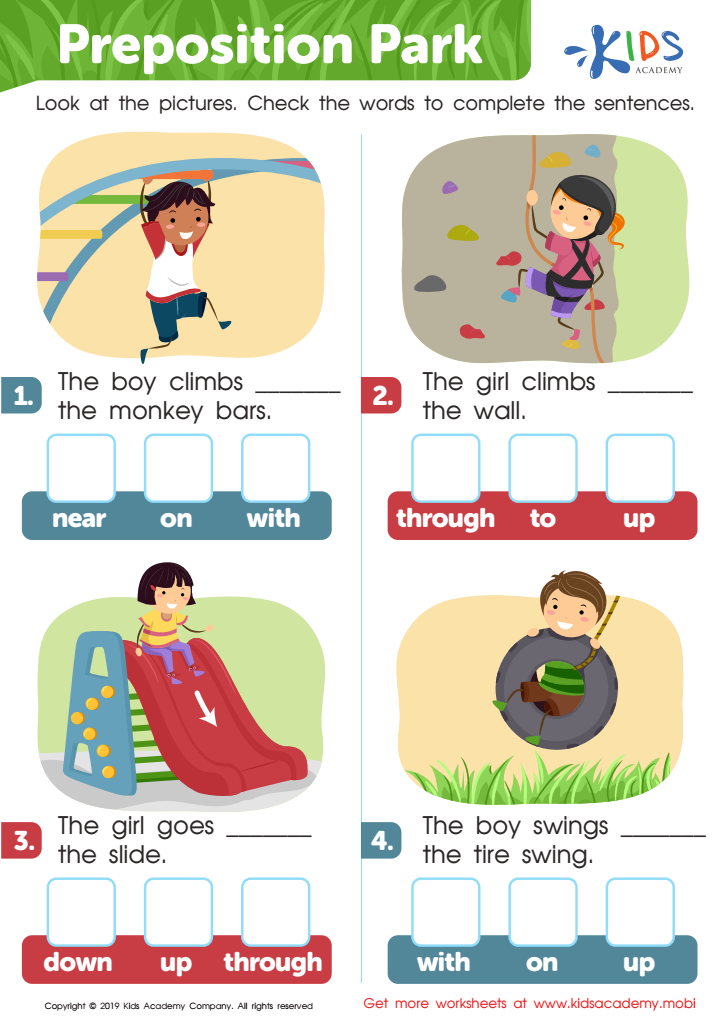
Preposition Park Worksheet
.
Check kids' understanding of prepositions by reminding them it's a word used to show location, direction or time. Look at the four pictures and ask what the kids are doing. Read the sentences below and help them check the words to complete them.
 Assign to My Students
Preposition Park Worksheet
Worksheet
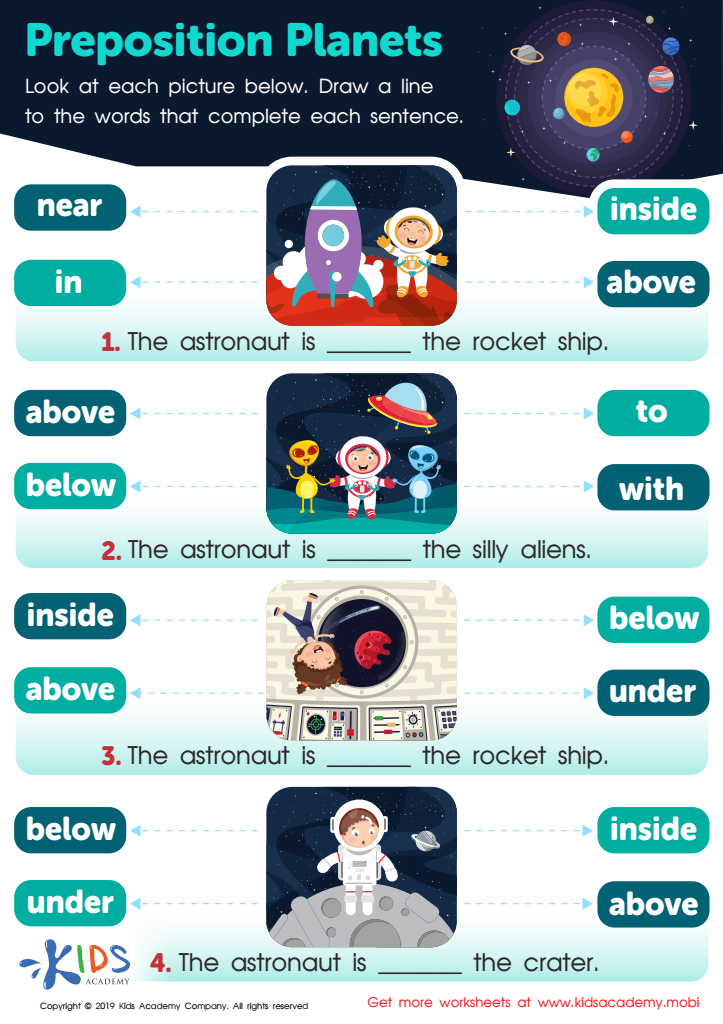
Preposition Planets Worksheet
Remind your child about outer space: which planet do we live on, and who travels there for research? Explain that prepositions show location, direction, and time. Look at the worksheet with colorful pictures of astronauts. Help your kids draw lines to the words that complete each sentence.
Preposition Planets Worksheet
Worksheet
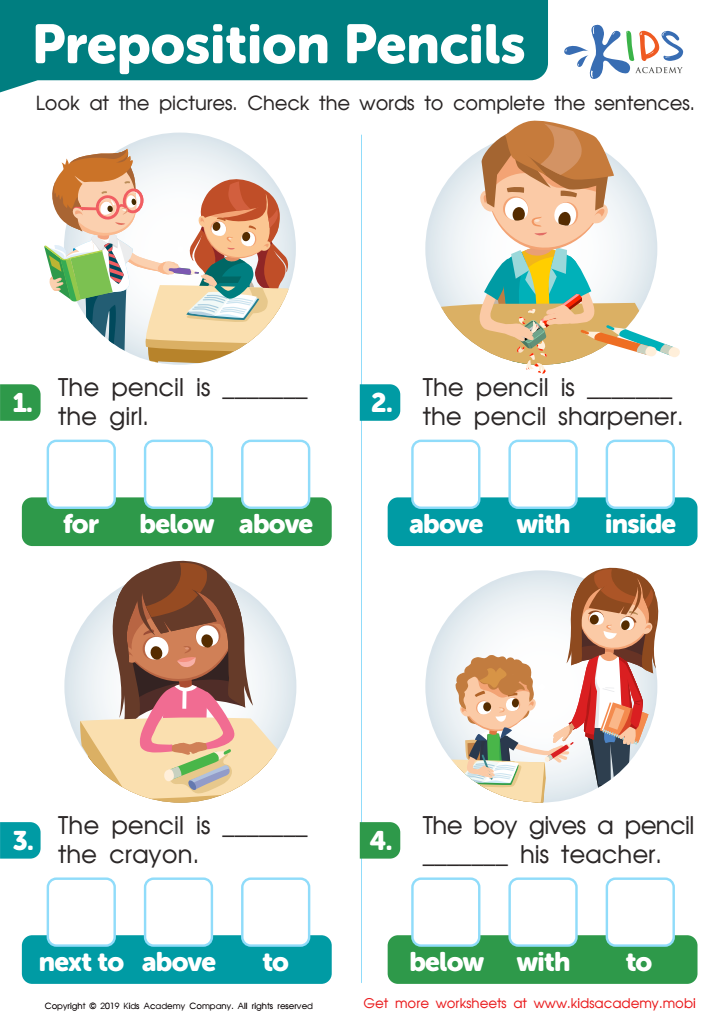
Preposition Pencils Worksheet
Constructing sentences follows rules. Parts of speech like nouns, verbs, adverbs, pronouns, and prepositions help. This worksheet focuses on prepositions. Explain prepositions to your child, then examine the pictures together and help them complete the sentences.
Preposition Pencils Worksheet
Worksheet
Join Kids Academy for Free
Who is primarily going to use this learning content?






Understanding prepositions is crucial for children ages 3-4 as they occupy a foundational role in language development and communication skills. At this age, children are beginning to explore the world around them, and prepositions help them describe their experiences and observations. For instance, words like “in,” “on,” “under,” and “between” allow children to articulate relationships between objects, fostering a clearer understanding of spatial concepts.
When parents and teachers prioritize learning about prepositions, they enhance children's reading and writing abilities. This early exposure strengthens vocabulary and improves sentence structure. As children learn to use prepositions correctly, they also boost their comprehension skills, making it easier for them to understand instructions and narratives.
Furthermore, prepositions play a vital role in everyday conversations, contributing to social interaction and cooperative play among peers. This understanding promotes social-emotional skills as children engage more effectively with others.
By focusing on prepositions at this pivotal age, parents and teachers lay a solid linguistic foundation, positively impacting future academic performance and effective communication. Simple activities, such as playing games that incorporate spatial language, can make learning engaging and meaningful, fostering a love for language in young learners.








