
Visualization skills Math Worksheets for Ages 3-5
3 filtered results
Difficulty Level
Grade
Age
-
From - To
Subject
Activity
Standards
Enhance your child's learning journey with our "Visualization Skills Math Worksheets" designed specifically for ages 3-5. These engaging worksheets focus on developing essential visualization skills, empowering young learners to analyze shapes, patterns, and spatial relationships in a fun and interactive way. Each worksheet features colorful graphics and age-appropriate activities that encourage critical thinking and creativity. As children explore various math concepts, they will build a strong foundation for future learning. Perfect for home or classroom use, our worksheets provide an enjoyable way to foster a love for math while aiding cognitive development through visual learning. Start your child's math adventure today!
Favorites
With answer key
Interactive
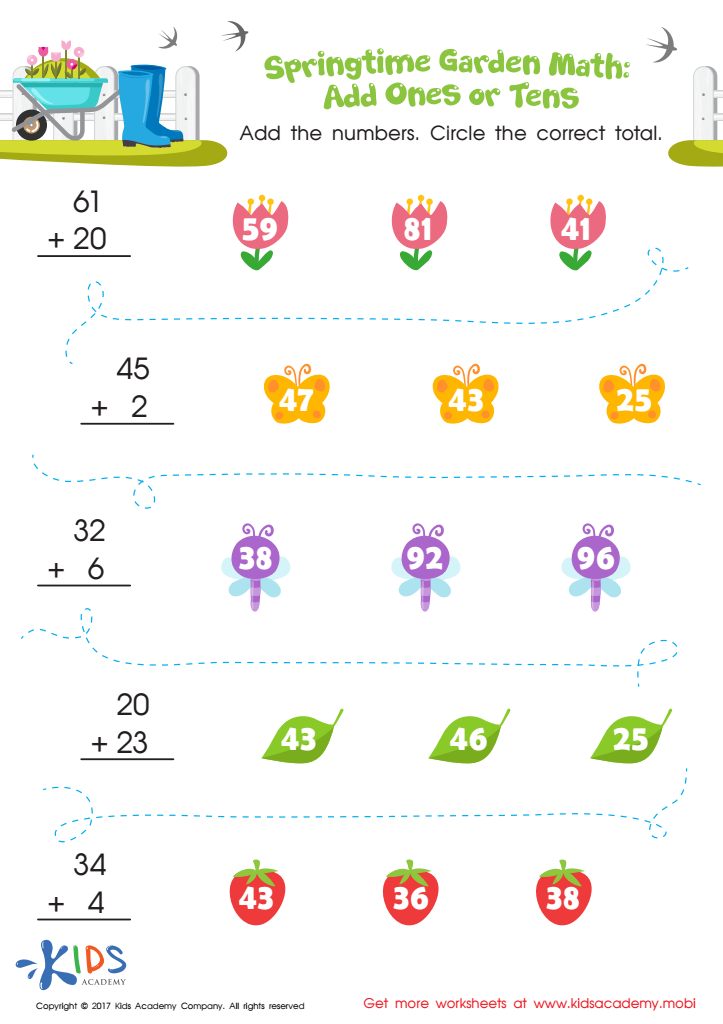
Springtime Garden Math Worksheet
Get your kid ready for math success with this bright garden-themed addition worksheet! They'll practice adding two-digit numbers and check their answers with the choices provided. It's an effective way to help kids build skills, as practice strengthens understanding. Get printing for math mastery!
 Assign to My Students
Springtime Garden Math Worksheet
Worksheet
Join Kids Academy for Free
Who is primarily going to use this learning content?







Visualization skills in math are crucial for children aged 3-5, as they form the foundation for a child's learning and understanding of mathematical concepts. When young learners can visualize shapes, patterns, and spatial relationships, they develop stronger problem-solving abilities and mathematical reasoning. This early exposure helps them grasp complex concepts later on, such as geometry, measurement, and arithmetic.
Moreover, visual-to-verbal connections foster critical thinking skills, allowing children to articulate their thought processes. Engaging in activities that promote visualization—like using blocks for sorting or drawing shapes—encourages creativity and independent thinking. These skills are not only important in math but also enhance cognitive abilities across other subjects.
Parents and teachers should recognize that the development of visualization skills starts early and should be nurtured through interactive, hands-on learning experiences. By integrating visual aids and engaging activities into their curriculum, they can create a rich learning environment that promotes mathematical competency and confidence. This early investment in visualization can ultimately lead to a smoother transition into more complex math concepts, equipping children with the tools they need for future success in education and everyday problem-solving.








