
Comparing lengths Measurement Worksheets for Ages 3-5
3 filtered results
Difficulty Level
Grade
Age
-
From - To
Subject
Activity
Standards
Introducing our engaging Comparing Lengths Measurement Worksheets for Ages 3-5! These printable activities are designed to help young learners develop essential math and measurement skills. By comparing objects of varying lengths, children will improve their understanding of concepts like short, long, longer, and shorter. Filled with colorful illustrations and fun characters, these worksheets are perfect for capturing their imagination and making learning enjoyable. Through hands-on practice, kids will enhance their critical thinking and observation skills, laying a solid foundation for future math success. Ideal for classroom or home use, start your child's measurement journey today!
Favorites
With answer key
Interactive
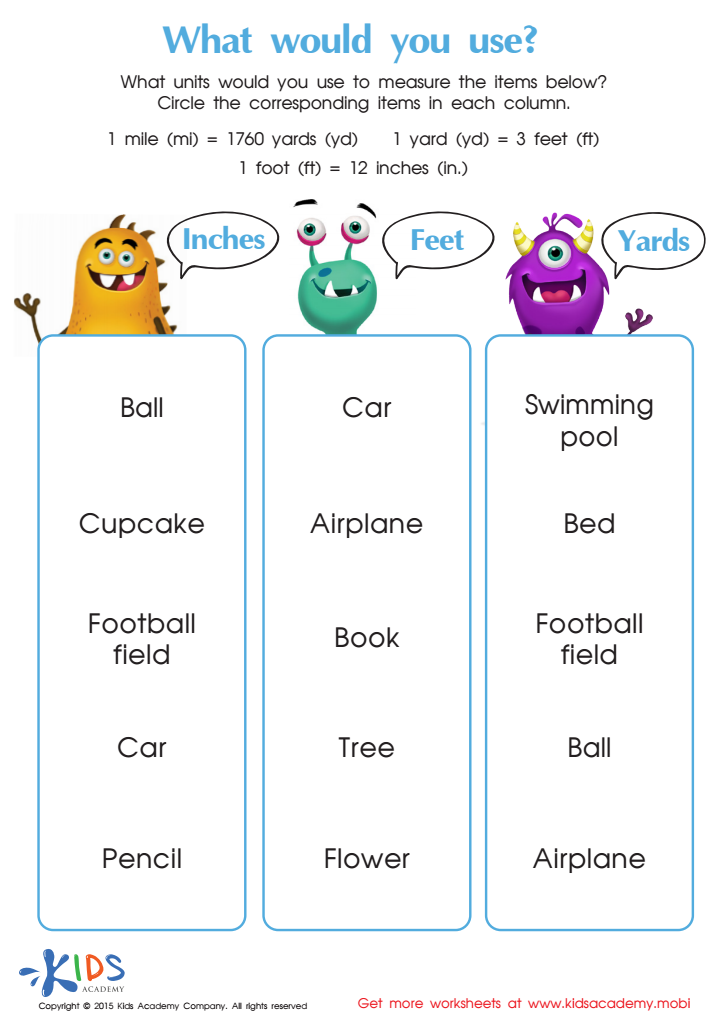
Learning about measuring objects in inches, feet and yards Worksheet
Download, cut and let your preschoolers learn and have fun estimating objects like pencils, airplanes and swimming pools in inches, feet and yards!
 Assign to My Students
Learning about measuring objects in inches, feet and yards Worksheet
Worksheet
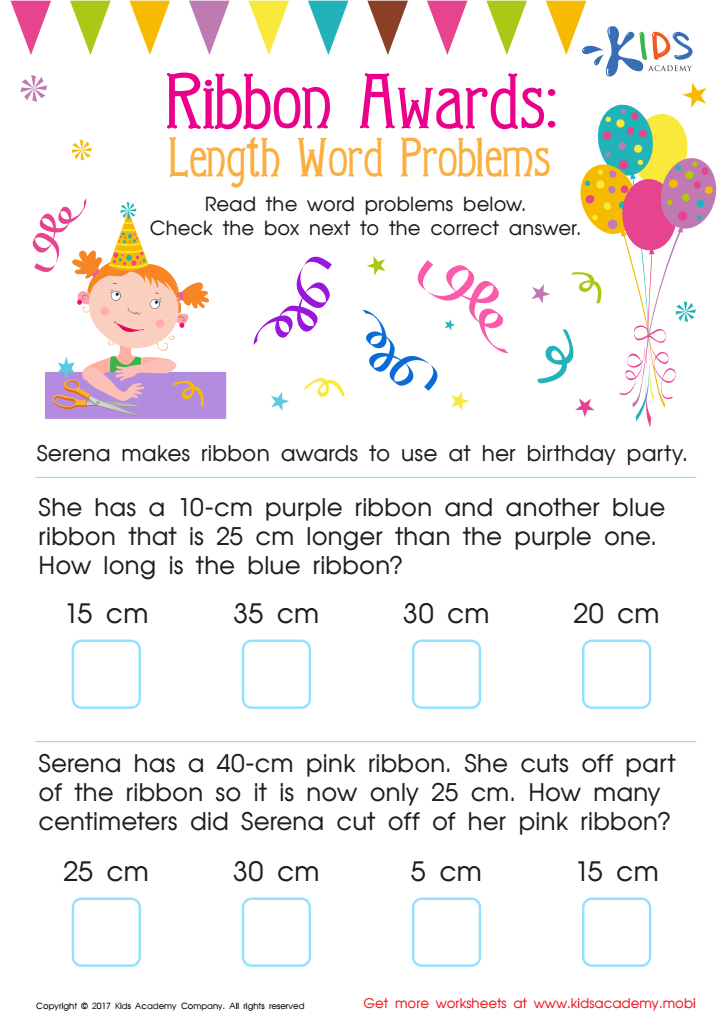
Length Word Problems Worksheet
Word problems help grade 2 students practice measurement using everyday scenarios. This worksheet provides practice in working with centimeters and inches, like measuring ribbon. It's a great way to learn and apply math skills.
Length Word Problems Worksheet
Worksheet
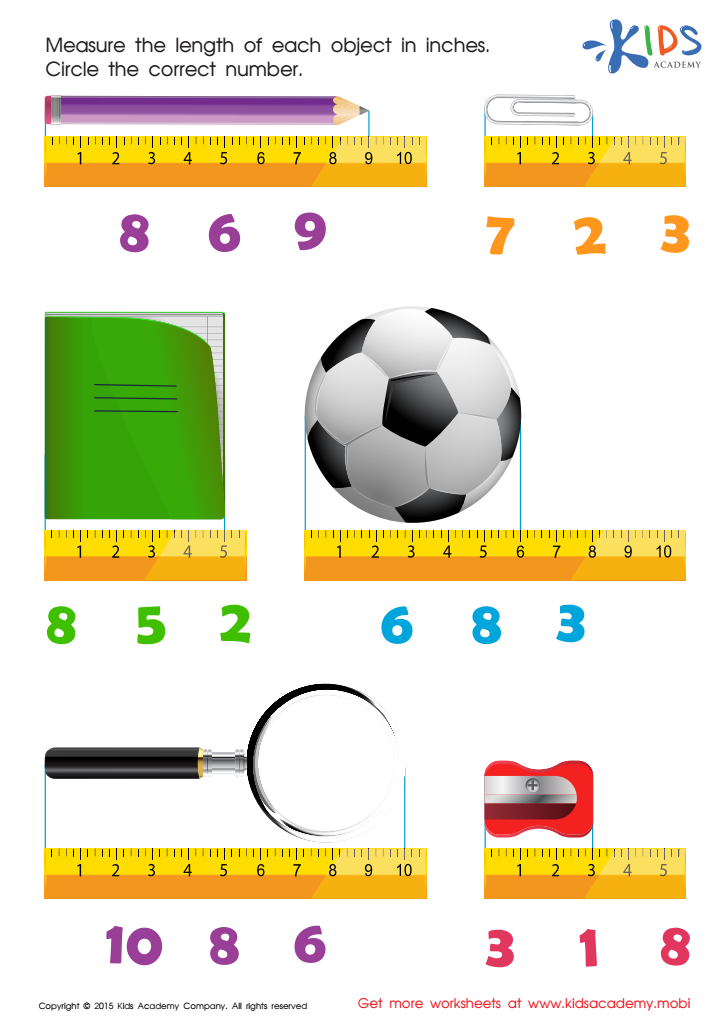
Learning measuring objects in inches Worksheet
Help your little learners gain confidence in using a ruler! Print out our free worksheet, cut out the inch ruler, and let them measure and record objects' width and length. Kids Academy has a variety of math worksheets to make learning math fun! Check out our website for more free printables!
Learning measuring objects in inches Worksheet
Worksheet
Join Kids Academy for Free
Who is primarily going to use this learning content?








Introducing the concept of comparing lengths to children ages 3-5 serves as a foundation for early mathematical and cognitive development. Firstly, it nurtures basic math skills. By comparing lengths, children begin to understand essential concepts of measurement, which are fundamental for more complex arithmetic and geometry in later educational stages. For instance, identifying which objects are longer or shorter envelopes early critical thinking skills.
In addition, comparing lengths enhances language development. When children learn terms like "longer," "shorter," and "equal," their vocabulary expands, fostering more effective communication skills. This verbal articulation of their observations bolsters their ability to express understanding and explain concepts clearly.
Moreover, early exposure to measurement concepts like length aids in developing fine motor skills. Activities such as lining up blocks or using rulers require precision and hand-eye coordination. For example, a child arranging sticks from shortest to longest enhances their ability to manipulate objects accurately, preparing them for tasks like writing and cutting.
Lastly, understanding measurement supports everyday problem-solving abilities. When children can compare objects' lengths, they apply this skill in real-life scenarios, such as fitting toys into boxes or comparing footprints, thereby making sense of their immediate world in practical ways. Therefore, engaging children in these activities is crucial for their holistic development.








