Comparing shapes Worksheets for Ages 3-6
3 filtered results
-
From - To
Introduce your little learners to the world of geometry with our Comparing Shapes worksheets, specially crafted for children ages 3-6. Our fun and educational worksheets aid in the recognition and comparison of various shapes through engaging activities. Easy to follow and brightly illustrated, these worksheets help young children develop critical thinking, observation, and fine motor skills. Designed to inspire curiosity and enthusiasm for learning, our comparing shapes worksheets are perfect for both preschool and early kindergarten. Set your child on a path to a strong mathematical foundation with these enjoyable and effective educational tools.
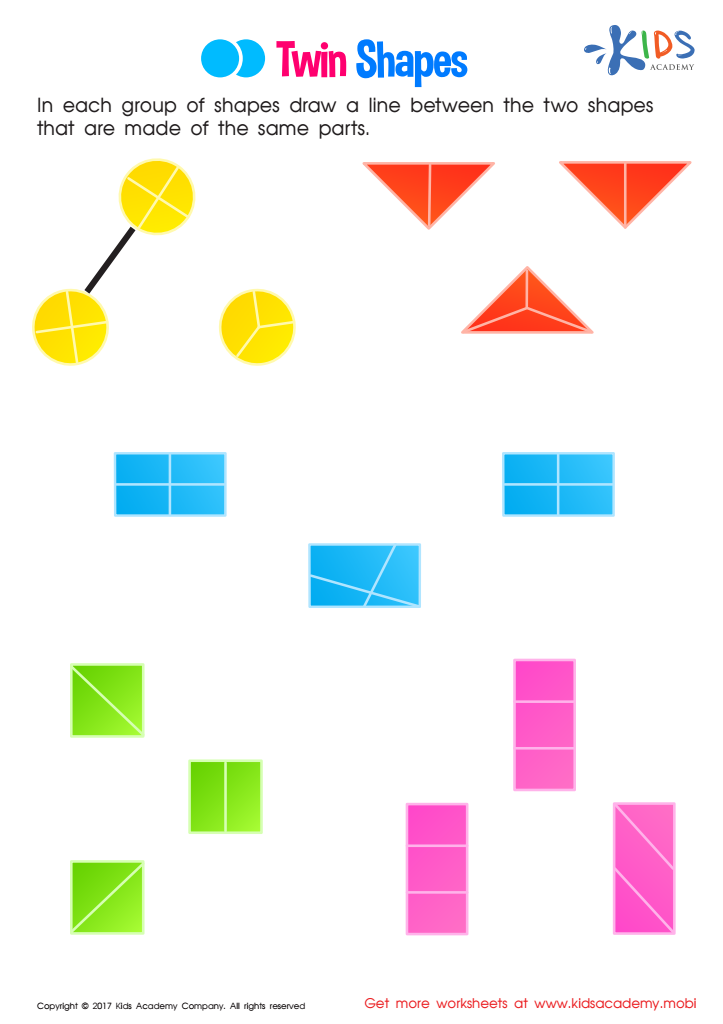
Twin Shapes Worksheet
 Assign to My Students
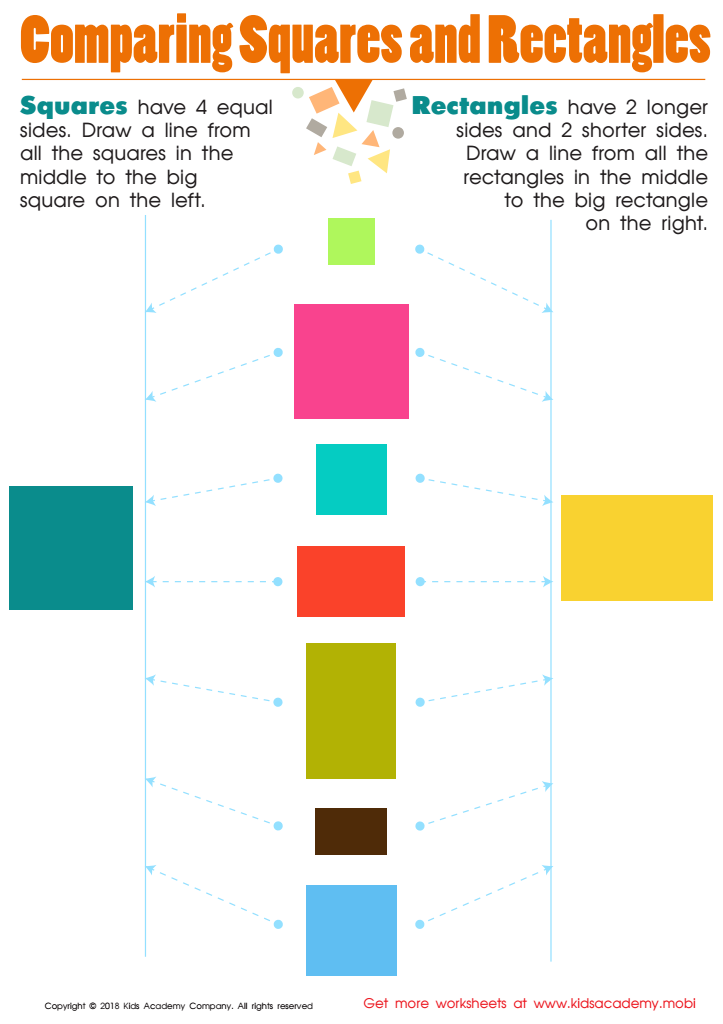
Comparing Squares Rectangles Worksheet
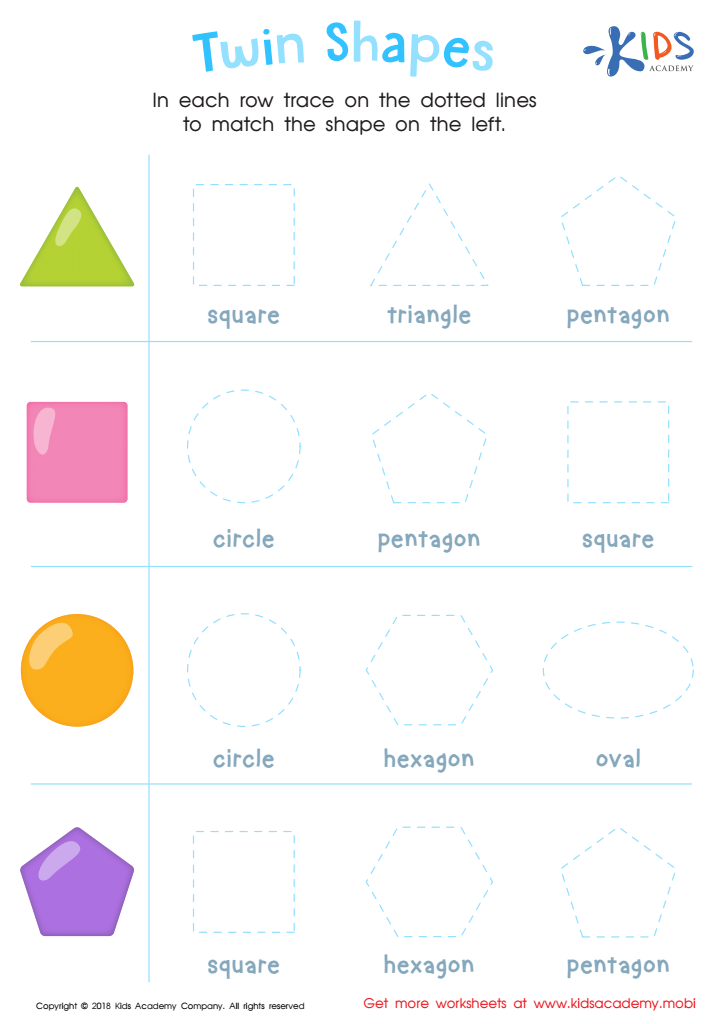
Twin Shapes Dot-to-Dot Worksheet


.jpg)




Comparing shapes is crucial for children ages 3-6 because it lays the groundwork for their cognitive and mathematical development, as well as their ability to reason and problem solve. At this formative age, children are naturally curious and their brains are primed for learning basic concepts that will serve as building blocks for more complex skills.
Understanding and comparing shapes helps children recognize patterns, categorize objects, and organize their world. This boosts their spatial awareness, which is essential for tasks ranging from navigating physical spaces to understanding more abstract mathematical concepts later on. For instance, recognizing that two different objects can both be circles regardless of size or color strengthens their ability to generalize and to grasp that certain attributes define a shape.
Moreover, comparing shapes can enhance language development. As children describe shapes and their attributes—like sides, corners, and curves—they expand their vocabulary and improve their descriptive language skills. Teachers and parents can foster this learning by engaging in activities like sorting and grouping objects, discussing similarities and differences, and playing shape-related games.
Ultimately, early practice in comparing shapes sets the stage for future mathematical learning, as children become familiar with concepts that will eventually evolve into understanding geometry, measurement, and logical reasoning. It also enhances their cognitive flexibility, a key skill that contributes to effective problem-solving.








