
Comparing shapes Math Worksheets for Ages 3-6
3 filtered results
Difficulty Level
Grade
Age
-
From - To
Subject
Activity
Standards
Enhance your child's early math skills with our "Comparing Shapes Math Worksheets" designed for ages 3-6! These engaging worksheets provide fun opportunities for young learners to explore and compare different shapes. Through colorful illustrations and interactive activities, children will develop essential skills in shape recognition, categorization, and visual discrimination. Our worksheets are tailored to boost confidence and promote critical thinking as kids identify similarities and differences between shapes. Ideal for preschool and kindergarten settings, these resources make learning playful and enjoyable. Download our free worksheets today and watch your little ones build a strong foundation in math while having a blast!
Favorites
With answer key
Interactive
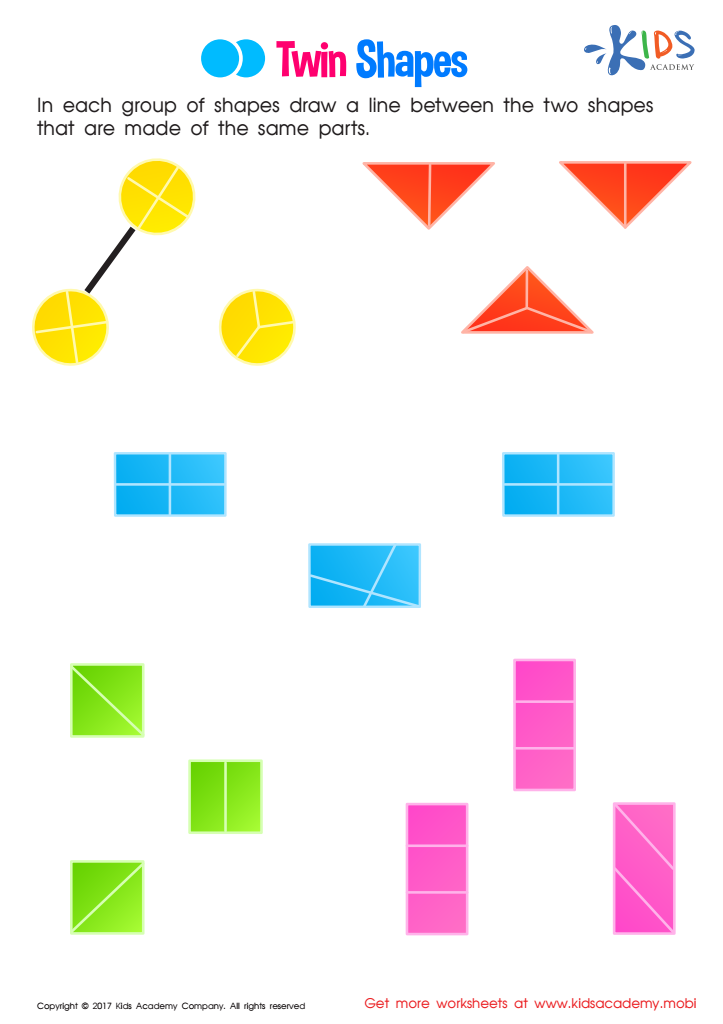
Twin Shapes Worksheet
Your students' goal in this worksheet is to find the twin shapes: drawing a line between two shapes made of the same parts. Likely, the first shapes encountered were circles, triangles, rectangles and squares - examples of which are seen frequently in everyday life. Encourage them to apply what they know and work out which is the twin shape!
 Assign to My Students
Twin Shapes Worksheet
Worksheet
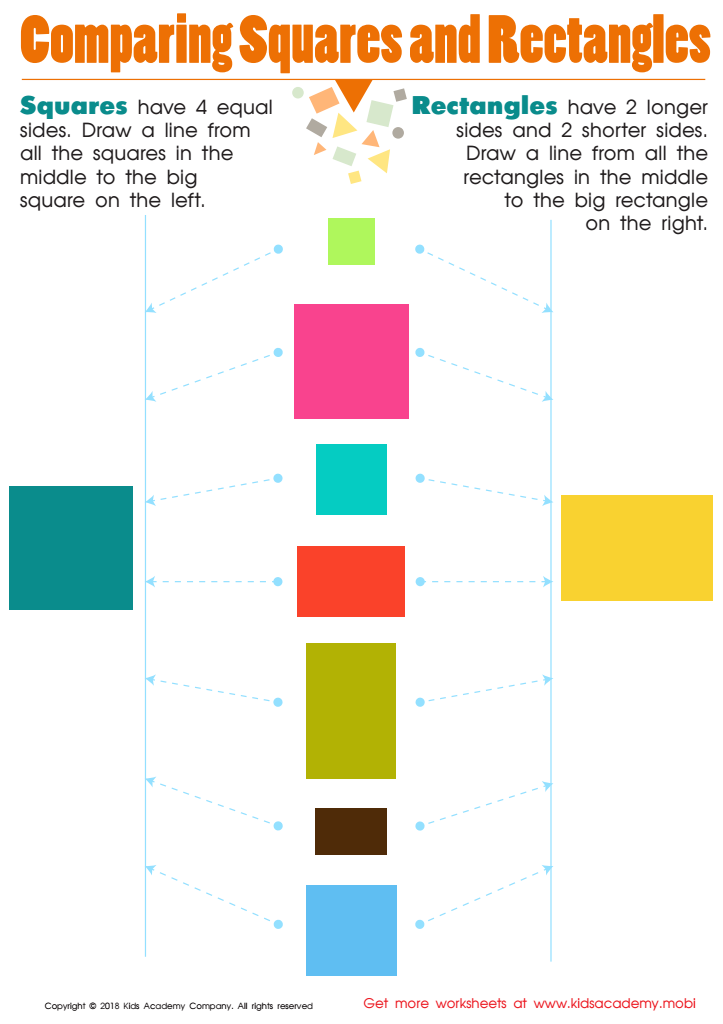
Comparing Squares Rectangles Worksheet
Help your little learner distinguish rectangles from squares with this fun geometry worksheet from Kids Academy! Read the definitions at the top, use the shapes on either side as a guide, then trace over the dotted line to match the rectangles and squares!
Comparing Squares Rectangles Worksheet
Worksheet
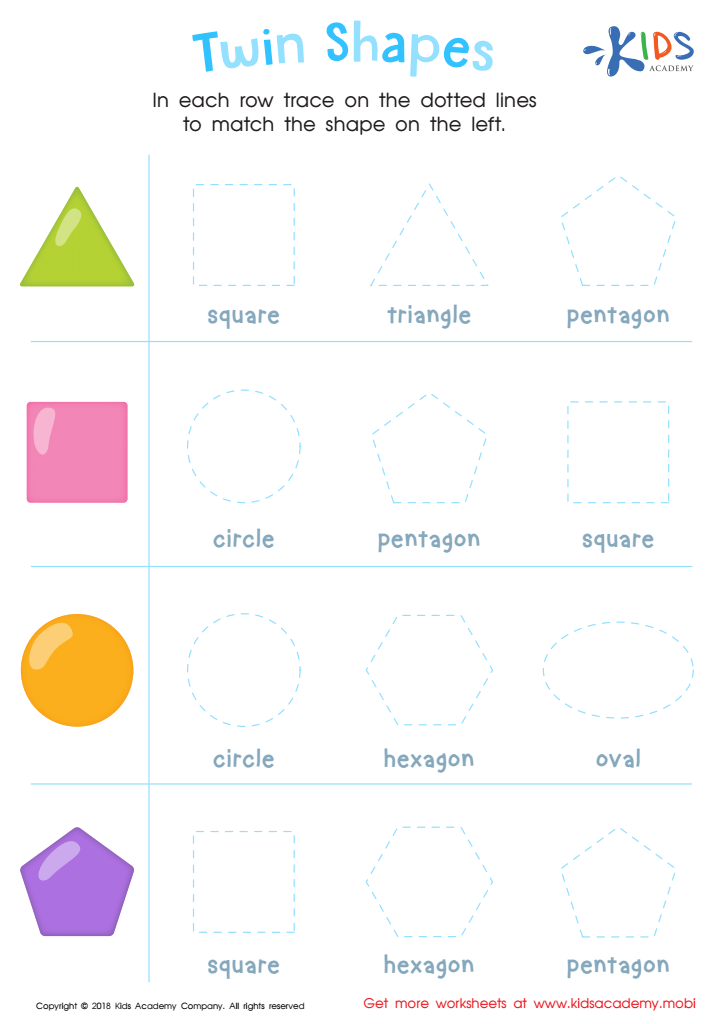
Twin Shapes Dot-to-Dot Worksheet
Test your child's ability to copy with this worksheet. Ask them to find and name the four shapes on the left. Then, they must match each with the dotted lines on the right. Help your child with all four shapes in this fun exercise.
Twin Shapes Dot-to-Dot Worksheet
Worksheet
Join Kids Academy for Free
Who is primarily going to use this learning content?








Comparing shapes is a vital math skill for children aged 3-6, and it holds significant importance for parents and teachers alike. At this developmental stage, children are naturally curious and eager to explore their surroundings, making it an ideal time to introduce mathematical concepts through play.
Engaging kids in comparing shapes fosters critical thinking and enhances spatial awareness. By identifying and distinguishing between shapes, children learn to recognize patterns, boost their problem-solving skills, and develop their observation abilities. This foundational knowledge lays the groundwork for more complex mathematical skills, which will be crucial as they progress in school.
Furthermore, comparing shapes encourages language development as children learn to articulate their observations, enhancing their vocabulary with terms like “similar,” “different,” “bigger,” and “smaller.” Parental and educator involvement in these activities promotes a supportive learning environment, helping children build confidence and a positive attitude towards math.
Moreover, these early experiences contribute to cognitive development. Activities that involve sorting, classifying, and comparing shapes cultivate early mathematics understanding and stimulate curiosity, which can lead to a lifelong love for learning. Ultimately, a strong foundation in shape comparison enriches children's overall cognitive, social, and emotional growth.








