
Space knowledge Science Worksheets for Ages 3-6
3 filtered results
Difficulty Level
Grade
Age
-
From - To
Subject
Activity
Standards
Unlock the wonders of the universe with our Space Knowledge Science Worksheets tailored for ages 3-6! Designed to captivate young minds, these printable resources turn learning about planets, stars, and galaxies into an exciting adventure. Each worksheet combines colorful visuals with engaging activities to help children grasp complex space concepts effortlessly. Perfect for parents and educators alike, our expertly crafted materials foster a love for science while developing critical thinking and observational skills. Embark on a cosmic journey today by exploring our fun and educational space worksheets! Visit our page to spark curiosity and inspire future scientists.
Favorites
With answer key
Interactive
 Assign to My Students
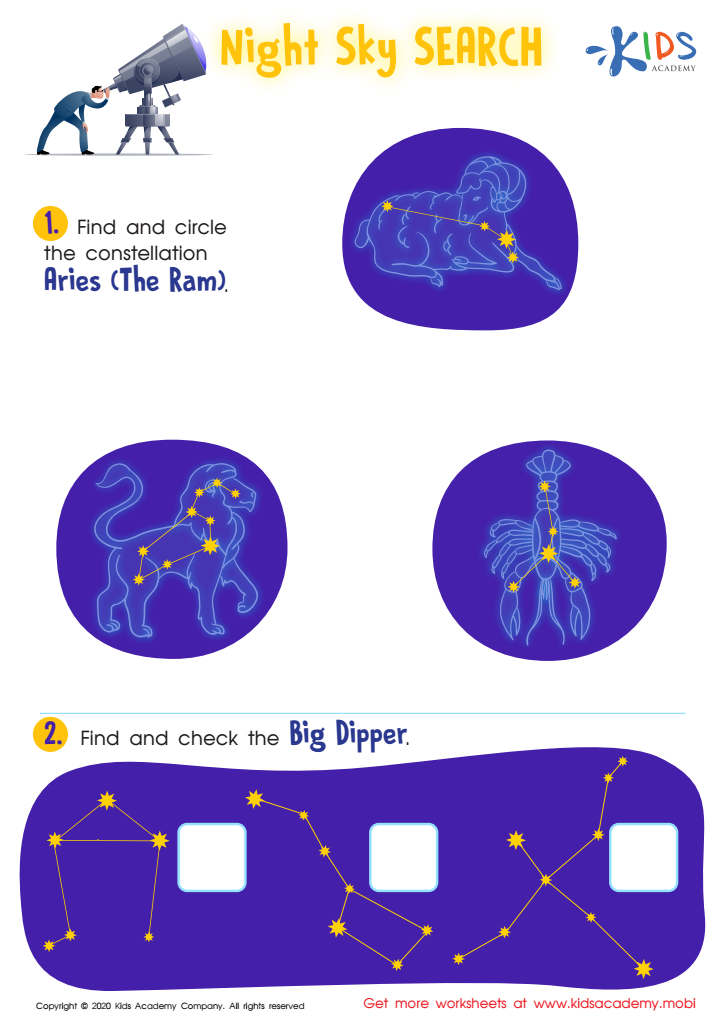
Night Sky Search Worksheet
Gaze up into the night sky and spot the stars! Your little astronomer can learn about Aries and Big Dipper constellations with this science worksheet. Simply find the ram for Aries and check the box for Big Dipper. Then, when the weather is right, go outside and look for them in the night sky!
Night Sky Search Worksheet
Worksheet
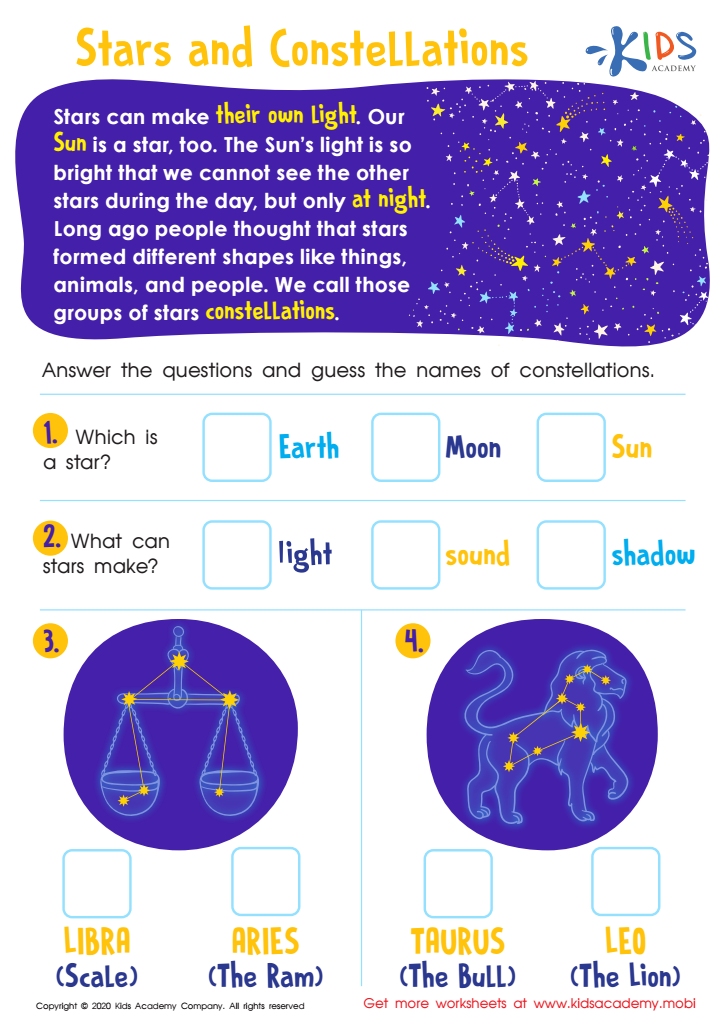
Stars and Constellations Worksheet
Learn about stars and constellations with this entertaining worksheet! Read the passage at the top of the page to gain an understanding of stars, then test your child's knowledge with the questions below. Check the right answers and finish this science worksheet with your child - they'll be amazed that stars can make their own light, just like the sun!
Stars and Constellations Worksheet
Worksheet
Join Kids Academy for Free
Who is primarily going to use this learning content?






Introducing space science to children aged 3-6 offers numerous benefits that extend far beyond simple knowledge. At this impressionable age, children are naturally curious and eager to learn about the world around them. Teaching them about space can ignite a lifelong fascination for science and encourage critical thinking and imagination.
First, learning about space provides a unique platform to explain fundamental scientific concepts, such as gravity, the solar system, and the differences between planets. This sets a foundation for more complex learning in school. Incorporating space science can cultivate curiosity, encouraging children to ask questions, seek answers, and thus develop problem-solving skills.
Moreover, space science fosters creativity. Imagining distant planets and alien life can inspire creative thinking and storytelling. Books, toys, and activities related to outer space can make learning fun and engaging, fostering a positive attitude towards education.
Additionally, being aware of the universe and our place within it helps inculcate a sense of wonder and perspective in young minds. It can teach them values like cooperation and global citizenship, using space missions that require international collaboration as examples.
Lastly, foundational space knowledge can help keep children enthusiastic about science, technology, engineering, and math (STEM). Early interest in these fields is crucial as it can influence their academic choices and career paths in the longer run.
Therefore, introducing space science early on is a meaningful way to enrich children’s natural curiosity and prepare them for future learning and the evolving world.







