Number comprehension Worksheets for Ages 3-7 - Page 2
26 filtered results
-
From - To
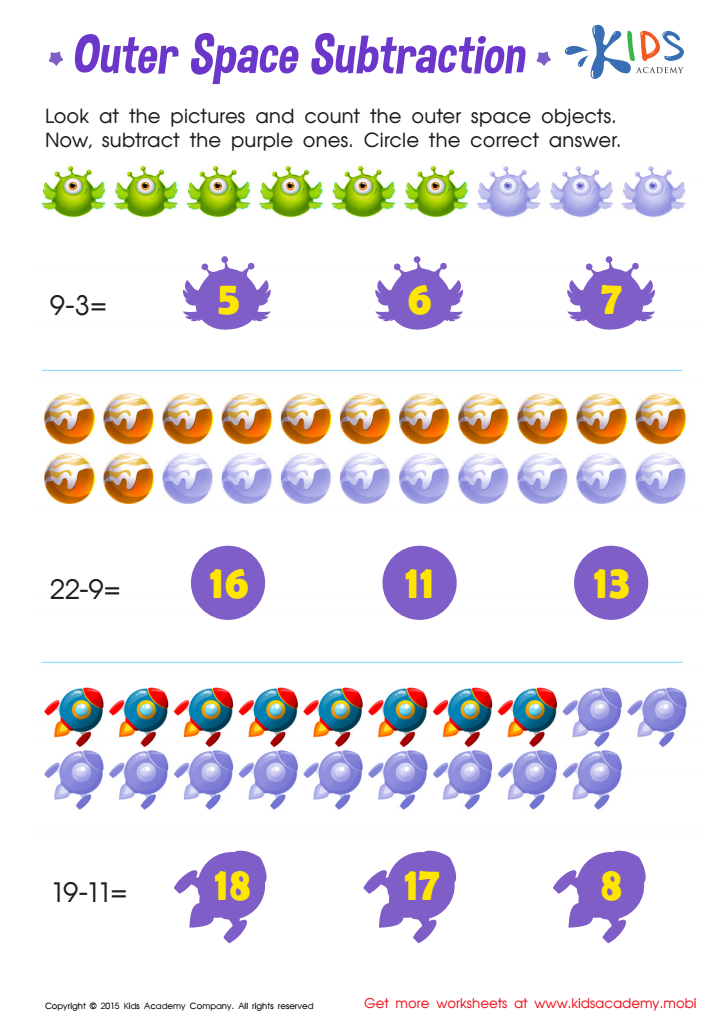
Outer Space Substraction Worksheet
 Assign to My Students







Number comprehension is essential for children aged 3-7 as it forms the foundation for lifelong mathematical skills. During these crucial early years, children are developing cognitive abilities and the basic numeracy skills that are critical for later academic success. Understanding numbers helps them recognize and appreciate patterns, quantities, and relationships in everyday situations, enhancing their problem-solving and critical thinking skills.
Moreover, fostering number comprehension at an early age encourages confidence in math-related subjects. Children who grasp these concepts are more likely to engage positively with math in school, reducing math anxiety and increasing their likelihood of pursuing advanced math in later years. Additionally, number comprehension is intertwined with various areas of learning, enabling children to connect math with other subjects like science, art, and even reading through counting, shapes, and measurements.
Parents and teachers play a significant role in this developmental stage, as their encouragement and active involvement can create a rich learning environment. Simple activities like counting objects, measuring ingredients while cooking, or playing math games can be incredibly beneficial. Ultimately, prioritizing number comprehension lays the groundwork for academic achievement and a positive attitude towards learning in children’s futures.








