Understanding regrouping Worksheets for Ages 3-7
4 filtered results
-
From - To
Discover our meticulously crafted Understanding Regrouping Worksheets for ages 3-7. These engaging and educational resources simplify regrouping, making learning fun for young children. Featuring vibrant visuals and age-appropriate exercises, the worksheets help kids grasp essential math concepts while fostering a love for learning. Perfect for early learners, our worksheets build a solid foundation in arithmetic by breaking down complex ideas into easy-to-understand steps. Tailored to fit diverse learning needs, they are ideal for home-schooling or classroom use. Boost your child's confidence and skills with our specialized regrouping worksheets, paving the way for future academic success.
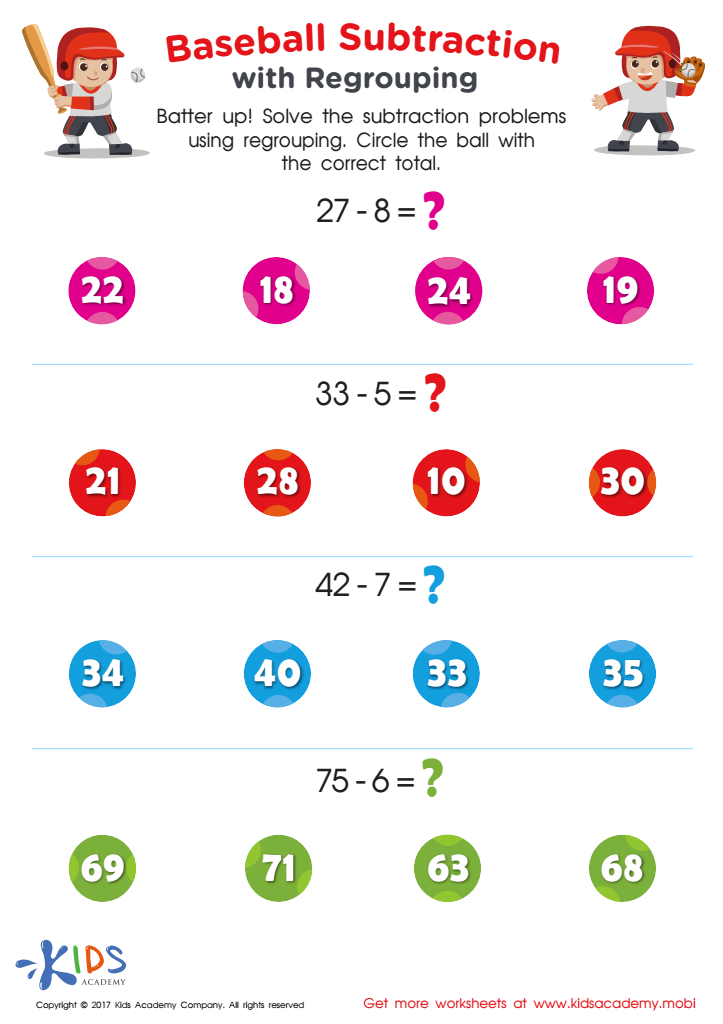
Subtraction With Regrouping for 2nd Grade Worksheet
 Assign to My Students
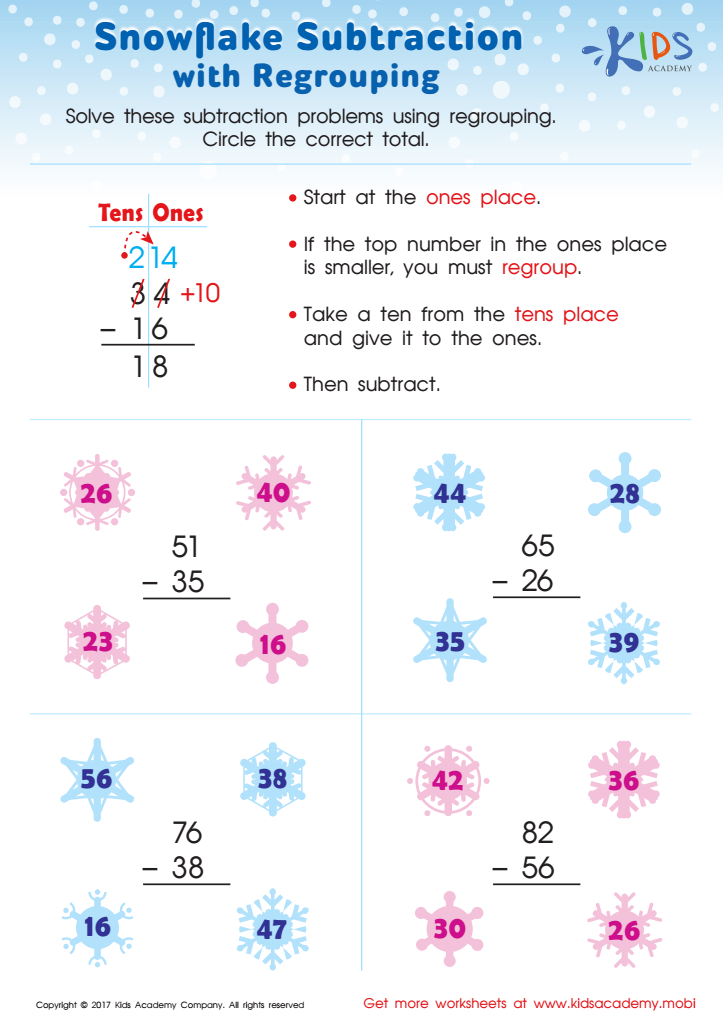
Subtraction With Regrouping Worksheet: Snowflake
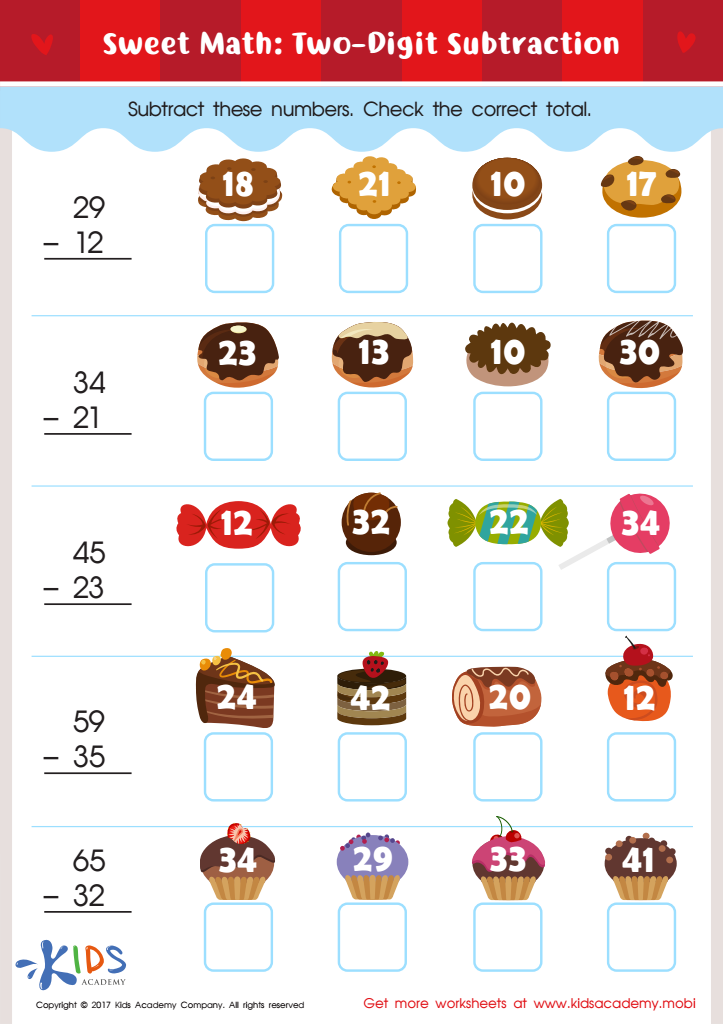
Two Digit Subtraction Worksheet








Understanding regrouping, a concept vital in early math education, is crucial for children aged 3-7 as it lays the foundation for advanced arithmetic skills. Regrouping, commonly introduced through addition and subtraction, helps children understand that numbers are composed of tens and ones, fostering a deeper comprehension of place value. This conceptual grasp is fundamental for mastering more complex mathematical operations in later grades.
For parents and teachers, ensuring children grasp regrouping is essential for their academic success. Early challenges with this concept can lead to difficulties in solving multi-digit problems and hamper their ability to progress in math. By focusing on regrouping, parents and teachers can build a child's confidence and problem-solving skills, making math less intimidating and more approachable.
Moreover, early mastery of regrouping aids in the development of logical thinking and analytical skills. It teaches children to break down complex problems into simpler parts, a skill applicable beyond mathematics. Engaging children with hands-on activities like using physical objects or visual aids can make learning regrouping enjoyable and effective.
In essence, understanding regrouping at an early age equips children with crucial mathematical tools, fostering a positive attitude towards math and setting the stage for future academic achievements. Parents and teachers play a key role in this foundational learning by providing the necessary support and resources.








