Math problem-solving skills Addition & Subtraction Worksheets for Ages 3-7
4 filtered results
-
From - To
Enhance your child's math problem-solving skills with our engaging Addition and Subtraction worksheets, designed specifically for ages 3-7. These worksheets make learning fun by incorporating colorful illustrations and interactive exercises that encourage independent thinking. Children will practice essential math concepts while developing critical thinking and reasoning skills. Our carefully crafted activities not only improve addition and subtraction proficiency but also boost confidence in tackling mathematical challenges. Perfect for both classroom and at-home learning, these worksheets serve as a valuable resource for parents and educators alike, supporting young learners on their journey toward mathematical understanding and success. Go ahead, explore the joy of math!
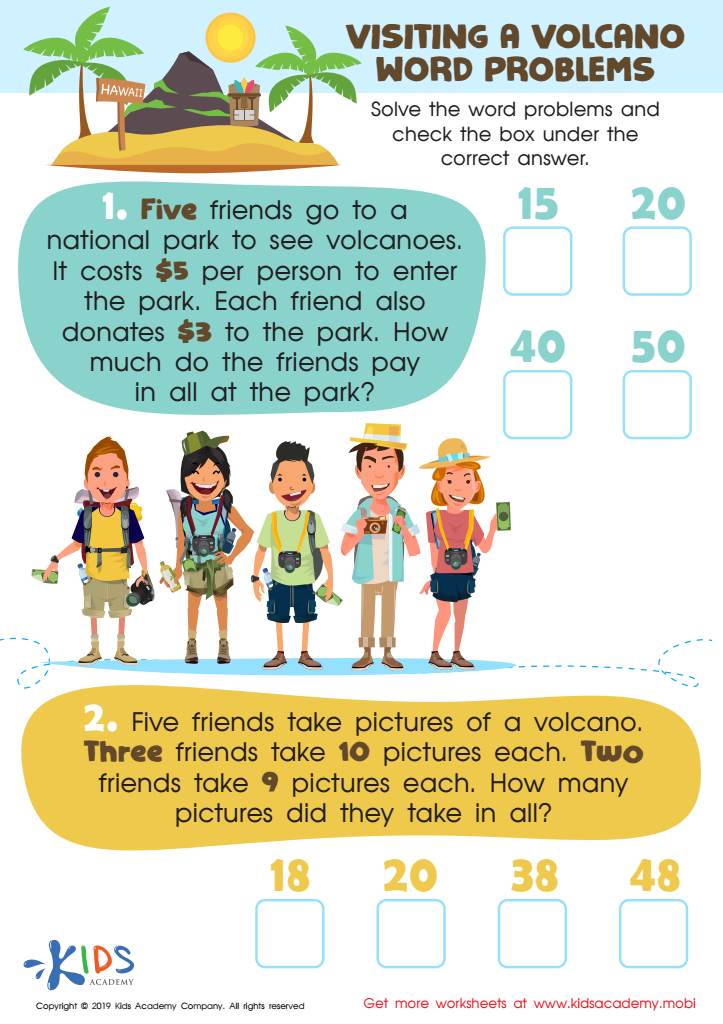
Visiting a Volcano Word Problems Worksheet
 Assign to My Students








Math problem-solving skills, particularly in addition and subtraction, are foundational for children's cognitive development and future academic success. For ages 3-7, these skills foster critical thinking and reasoning abilities. During this formative period, children are developing mathematical understanding through hands-on experiences and interactions with the world around them.
Encouraging problem-solving in addition and subtraction equips children with tools to approach challenges creatively and logically. These skills help young learners grasp concepts like quantity, order, and relationships, building a strong mathematical foundation. Early proficiency in these areas translates to self-confidence, which is essential for engaging in complex mathematical tasks as they progress in school.
Furthermore, strong math skills are linked to improved performance in various subjects, enhancing overall academic achievement. Math problem-solving encourages perseverance and resilience—qualities valuable for lifelong learning. Educators and parents play a crucial role in supporting this development by providing engaging activities, creating a positive math environment, and addressing any anxieties related to math. By prioritizing addition and subtraction problem-solving skills, caregivers help children develop a love for learning and the ability to tackle real-world problems, preparing them for success both in and outside the classroom.








