Solve word problems Addition & Subtraction Worksheets for Ages 3-7
3 filtered results
-
From - To
Explore our engaging Solve Word Problems Addition & Subtraction Worksheets, designed specifically for children ages 3-7! These worksheets provide a fun and interactive way for young learners to develop essential math skills through real-life scenarios. With colorful illustrations and relatable situations, children will find joy in solving addition and subtraction challenges. Our resources encourage critical thinking and help build a strong foundation in mathematics. Perfect for both classroom activities and at-home learning, these worksheets aim to boost confidence and problem-solving abilities. Download now to transform math practice into a delightful experience for your little ones!
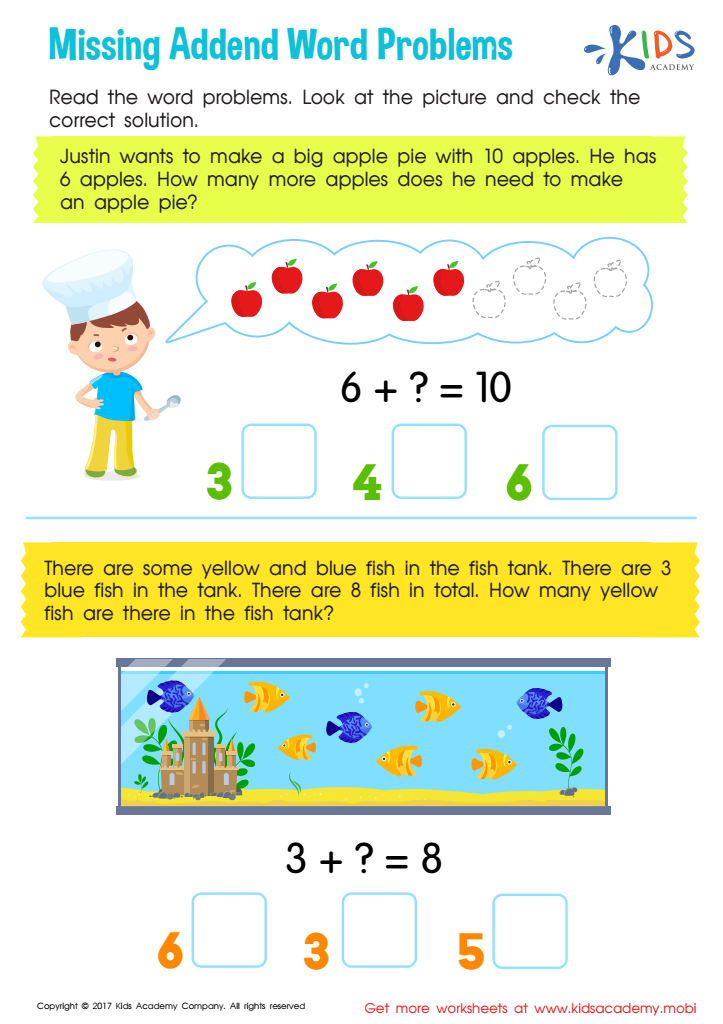
Missing Addend Word Problems Worksheet
 Assign to My Students








Parents and teachers should prioritize teaching word problems focused on addition and subtraction for children ages 3-7 for several essential reasons. First, these problems promote critical thinking and comprehension skills. Unlike straightforward computational tasks, word problems require children to process information, identify relevant data, and formulate a strategy for solving it. This lays a strong foundation for analytical skills crucial in higher-level math and everyday situations.
Additionally, solving word problems fosters language development. Children learn to interpret language, identify keywords, and translate verbal descriptions into mathematical operations, connecting math to their world. This integration of literacy and numeracy enhances their overall cognitive development.
Moreover, mastering word problems builds confidence in young learners. Successfully solving these challenges encourages perseverance and resilience, helping children embrace challenges in math and other subjects. It also allows for real-life applications, as children see math’s relevance in daily situations like sharing, counting, and problem-solving in various contexts.
Furthermore, involving parents and teachers in this process strengthens the learning partnership, encouraging consistent practice and support. Ultimately, focusing on word problems in addition and subtraction sets the stage for academic success in mathematics and critical life skills, making it a vital area of focus.








