
Pattern identification Addition Worksheets for Ages 3-7
3 filtered results
Difficulty Level
Grade
Age
-
From - To
Subject
Activity
Standards
Introduce your little ones to the exciting world of math with our Pattern Identification Addition Worksheets, designed specifically for ages 3-7. These engaging worksheets blend the fun of pattern recognition with the basics of addition, helping young learners develop essential mathematical skills. Our carefully crafted activities encourage critical thinking and problem-solving, laying a strong foundation for future math concepts. Each worksheet is vibrantly illustrated to capture children's attention and make learning enjoyable. Enhance your child's cognitive abilities and mathematical confidence with our Pattern Identification Addition Worksheets, available now at Kids Academy. Start their educational journey today!
Favorites
With answer key
Interactive
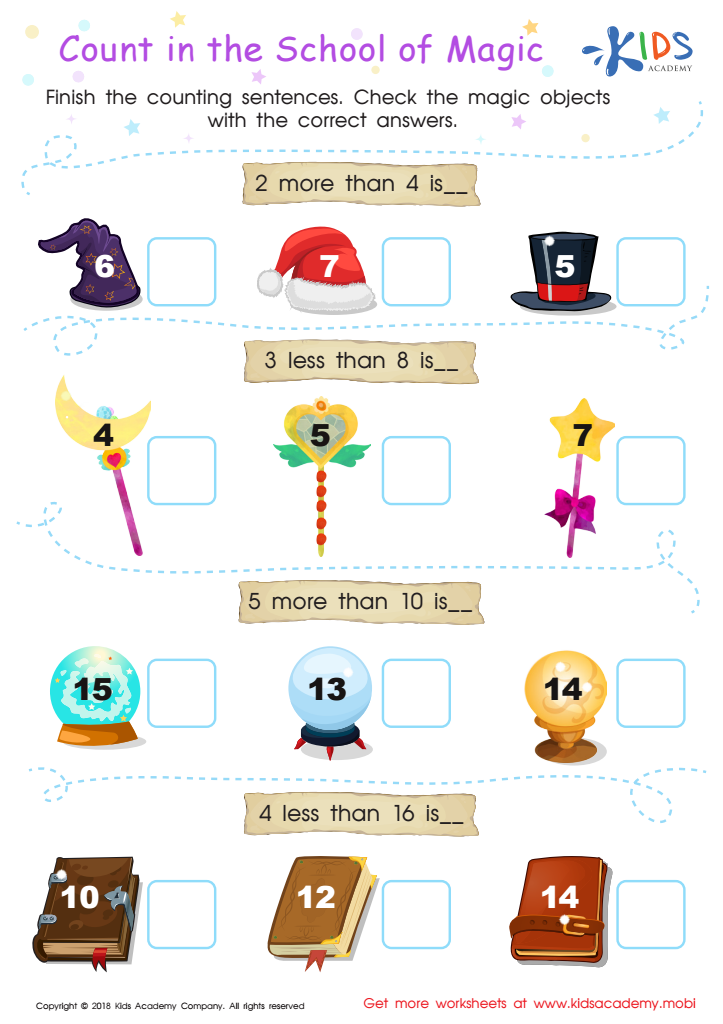
Count in the School of Magic Worksheet
Your math learners can explore the School of Magic with this worksheet. They'll read equations with addition and subtraction numbers under 20, count back and forth to find the answer, then complete the counting sentences. Fun pictures and easy accuracy make it an enjoyable and successful learning experience.
 Assign to My Students
Count in the School of Magic Worksheet
Worksheet
Join Kids Academy for Free
Who is primarily going to use this learning content?







Pattern identification and addition are fundamental skills for young children, impacting their cognitive development and future academic success. For ages 3-7, recognizing patterns helps children understand order and predictability in their environment, which is essential for logical thinking. Patterns teach children to observe, compare, and make connections, key components of critical thinking and problem-solving, crucial skills for advanced subjects like math and science.
Addition is a cornerstone of arithmetical understanding and the basis for more complex mathematical operations. Introducing addition at an early age builds a strong number sense. Through activities that combine patterns and addition, such as finding the next shape in a sequence or counting objects, children develop familiarity with basic math concepts.
Furthermore, these skills promote a positive attitude toward learning. Making patterns and adding numbers can be fun, engaging, and tangible, using toys, blocks, or everyday objects to turn abstract concepts into concrete experiences. This hands-on learning stimulates curiosity, encourages exploration, and develops fine motor skills.
Investing time in teaching pattern identification and addition early on lays a strong educational foundation. Children equipped with these skills are more likely to excel academically, enjoy deeper conceptual understanding, and develop a lifelong love of learning. Thus, parents and teachers play crucial roles in nurturing these abilities during early childhood.








