Identify shapes Math Worksheets for Ages 3-7
11 filtered results
-
From - To
Explore our engaging "Identify Shapes" math worksheets designed specifically for children ages 3-7! These interactive materials make learning fun as young learners discover and recognize various shapes, from circles to triangles and squares. Each worksheet is designed with colorful illustrations and easy-to-follow activities that capture children's attention and spark their curiosity. Perfect for home or classroom settings, these worksheets help to build essential foundational math skills while boosting fine motor development. Empower your little ones to master shape identification through playful exercises that cultivate critical thinking and creativity. Download your suitable worksheets today and watch your child's confidence grow in mathematics!
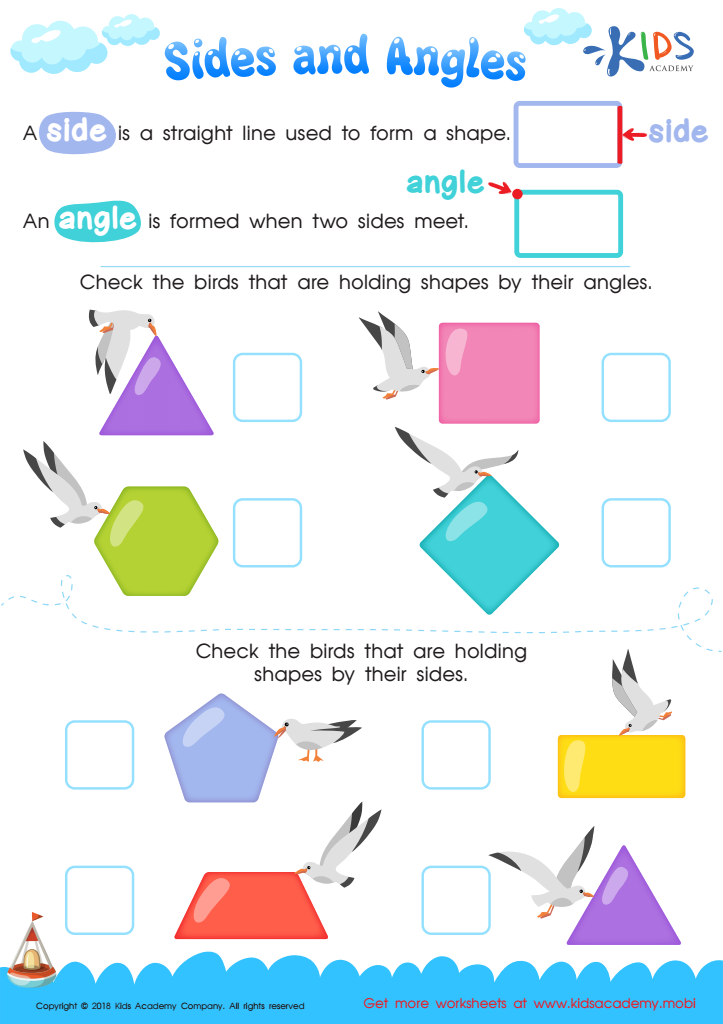
Sides and Angles Worksheet
 Assign to My Students







Identifying shapes is a crucial foundational skill for children ages 3-7, as it plays a significant role in their early mathematical development. Understanding shapes aids in enhancing spatial awareness, which is necessary for problem-solving in various contexts—both in math and real-world situations. When children learn to recognize and categorize shapes, they develop critical thinking skills and the ability to compare and contrast different objects.
Moreover, shape identification forms the groundwork for more complex mathematical concepts like geometry, measurement, and fractions which they will encounter later in their education. Parents and teachers should be engaged in this process by incorporating fun and interactive activities, such as puzzles, blocks, or shape-sorting games that can make learning joyful and effective.
Furthermore, discussing shapes in everyday life helps children connect abstract math concepts to their surroundings, reinforcing their learning. This connection contributes to a positive attitude towards math and enhances overall cognitive development. Ultimately, fostering an interest and competence in recognizing shapes equips children with essential tools they will use throughout their schooling and beyond, establishing a basis for lifelong learning and success.








