
Time recognition Math Worksheets for Ages 3-7
6 filtered results
Difficulty Level
Grade
Age
-
From - To
Subject
Activity
Standards
Introduce your little learners to the fascinating world of time with our engaging Time Recognition Math Worksheets for Ages 3-7 from Kids Academy! These printable worksheets offer a fun, interactive way to help children grasp the concept of hours, minutes, and reading clocks. Designed to cater to early age groups, each worksheet combines playful pictures and simple exercises that make mastering time fruitful and enjoyable. Perfect for preschool and early elementary students, these resources foster confidence and proficiency in time-telling skills, ensuring a strong mathematical foundation. Set your child on the path to success with Kids Academy Time Recognition Worksheets!
Favorites
With answer key
Interactive
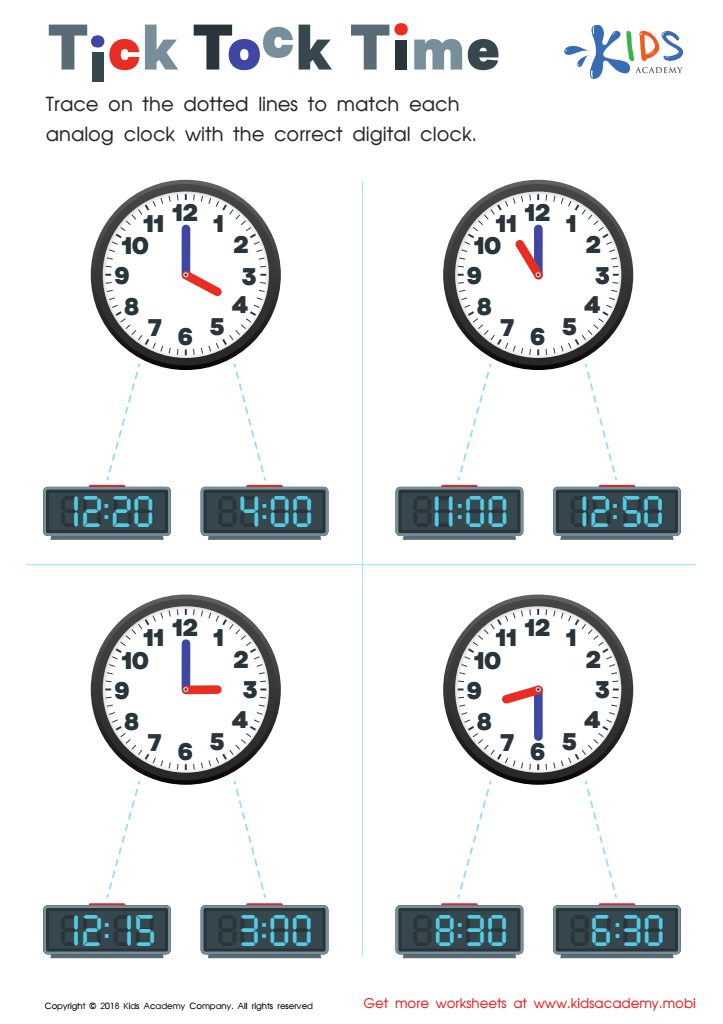
Tick Tock Time Worksheet
Trace the dotted lines on this worksheet to match analog and digital clocks! It's a great way to help your kids learn time-telling. They'll get better at converting analog to digital, and vice versa. Get your children to try it - it's a fun way to practice!
 Assign to My Students
Tick Tock Time Worksheet
Worksheet
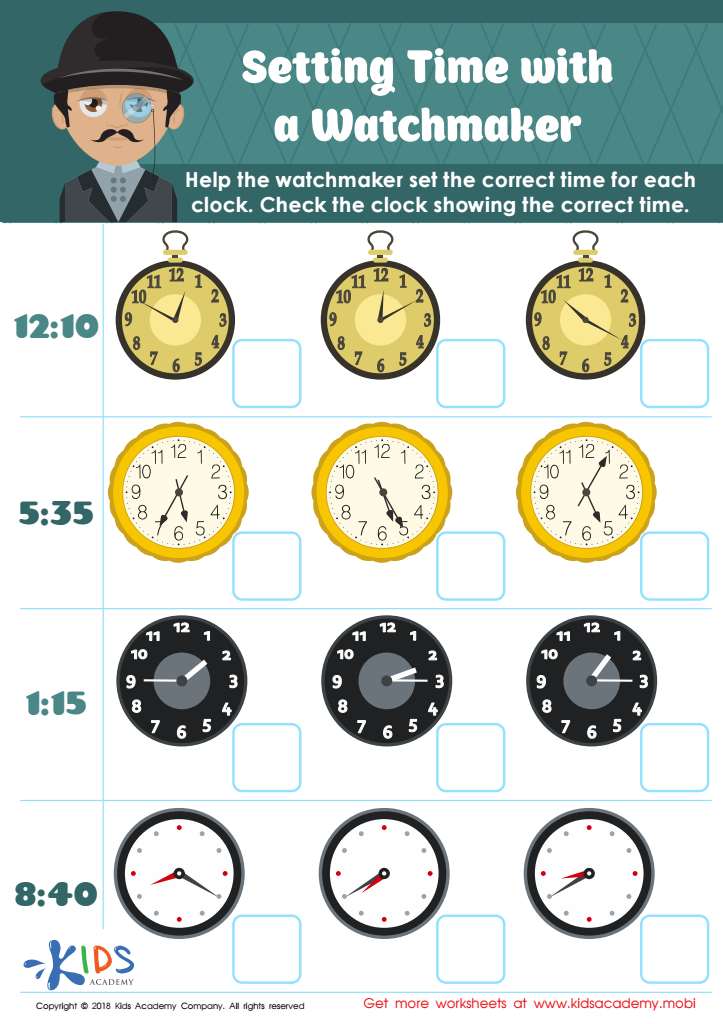
Setting Time with Watchmaker Worksheet
Can your kids tell the time? If so, this worksheet should be easy. Help them set the time for each clock: look at the time written on the left side and find the clock on the right side that matches.
Setting Time with Watchmaker Worksheet
Worksheet
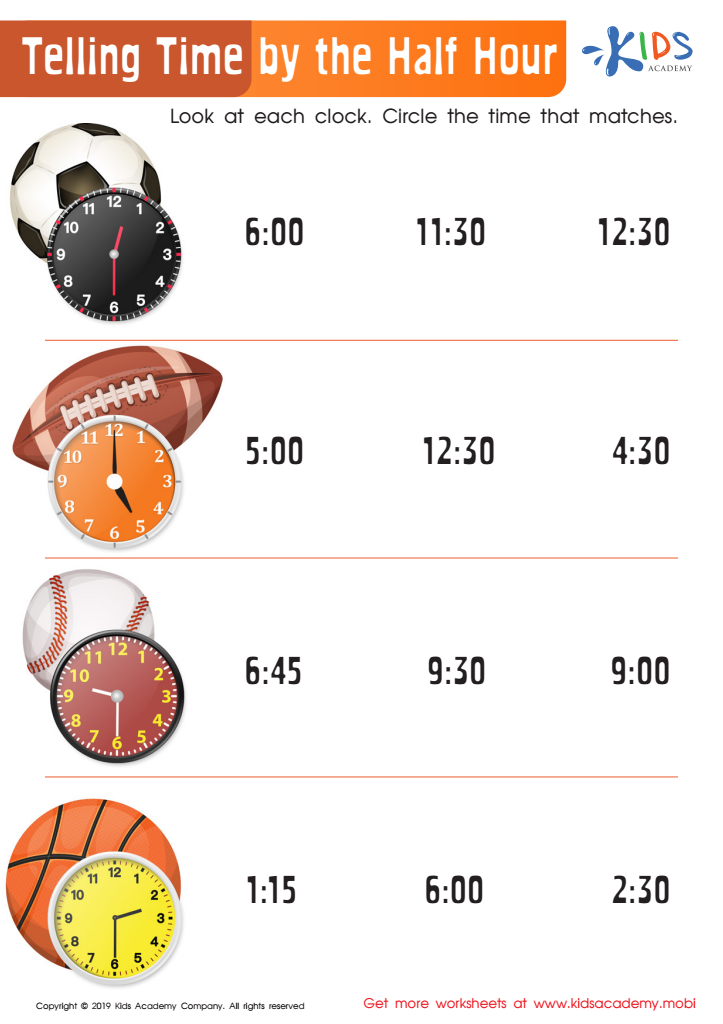
Telling Time by the Half Hour Worksheet
Teach kids to tell time with this worksheet! Four clocks are labeled with different times; help your child circle the right one. It's a great way to teach them to read analog and digital clocks, watches, and written times. Easy and fun learning!
Telling Time by the Half Hour Worksheet
Worksheet
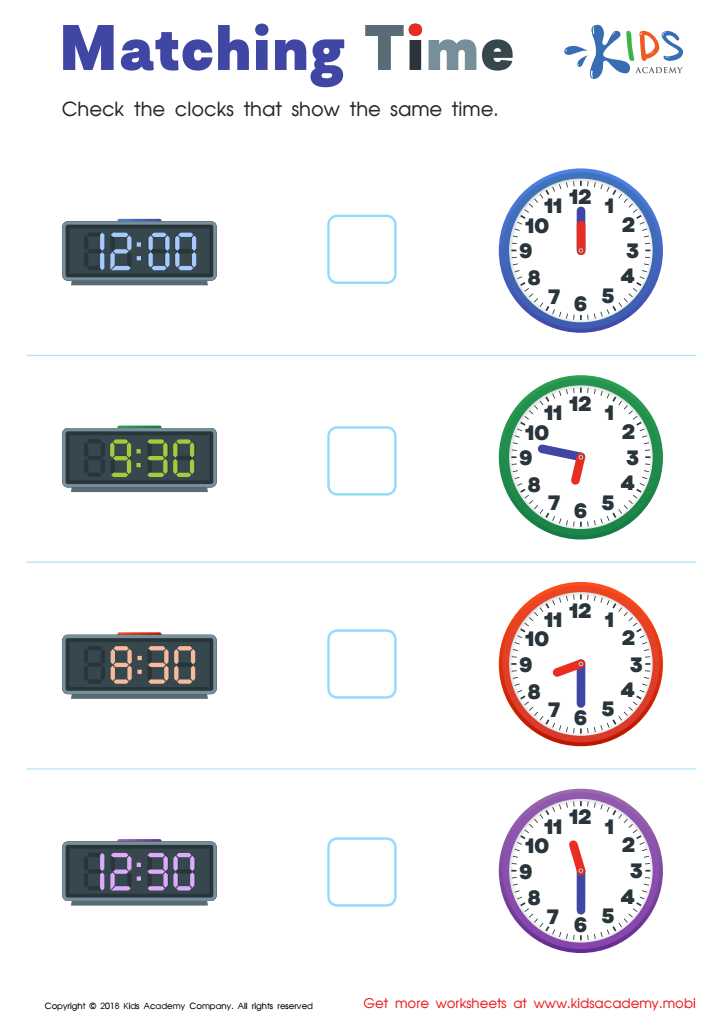
Matching Time Worksheet
Teach your child to read time in both digital and analog formats with this helpful printout. They'll identify clocks that match in both formats and check them off. Colorful and engaging, it's a great way to help your child understand the concept of time-telling.
Matching Time Worksheet
Worksheet
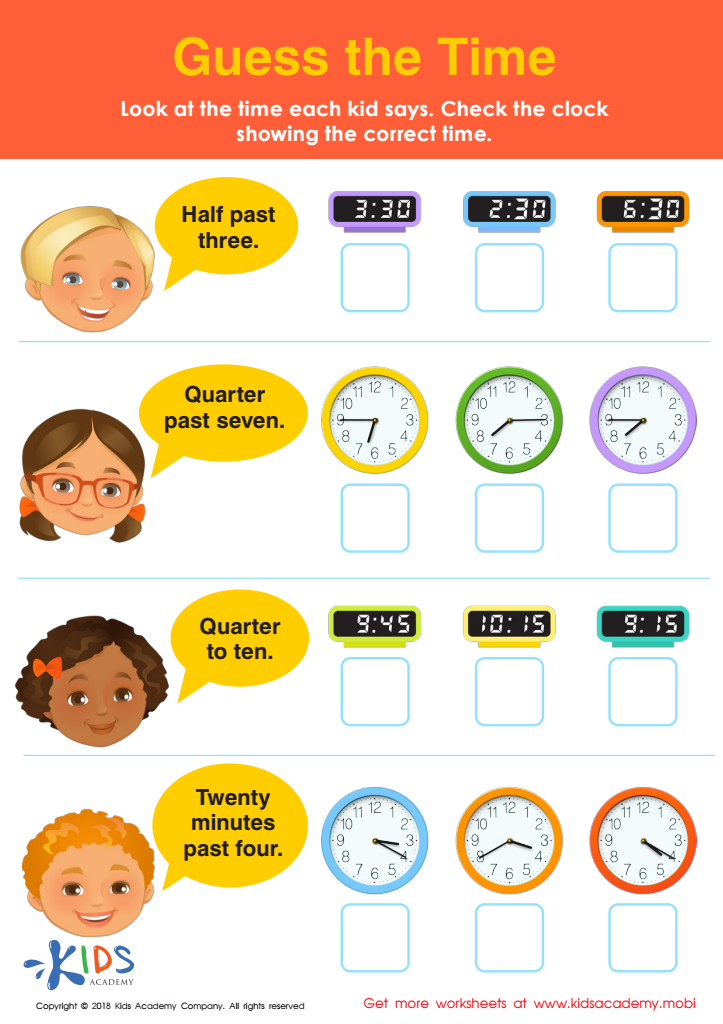
Guess the Time Worksheet
Help students tell the time accurately with this fun exercise. Read the time each person says and find the corresponding clock. Check the options on the left and have students guess the right time. This worksheet is sure to sharpen their time-telling skills.
Guess the Time Worksheet
Worksheet
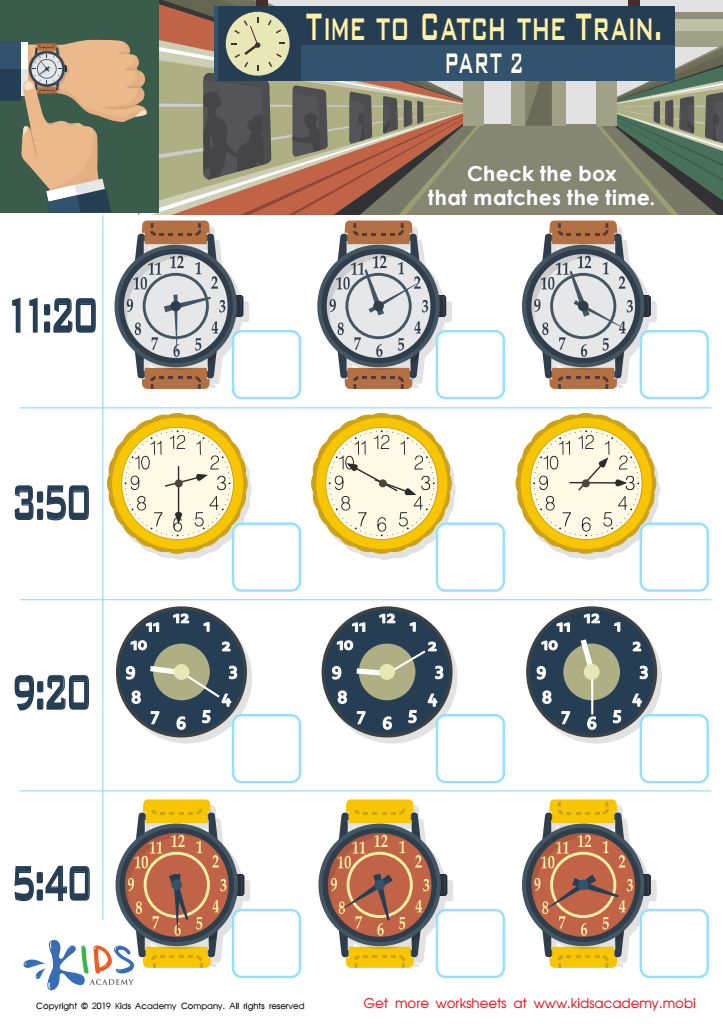
Time to Catch the Train Part 2 Worksheet
Teach your kids the importance of telling time and how to do it. Explain that there are multiple ways to show the time, such as written on the left side or watches in the picture. Guide them to check the box that matches the time. Knowing the time is essential to get things done and create order. Ensure your kids understand this and they will reap the benefits.
Time to Catch the Train Part 2 Worksheet
Worksheet
Join Kids Academy for Free
Who is primarily going to use this learning content?






Understanding time is a crucial skill for young children, as it lays the foundation for various aspects of their daily life and future academic success. For ages 3-7, grasping time concepts fosters independence and responsibility. When children learn to tell time, they can better understand routines and schedules, which teaches them the importance of task management and punctuality.
Early time recognition also encourages the development of mathematical skills. Concepts such as counting, recognizing numbers, and understanding sequences are integral parts of telling time. By learning about hours and minutes, children practice addition, subtraction, and even fractions, which are core areas in early math education.
Moreover, understanding time enhances children’s sensory perception and cognitive abilities. It helps them make connections between numbers and real-world events, aiding in the development of critical thinking and problem-solving skills.
Socially, kids with a good grasp of time are better able to participate in group activities and adhere to communal norms, fostering essential life skills like team cooperation and planning. In summary, time recognition in early childhood not only builds essential math skills but also nurtures a child’s overall development and readiness for future life’s challenges.








