Understanding Quantities Math Worksheets for Ages 3-7 - Page 3
50 filtered results
-
From - To
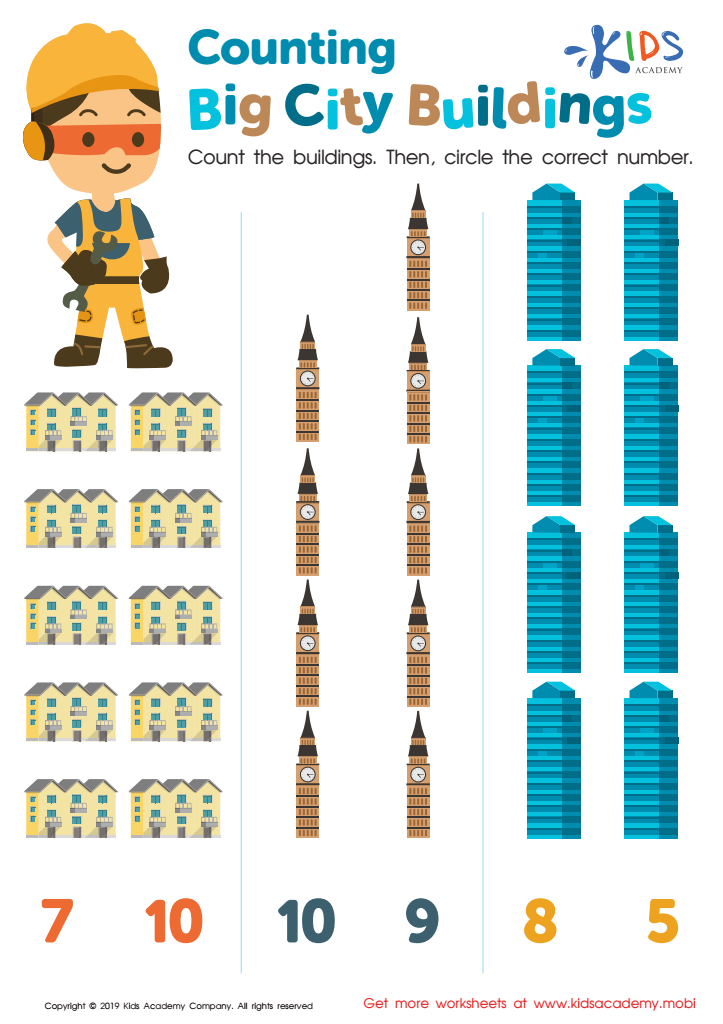
Counting Big City Buildings Worksheet
 Assign to My Students





.jpg)
.jpg)

Understanding quantities is a foundational concept in early mathematics that plays a crucial role in a child's cognitive development. For children ages 3-7, grasping the idea of quantity helps them make sense of the world around them. Recognizing and manipulating quantities underpins essential skills such as counting, addition, and subtraction, all of which are vital as they progress in their education.
Parents and teachers should care about this because early mathematics influence long-term academic success. When children have a firm grasp of quantities, they become more confident in tackling complex math problems later in life. Moreover, understanding quantities helps develop critical thinking and problem-solving abilities, equipping children with skills necessary not just for math, but also for science, engineering, and everyday situations.
Additionally, engaging with quantities can be a fun and interactive experience, fostering positive attitudes toward learning. Activities like sorting objects, counting toys, and cooking can turn learning into play, making it enjoyable. By cultivating an environment that encourages exploration of quantities, parents and teachers can instill a solid mathematical foundation, helping children become enthusiastic and competent learners. This investment in their early education not only supports academic success but also nurtures a lifelong love for learning.








