
Understanding forces Physical Science Worksheets for Ages 3-7
3 filtered results
Difficulty Level
Grade
Age
-
From - To
Subject
Activity
Standards
Explore the fascinating world of forces with our "Understanding Forces" Physical Science Worksheets, designed specifically for children ages 3-7. These engaging, interactive worksheets introduce young learners to fundamental concepts, including push and pull, gravity, friction, and more. With colorful illustrations and age-appropriate activities, children will enhance their problem-solving skills while having fun. Perfect for home or classroom use, these worksheets foster curiosity and encourage exploration of the physical world around them. Empower your little scientists to grasp the significance of forces through play and discovery. Download now and watch their understanding of physical science grow!
Favorites
With answer key
Interactive
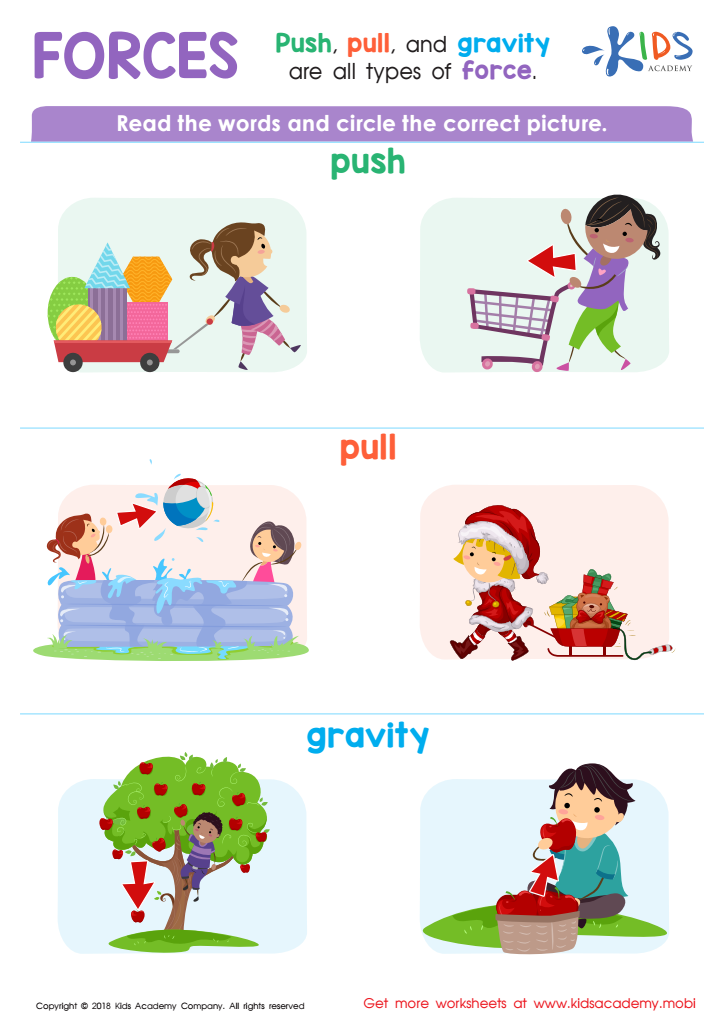
Forces Worksheet
Teach your child about forces! Ask them to identify which of six pictures shows push, pull or gravity. Read the words beside each picture and have them circle the correct one. It's a great way to learn about forces; push, pull and gravity!
 Assign to My Students
Forces Worksheet
Worksheet
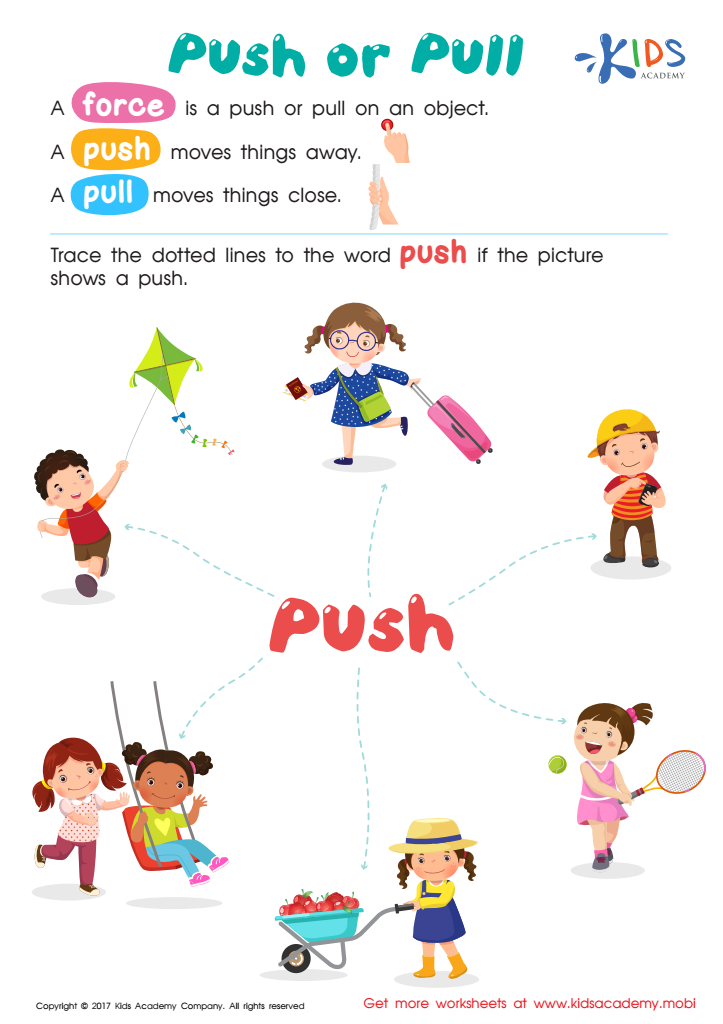
Push or Pull Worksheet
and which involve pulling! With this fun worksheet, your child will learn about force and its simple application in everyday activities. Get them started with Push or Pull! (80 words)
Push or Pull Worksheet
Worksheet
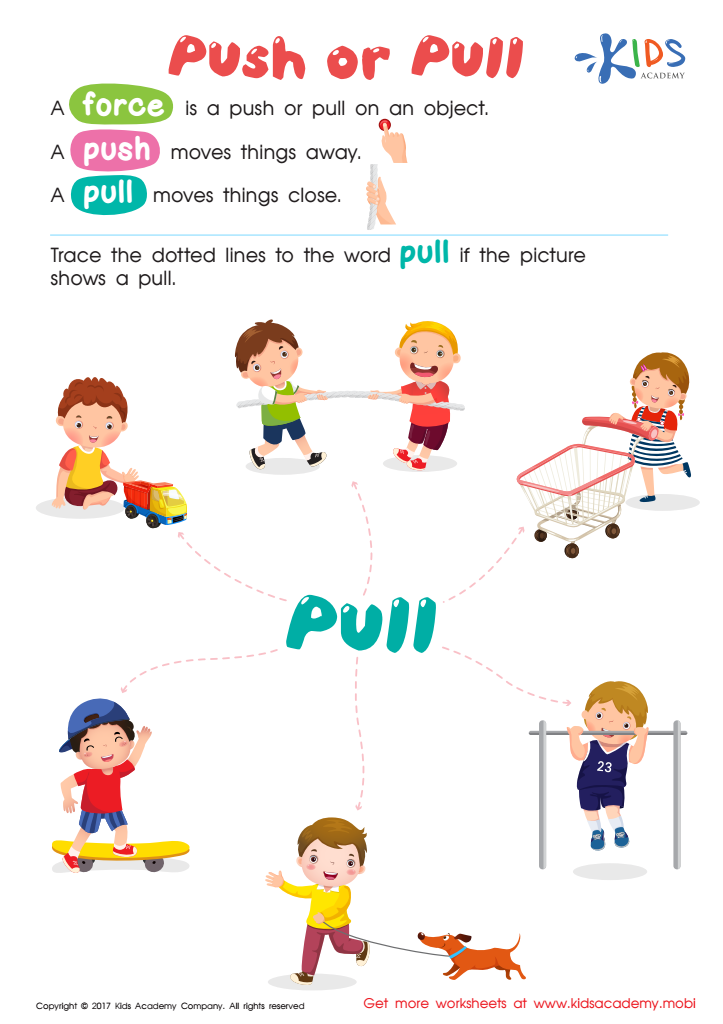
Pull or Push Worksheet
With this fun worksheet, they'll explore physics by sorting objects into categories according to their mode of motion. It's a great way to get them interested in science.
Pull or Push Worksheet
Worksheet
Join Kids Academy for Free
Who is primarily going to use this learning content?







Understanding forces is essential for children aged 3-7, as it lays the groundwork for their overall scientific literacy and critical thinking skills. At this early stage of development, children are naturally curious about the world around them. By exploring concepts related to forces—such as push, pull, gravity, friction, and magnetism—they begin to grasp how things interact and the cause-and-effect relationships present in their everyday lives.
Parents and teachers should care about introducing forces in a fun and engaging manner because it not only nurtures curiosity but also encourages hands-on learning. Activities like playing with toys that move, experimenting with rolling objects, or observing real-life examples can make abstract concepts tangible. Such experiences promote problem-solving abilities and instill a foundational understanding of science that is crucial in an increasingly STEM-focused world.
Moreover, fostering a love of science early on can have lasting implications for children’s academic trajectories. Understanding the principles of forces helps them make sense of more complex scientific phenomena later in life and prepares them for future educational challenges. Ultimately, teaching young children about forces can spark their interest and lay the groundwork for lifelong learning and exploration in the fields of physics and beyond.







