
Understand number sequencing Worksheets for Ages 3-8
3 filtered results
Difficulty Level
Grade
Age
-
From - To
Subject
Activity
Standards
Welcome to our "Understand Number Sequencing Worksheets" for children aged 3-8! These engaging worksheets are designed to help young learners grasp the concept of number sequences through fun activities that promote logical thinking and mathematical skills. Your child will enjoy sorting numbers, filling in missing patterns, and completing sequential puzzles, fostering their understanding of numerical order while building essential counting skills. Perfect for both classroom and home use, these worksheets align with early childhood education standards and encourage independent thinking. Download our user-friendly printables today and watch your child gain confidence in their number sequencing abilities!
Favorites
With answer key
Interactive
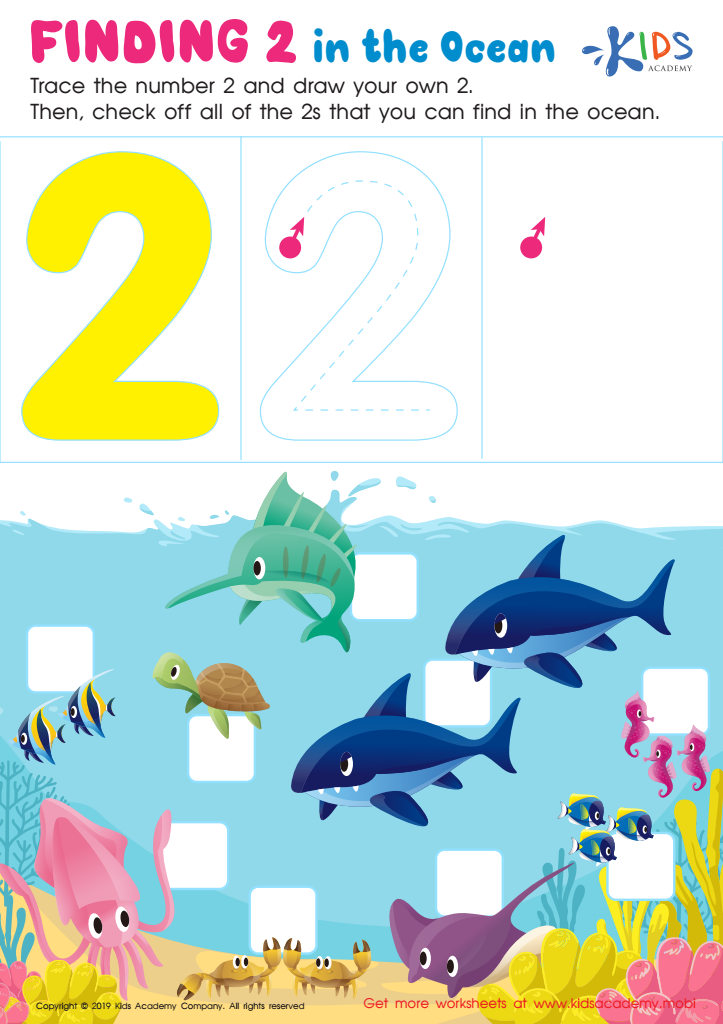
Finding 2: In the Ocean Worksheet
Kids start their math journey with basic numbers. Finger counting, number representation with pictures and this worksheet help build number sense. Kids trace lines and dots to write the number two and identify groups of two sea creatures for easy success and to feel proud of their math skills.
 Assign to My Students
Finding 2: In the Ocean Worksheet
Worksheet
Join Kids Academy for Free
Who is primarily going to use this learning content?






Understanding number sequencing is crucial for children aged 3-8 as it forms the foundation for their mathematical development and problem-solving skills. For parents and teachers, nurturing this understanding can have a lasting impact on a child's academic journey. During these formative years, children learn to recognize patterns, develop logical thinking, and enhance their ability to perform basic operations such as addition and subtraction.
Number sequencing helps children make sense of the world around them. It enables them to understand concepts like order, quantity, and time, all of which are essential for daily activities like telling time and managing money. As children progress in their understanding of numbers, they also become capable of tackling more complex math challenges in later grades, such as multiplication and division.
Additionally, mastery of sequencing can significantly boost a child's confidence. When children feel confident in their number skills, they're more likely to engage actively in learning and explore math-related concepts with enthusiasm. Engaging parents and teachers in this process ensures consistent support and reinforcement, paving the way for stronger math skills and a more positive attitude toward learning. Encouraging number sequencing in early childhood ultimately prepares children for lifelong success in mathematics and critical thinking.








