Subtraction Worksheets for Ages 3-8 - Page 5
97 filtered results
-
From - To
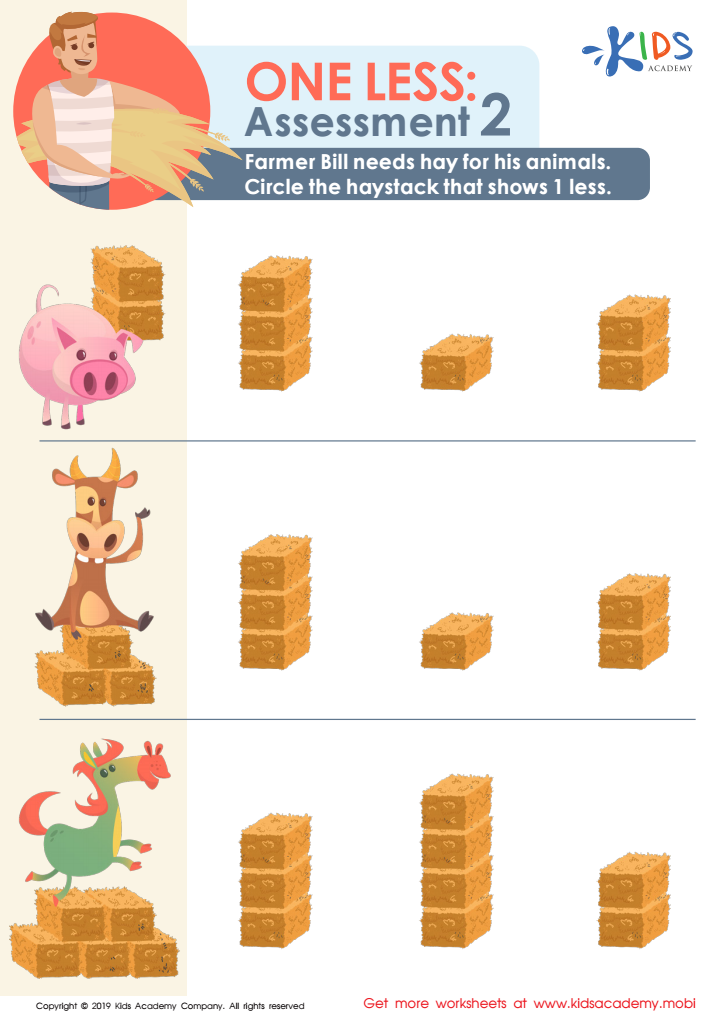
One Less: Assessment 2 Worksheet
 Assign to My Students








Subtraction is a fundamental mathematical operation that plays a crucial role in a child's early cognitive development, making it essential for parents and teachers to prioritize its understanding for ages 3-8. At this developmental stage, children begin to grasp essential concepts of numbers and quantities, laying the groundwork for more complex mathematics.
Understanding subtraction helps children develop critical thinking skills, as they learn to analyze situations, make comparisons, and understand the idea of 'taking away.' This operation also enhances their problem-solving abilities and prepares them for real-life scenarios, such as sharing items or evaluating how many toys remain after some are given away.
Moreover, teaching subtraction fosters a sense of accomplishment and boosts confidence, crucial for motivation in learning. When parents and teachers utilize engaging methods, such as games or interactive activities, it not only makes learning fun but also improves retention.
Encouraging early mastery of subtraction builds a strong mathematical foundation, ensuring children are well-equipped for future academic success. As math skills develop, children will find science, technology, engineering, and math (STEM) concepts more accessible, transforming their learning experiences and broadening their horizons. Ultimately, investing in subtraction skills is investing in a child’s future capabilities and confidence in learning.








