
Math problem-solving Reading Worksheets for Ages 3-8
7 filtered results
Difficulty Level
Grade
Age
-
From - To
Subject
Activity
Standards
Discover engaging Math Problem-Solving Reading Worksheets designed for children ages 3-8! Our worksheets combine essential reading skills with fun math challenges, encouraging young learners to develop critical thinking and problem-solving abilities. Through interactive stories and relatable scenarios, kids will enhance their comprehension while tackling age-appropriate math questions. Each worksheet is thoughtfully crafted to cater to different learning stages, making math accessible and enjoyable for all. Incorporate these versatile resources into your teaching toolkit to foster a love for learning in your classroom. Transform math and reading into an exciting adventure, equipping the next generation with the skills they need for success!
Favorites
With answer key
Interactive
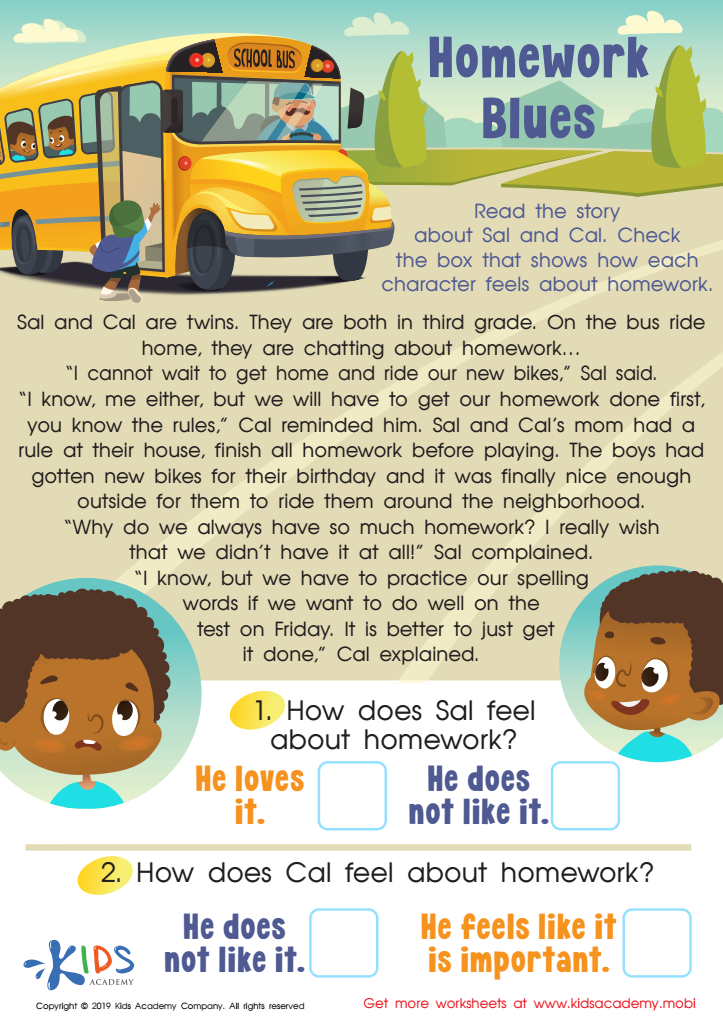
Homework Blues Worksheet
Cal and Sal don't love doing homework, just like your kids. Use this worksheet to help your children understand why homework is important. Read the passage together and then answer the questions at the bottom of the page. It's a fun way to learn together!
 Assign to My Students
Homework Blues Worksheet
Worksheet
Join Kids Academy for Free
Who is primarily going to use this learning content?







Math problem-solving skills are fundamental for children aged 3-8, as they form the foundation for critical thinking and cognitive development. During these early years, children are naturally curious and equipped to explore mathematical concepts through play and everyday experiences. Engaging in math problem-solving helps foster their ability to analyze situations, make decisions, and approach challenges analytically.
Support from parents and teachers in enhancing math literacy enables children to develop a positive attitude towards mathematics, reducing anxiety and reinforcing confidence in their abilities. Problem-solving encourages perseverance, as young learners learn to strategize, try different approaches, and understand that mistakes are part of the learning process.
Moreover, math is interconnected with various subjects, generating a holistic understanding of the world. By nurturing problem-solving skills, educators and families are equipping children with essential life skills such as reasoning, pattern recognition, and critical analysis.
Additionally, encouraging collaborative problem-solving, whether through group activities or family-oriented games, enables children to communicate effectively, share their thought processes, and learn from one another—key social skills for their future. In essence, prioritizing math problem-solving in early education enriches children’s overall development, setting the stage for academic and personal success.








