Map reading skills Our Planet and Environment Worksheets for Ages 3-8
1 filtered results
-
From - To
Enhance your child's understanding of the planet and environment with our engaging "Map Reading Skills" worksheets, designed for ages 3-8. These interactive resources help young learners develop essential map literacy skills, encouraging them to explore geographical concepts such as directions, landmarks, and symbols. Packed with fun activities, our worksheets foster critical thinking, spatial awareness, and a love for exploration. As children navigate through colorful maps, they will build a solid foundation for future learning. Perfect for at-home practice or in the classroom, these worksheets create an exciting learning experience that nurtures curiosity about the world around them.
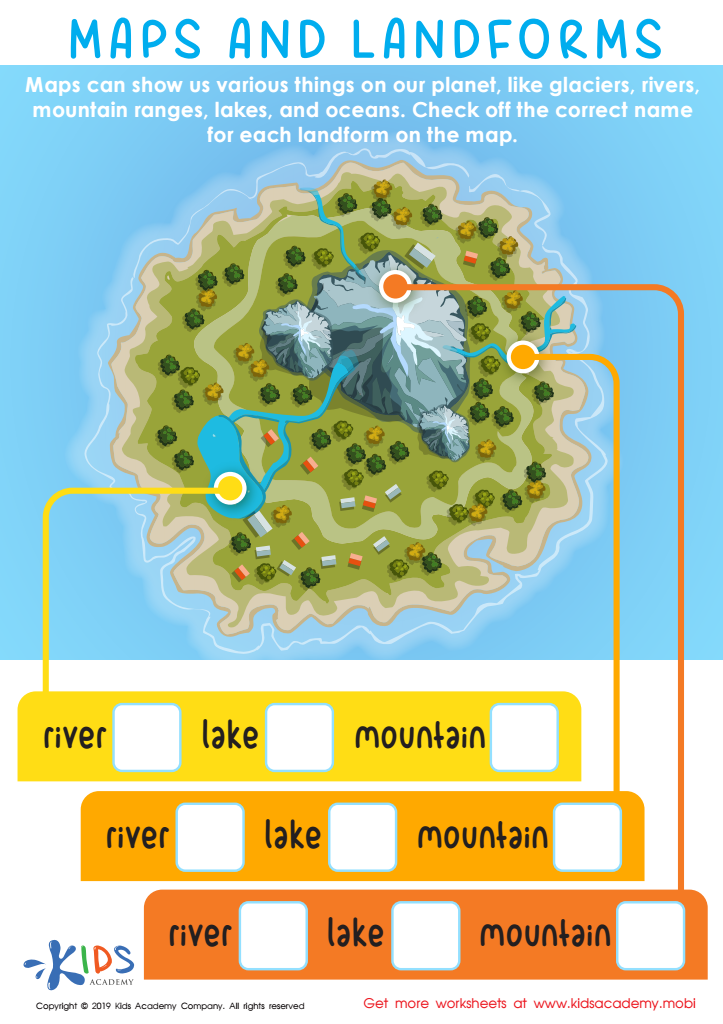
Maps and Landforms Worksheet
 Assign to My Students





Map reading skills are vital for young children, as they serve as a gateway to understanding our planet and environment. For ages 3-8, developing these skills can foster a sense of curiosity about the world around them. Learning to read maps enables children to visualize spatial relationships, recognize their surroundings, and learn important concepts such as direction, distance, and symbols. This foundational knowledge encourages exploration, whether in their neighborhoods or while studying global environments.
Parents and teachers should prioritize map reading because it promotes critical thinking and problem-solving. By interpreting maps, children develop cognitive skills that are essential for later learning in geography and science, enhancing their understanding of ecological issues and the importance of conservation. Familiarity with maps also empowers children to engage with their communities, fostering a sense of belonging and responsibility towards the environment.
Furthermore, incorporating map reading into learning allows for interactive and playful educational experiences, making lessons more engaging. By nurturing these skills early on, caregivers can instill a lifelong appreciation for the world, paving the way for informed, environmentally conscious individuals. In essence, map reading is not just about navigation; it's about nurturing informed, ecosystem-aware citizens from a young age.







