
Comparing object weights Worksheets for Ages 3-9
3 filtered results
Difficulty Level
Grade
Age
-
From - To
Subject
Activity
Standards
Explore our engaging Comparing Object Weights Worksheets for kids aged 3-9 at Kids Academy! These printable worksheets help young learners develop essential skills in comparing and contrasting, critical thinking, and basic math and science concepts. Through fun and interactive activities, children will measure and compare the weights of different objects, enhancing their understanding of heavy versus light. Perfect for home or classroom use, our worksheets support a hands-on learning approach to foster curiosity and foundational knowledge in early education. Visit Kids Academy today to discover a variety of worksheets tailored to streamline learning and make education enjoyable!
Favorites
With answer key
Interactive
 Assign to My Students
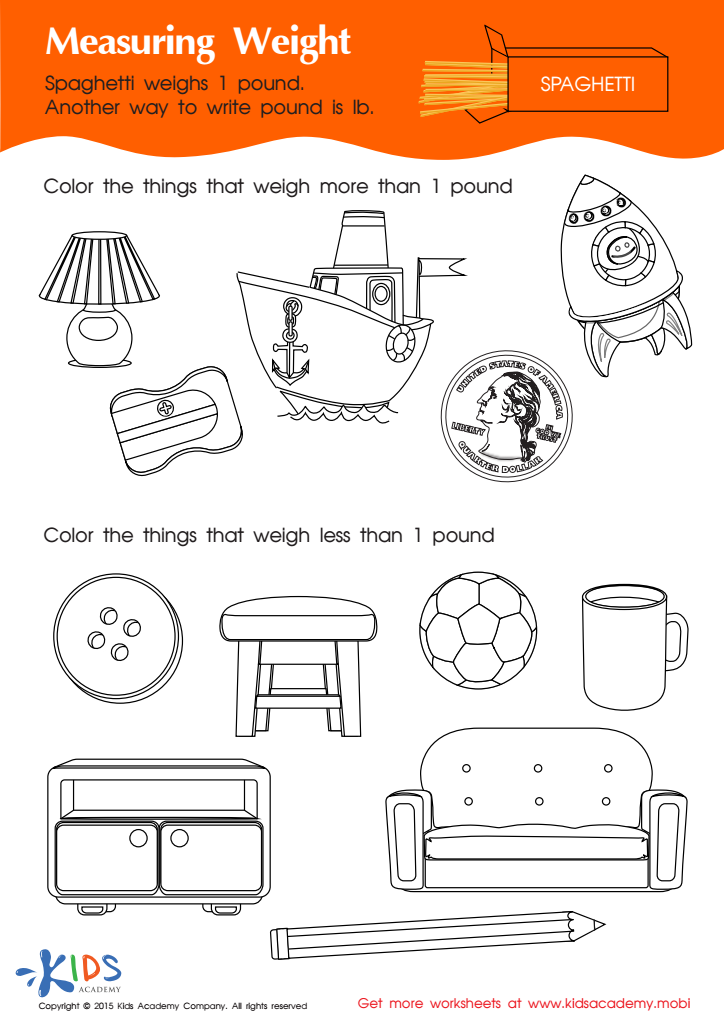
Measurement: Measuring Weight in Pounds 1 Worksheet
Worksheet
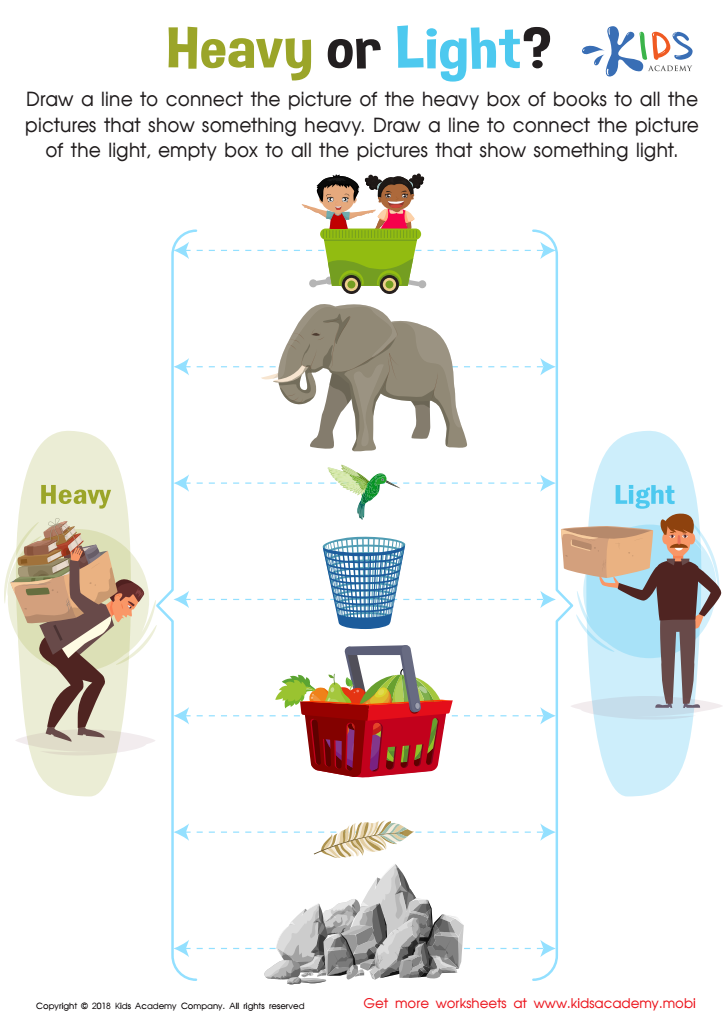
Heavy or Light? Worksheet
Kids can struggle to understand weight comparison, as size and mass matter. This free PDF helps develop fine-motor and hand-eye skills as kids trace lines to match pictures. The familiar pictures create concrete representations, ideal for learning more complex concepts.
Heavy or Light? Worksheet
Worksheet
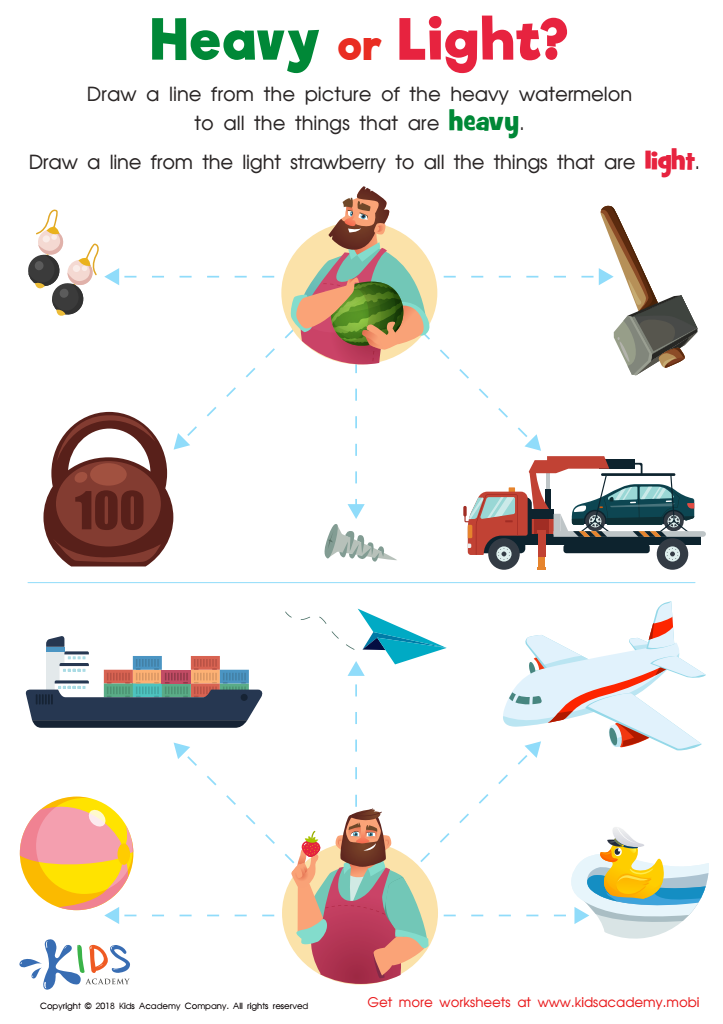
Heavy or Light? Worksheet
This fun, free worksheet helps kids build measurement skills and reinforce concepts of 'heavy' and 'light', while also improving their fine motor skills. Kids use traceable lines to connect the gentleman to objects they know, giving them a strong foundation for understanding weight.
Heavy or Light? Worksheet
Worksheet
Join Kids Academy for Free
Who is primarily going to use this learning content?




.jpg)
.jpg)
Learning to compare object weights is a fundamental concept that plays a crucial role in the cognitive and sensory-motor development of children aged 3-9. For parents and teachers, fostering this skill is essential for several reasons.
Firstly, comparing object weights strengthens essential math skills such as measurement and estimation. These foundational abilities are integral for more complex mathematical concepts children will encounter later in their education. Moreover, by physically handling objects of different weights, children develop their fine motor skills and gain a better understanding of the physical properties of diverse materials.
Secondly, engaging children in weight comparison activities nurtures their problem-solving abilities and critical thinking. For instance, when asked whether a toy car is heavier than a plastic dinosaur, children are encouraged to make predictions, conduct experiments (e.g., lifting or using a balance scale), observe outcomes, and draw conclusions.
Furthermore, these activities lay the groundwork for scientific inquiry. Understanding weight invites curiosity about why objects differ in heaviness, potentially leading to discussions about material density, volume, and composition. This natural inquisitiveness can ignite a lifelong interest in science and technology.
In essence, by focusing on comparing object weights, parents and teachers support a child's holistic development—enhancing academic skills, promoting motor coordination, and cultivating curiosity—all vital for future learning experiences and everyday problem-solving.








