
Grammar skills Worksheets for Ages 3-9
7 filtered results
Difficulty Level
Grade
Age
-
From - To
Subject
Activity
Standards
Discover engaging and educational Grammar Skills Worksheets for ages 3-9 at Kids Academy. Our printable worksheets are designed to make learning grammar fun and effective for young learners. From basic sentence structure to more complex grammatical rules, our resources cover a wide range of topics to enhance your child's language skills. Each worksheet is crafted by educational experts, ensuring clear instructions and age-appropriate content. Perfect for both classroom use and home learning, these worksheets help children build a solid grammatical foundation, improve their writing, and boost their communication skills in an interactive way. Visit us now to explore our complete collection!
Favorites
With answer key
Interactive
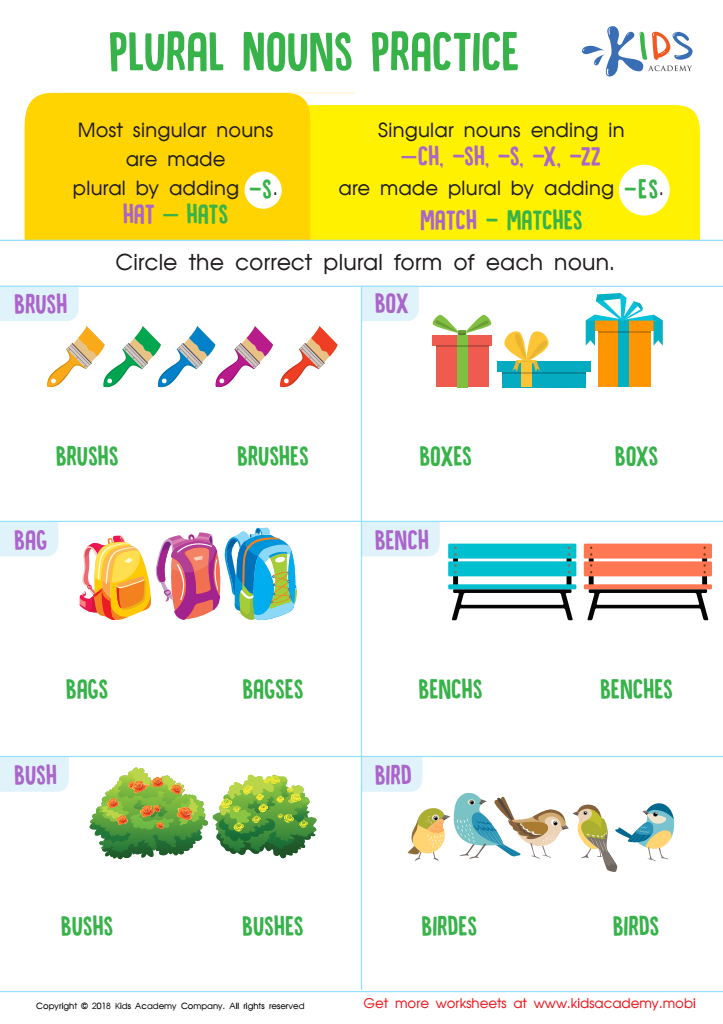
Plural Nouns Practice Worksheet
Explain to your child that most singular nouns become plural by adding "-s". E.g. "cat"->"cats". For words ending in "-ch", "-sh", "-s", "-x", or "-zz", add "-es". E.g. "buzz"->"buzzes". Then, get them to circle the right plural form of each noun on the worksheet.
 Assign to My Students
Plural Nouns Practice Worksheet
Worksheet
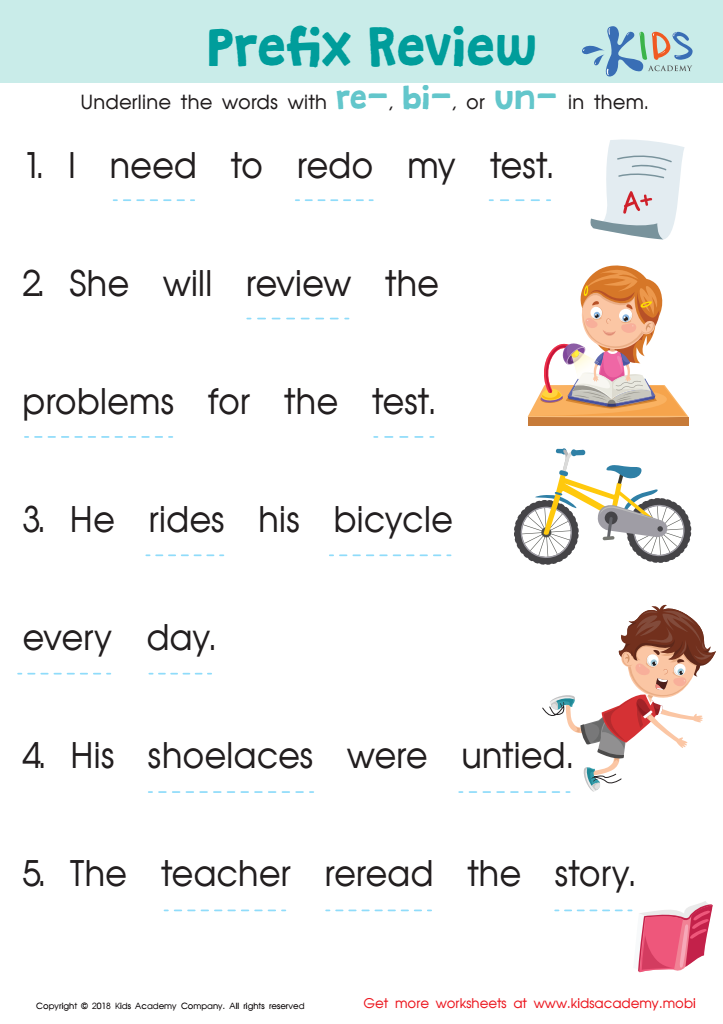
Prefix Review Worksheet
Learning prefixes is key for effective communication. Help your child master re-, bi-, and un- with a Kids Academy worksheet. Ask them to go through each sentence, underlining words with one of the prefixes. This will help them appreciate how prefixes alter the meaning of a root word.
Prefix Review Worksheet
Worksheet
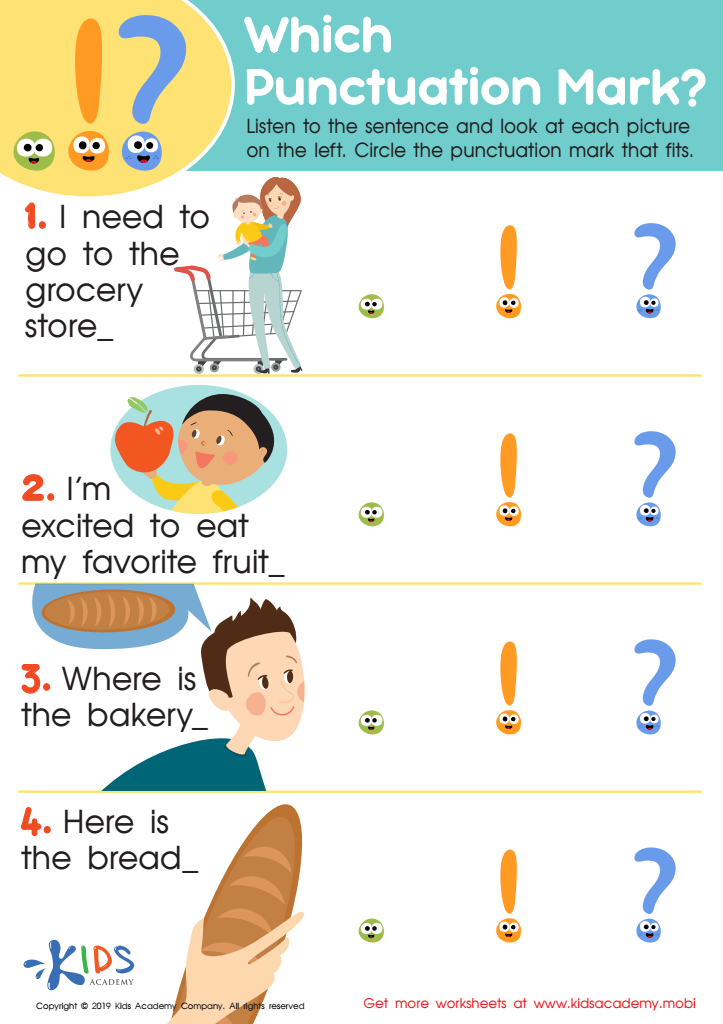
Which Punctuation Mark Worksheet
Punctuation marks are essential for expressing what we say. This worksheet asks your kindergarten student to circle the correct punctuation mark for each sentence. Read each sentence aloud and help them identify the expression needed. A picture accompanies each sentence. Enjoy! (79 words)
Which Punctuation Mark Worksheet
Worksheet
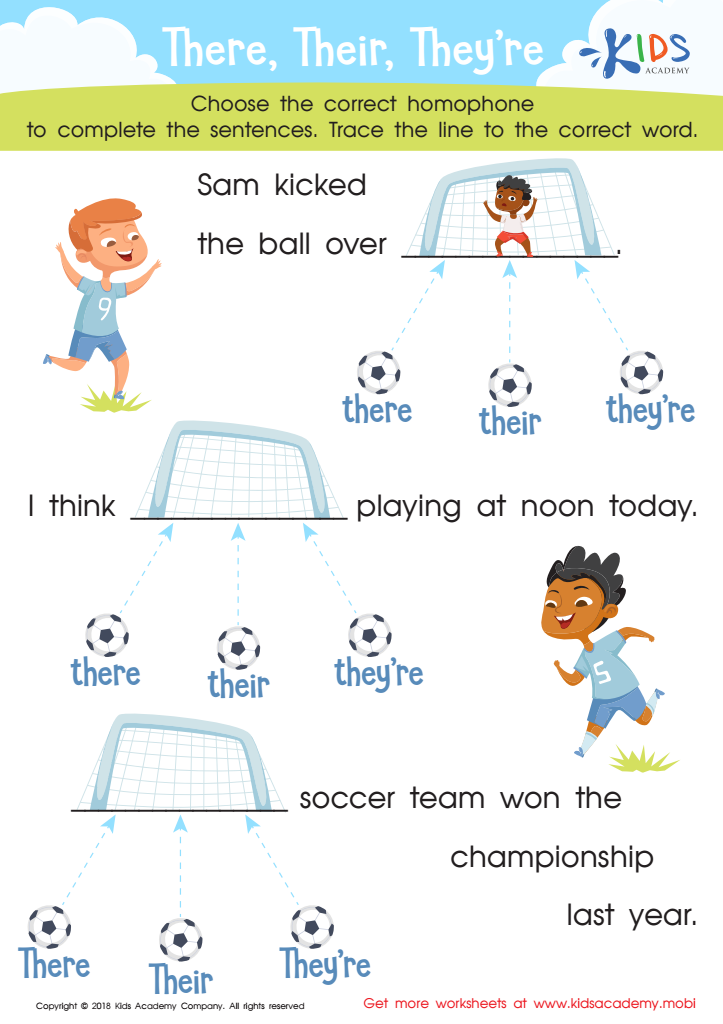
There, Their, They're Worksheet
Explain to your kids the difference between 'there', 'their' and 'they're'. These three words are homophones - spelt similarly but with different meanings. Help them choose the correct homophones when completing sentences, and trace the line to the right word.
There, Their, They're Worksheet
Worksheet
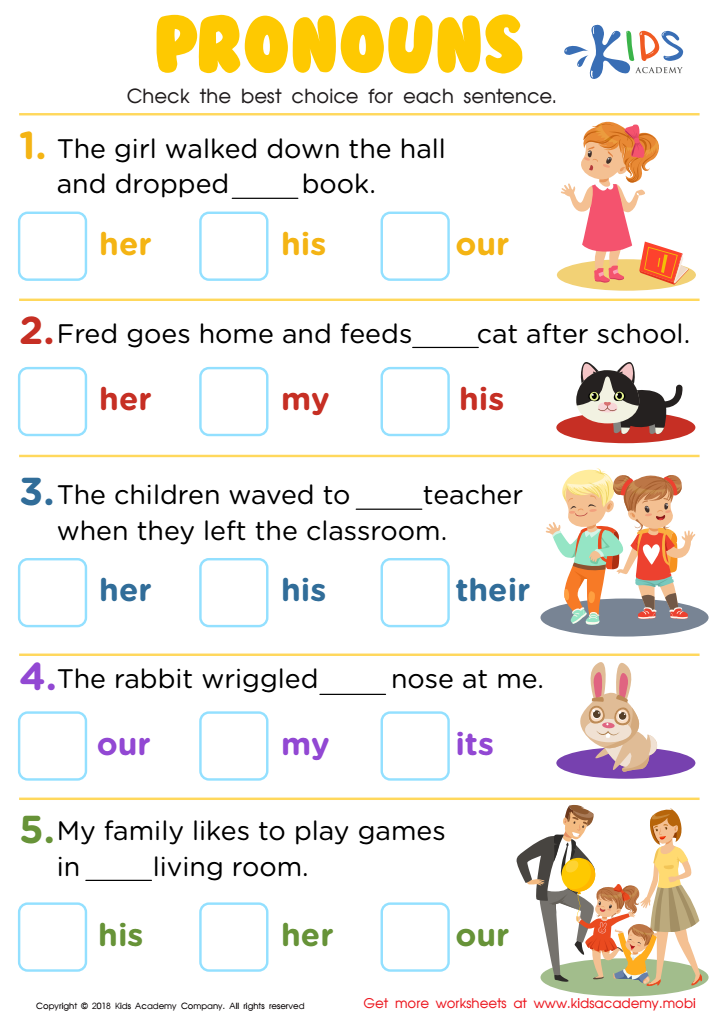
Pronouns Worksheet
Help your child explore pronouns with this worksheet: start by asking them which pronouns they know. Then, read the sentences and their options aloud together, and ask your child to choose the best pronoun for each sentence. This worksheet should be easy for them if they can already read short sentences.
Pronouns Worksheet
Worksheet
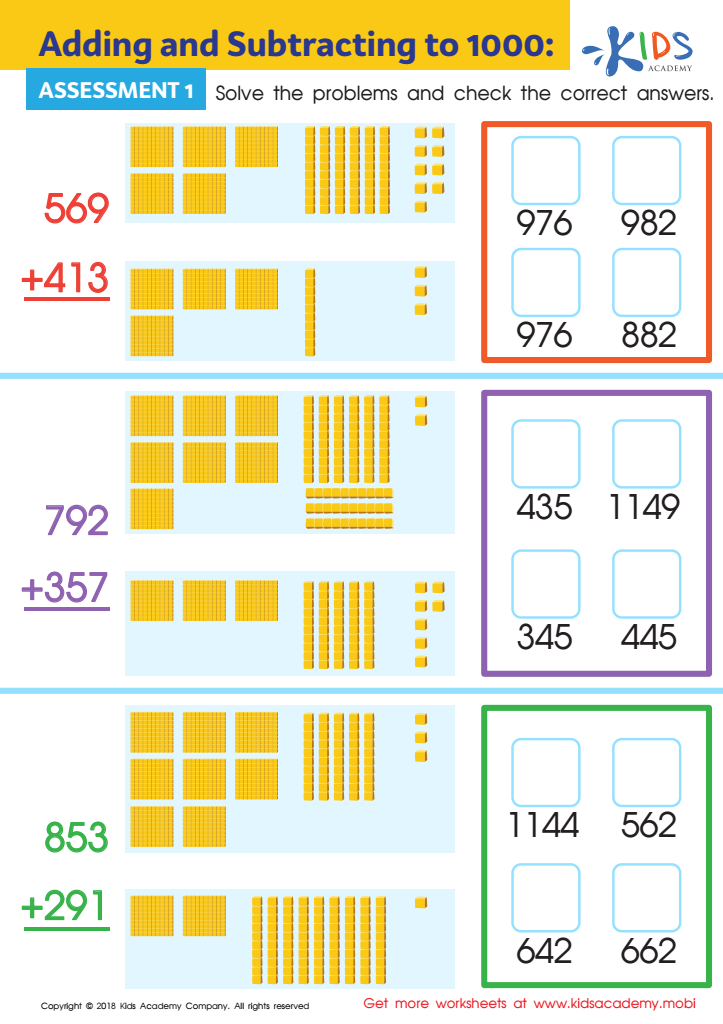
Adding and Subtracting to 1 Worksheet: Assessment 1
This assessment worksheet tests your child's addition skills. It has 3 3-digit problems with base ten blocks for visual aid. Encourage learners to use these visuals for better understanding. When they have solved the problems, they can check the box with the right answer. It's a quick and easy way to gauge numeracy development.
Adding and Subtracting to 1 Worksheet: Assessment 1
Worksheet
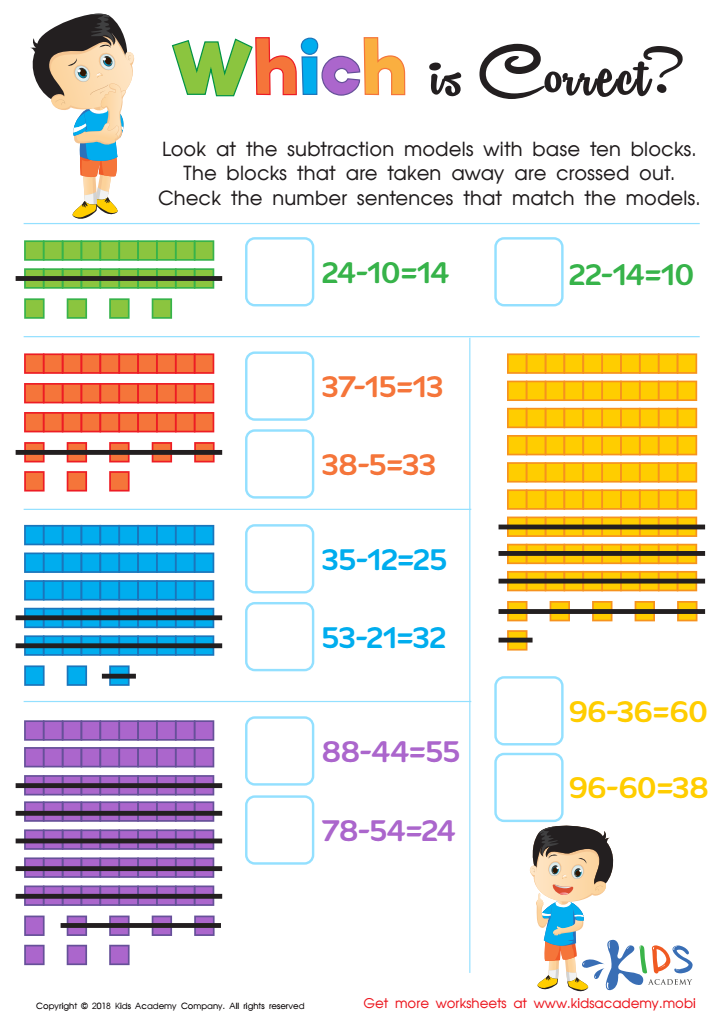
Which Is Correct? Math Worksheet
Young mathematicians will gain confidence solving subtraction problems with this bright, colorful worksheet. They'll use base ten blocks representations, then pick the right number sentence to match. It's great practice for developing number sense, helping them excel in higher-level math.
Which Is Correct? Math Worksheet
Worksheet
Join Kids Academy for Free
Who is primarily going to use this learning content?







Grammar skills are crucial for children aged 3-9 because they form the foundation for effective communication. During these formative years, children's brains are highly receptive to language acquisition, and proper grammar helps them convey their thoughts clearly and accurately. Mastering grammar enables children to structure sentences coherently, which boosts both their spoken and written communication.
For parents and teachers, fostering good grammar skills early on also aids in academic performance. Proficient grammar helps children understand and complete school assignments, participate in discussions, and comprehend reading materials more effectively. This solid foundation in language arts can translate into better grades and a more positive attitude towards learning.
Moreover, strong grammar skills enhance social development. As children learn to express themselves clearly, they build confidence in social interactions, form stronger relationships, and develop better listening skills. This can be particularly beneficial in collaborative classroom settings where effective communication fosters teamwork and mutual understanding.
Lastly, early grammar proficiency sets the stage for lifelong learning and professional success. Good grammar is a transferable skill that is valued in almost all career paths. Investing in grammar education during the early years, therefore, equates to investing in a child's future, ensuring they have the tools they need to succeed both academically and socially.








