Comparing Fractions Reading Worksheets for Ages 3-9
37 filtered results
-
From - To
Discover our engaging Comparing Fractions Reading Worksheets designed for children ages 3-9. These fun and educational resources help young learners grasp the concept of fractions through colorful visuals and interactive exercises. Each worksheet simplifies complex ideas, making it easy for kids to compare and understand fractions. Our materials support key learning skills, ensuring a strong mathematical foundation. Perfect for parents and educators, these worksheets provide step-by-step guidance to make learning fractions enjoyable and accessible. Enhance your child's reading and math abilities today with our expertly crafted Comparing Fractions Reading Worksheets from Kids Academy.
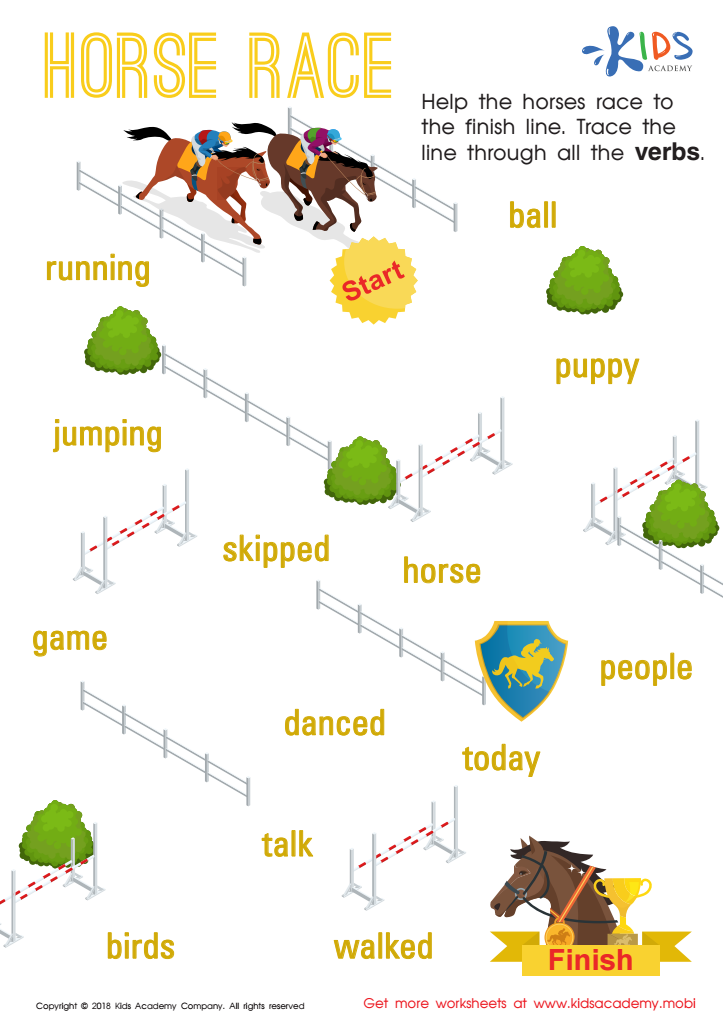
Horse Race Worksheet
 Assign to My Students







"Comparing Fractions Reading" for ages 3-9 plays a crucial role in early childhood education, and parents and teachers should value this foundation for several compelling reasons:
Firstly, it nurtures mathematical thinking. Introducing young children to comparing fractions helps cultivate a robust mathematical foundation by fostering an understanding of how numbers work in relation to each other. This foundation is critical as they progress to more complex math concepts in later grades.
Secondly, it aligns with cognitive development. During these formative years, children's brains are exceptionally receptive to new skills. Comparing fractions requires recognizing numerical patterns, visualizing parts of a whole, and understanding equivalence—all of which enhance cognitive abilities like reasoning and problem-solving.
Additionally, it promotes critical thinking and decision-making. When children compare fractions, they use logical thinking to determine which is larger or smaller and why. This practice encourages them to think analytically and make sound judgments based on evidence.
Fraction comparison also improves readiness for real-world applications. Concepts like dividing a pizza, sharing treats, or comparing time intervals are tied to fractions. Understanding them early helps children relate classroom learning to their everyday experiences.
Lastly, fostering a positive math attitude is vital. Early exposure to fraction comparison can build confidence and reduce math anxiety. By presenting math as fun and accessible, educators and parents can instill a lifelong love for learning, setting children on a path toward academic and personal success.








