
Understanding measurements Math Worksheets for 3-Year-Olds
3 filtered results
Difficulty Level
Grade
Age
-
From - To
Subject
Activity
Standards
Our "Understanding Measurements Math Worksheets for 3-Year-Olds" help introduce young learners to basic measurement concepts through fun, engaging activities. Designed specifically for toddlers, these worksheets focus on foundational skills like comparing lengths, identifying sizes, and recognizing patterns. Each activity employs vivid illustrations and simple exercises to ignite curiosity and build early math confidence. Perfect for home or classroom use, these resources foster critical thinking and problem-solving abilities right from the start. Support your little one's mathematical journey with our thoughtfully crafted worksheets, ensuring a solid understanding of measurements in a playful, age-appropriate manner!
Favorites
With answer key
Interactive
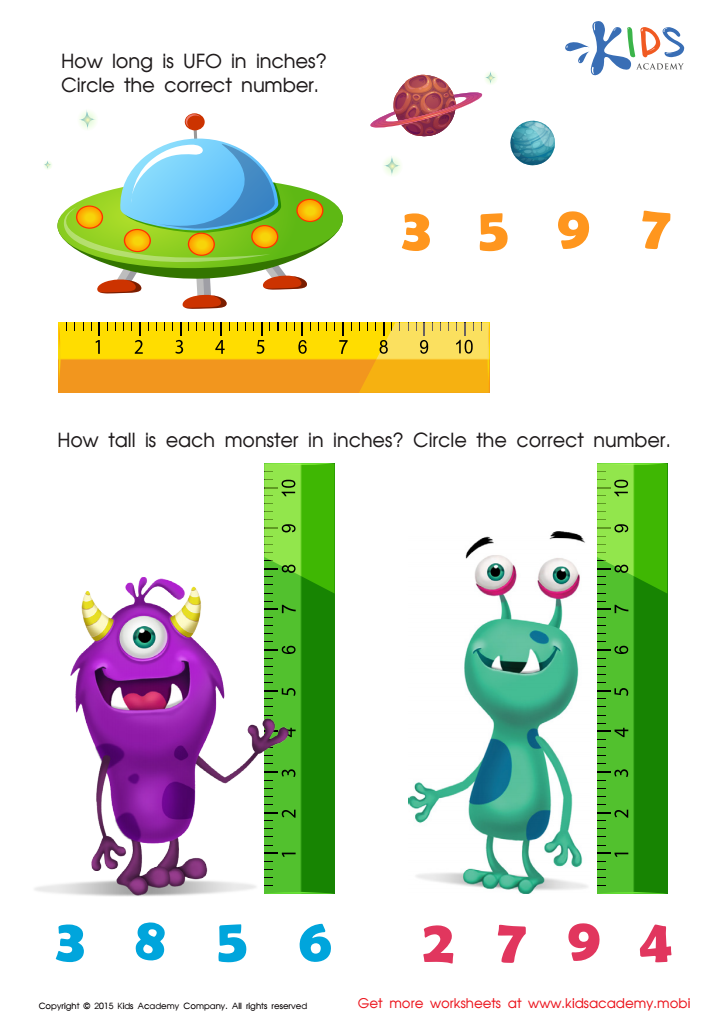
Measuring in Inches Worksheet
Look at the picture, can you measure the UFO & monsters? Write down how long each is. Which is tallest? Circle it. Get more free printable math worksheets for kindergarten at our website.
 Assign to My Students
Measuring in Inches Worksheet
Worksheet
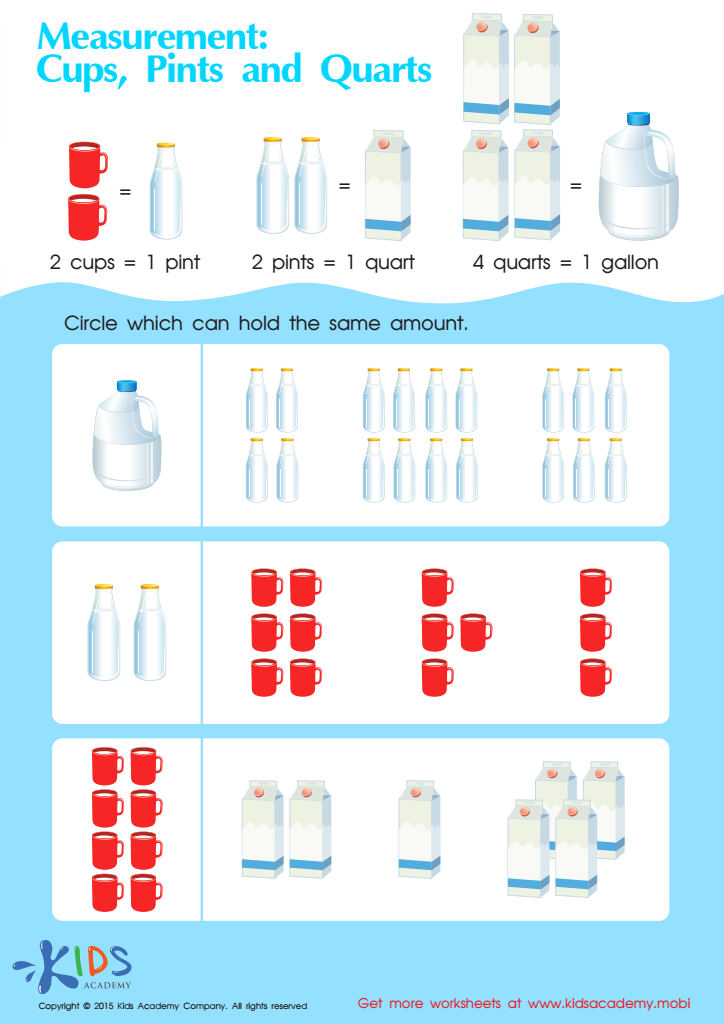
Cups, Pints and Quarts 2 Worksheet
Practice measuring liquids with our free math worksheets. Learn how many cups are in a quart and how many quarts are in a gallon. Accurately calculate the answers and write them in the provided spaces. Visit Kids Academy for a collection of free worksheets and make math fun!
Cups, Pints and Quarts 2 Worksheet
Worksheet
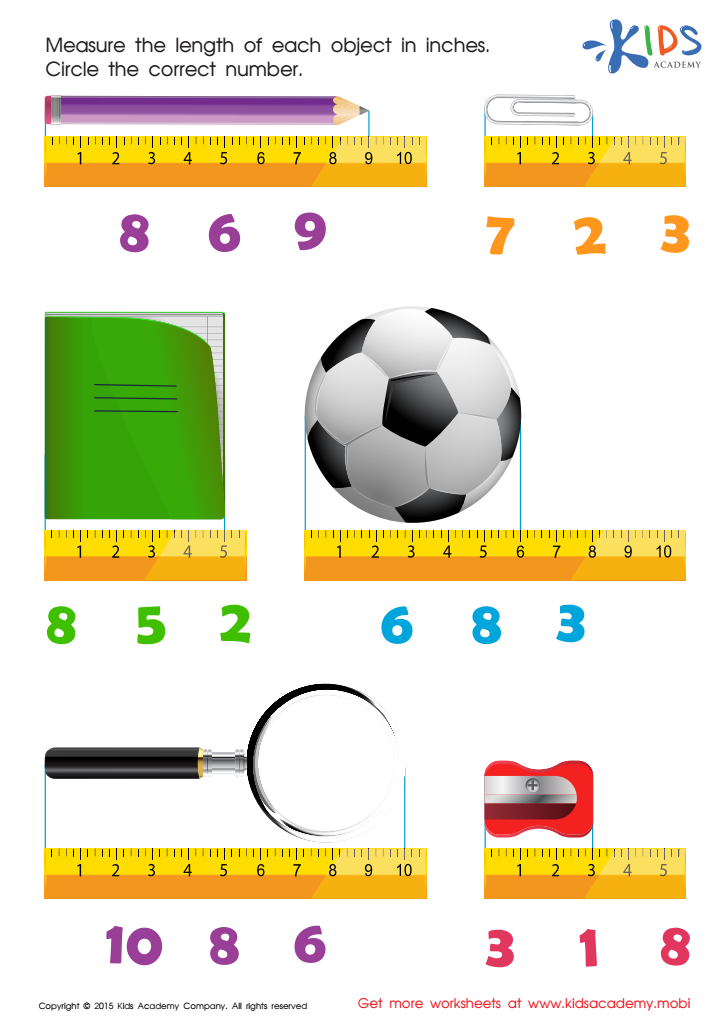
Learning measuring objects in inches Worksheet
Help your little learners gain confidence in using a ruler! Print out our free worksheet, cut out the inch ruler, and let them measure and record objects' width and length. Kids Academy has a variety of math worksheets to make learning math fun! Check out our website for more free printables!
Learning measuring objects in inches Worksheet
Worksheet
Join Kids Academy for Free
Who is primarily going to use this learning content?





Understanding measurements is fundamental for young learners, and introducing it to 3-year-olds can have a profound impact on their cognitive and motor development. At this age, children are naturally curious and possess a remarkable capacity to absorb new concepts through play and exploration. Engaging them with basic measurements—comparing lengths, weights, and volumes, for instance—can help spark their interest in the world around them.
By learning about measurements, children can develop critical thinking and problem-solving skills. These activities enhance spatial awareness and understanding of abstract concepts, laying the groundwork for future mathematics learning. For example, comparing the height of a toy tower to their own height teaches them basic concepts of size and comparison, fundamental aspects of quantitative reasoning.
Furthermore, incorporating measurement lessons into daily routines and play can improve fine motor skills and coordination. Tasks such as pouring water into different-sized containers or stacking blocks require precision and control, promoting dexterity and hand-eye coordination.
For parents and teachers, fostering a positive association with measurements at an early age can make math more approachable and enjoyable, setting the stage for success in more advanced mathematical concepts later on. By embedding measurement lessons into everyday experiences, we support holistic growth—in intellect, motor functions, and emotional comfort with numbers and logical reasoning.








