
Lowercase letter writing Worksheets for Ages 4-5
3 filtered results
Difficulty Level
Grade
Age
-
From - To
Subject
Activity
Standards
Unlock your child's writing potential with our Lowercase Letter Writing Worksheets for Ages 4-5! Designed by education experts, these engaging worksheets focus on essential handwriting skills, helping young learners master their ABCs with ease. Each sheet offers fun, tracing activities and colorful illustrations, ensuring kids stay excited about learning. Perfect for preschoolers, these worksheets not only boost fine motor skills but also lay a strong foundation for literacy. With clear, step-by-step guidance, your child will confidently practice lowercase letter formation. Make learning an adventure – explore our collection and watch your young writer thrive!
Favorites
With answer key
Interactive
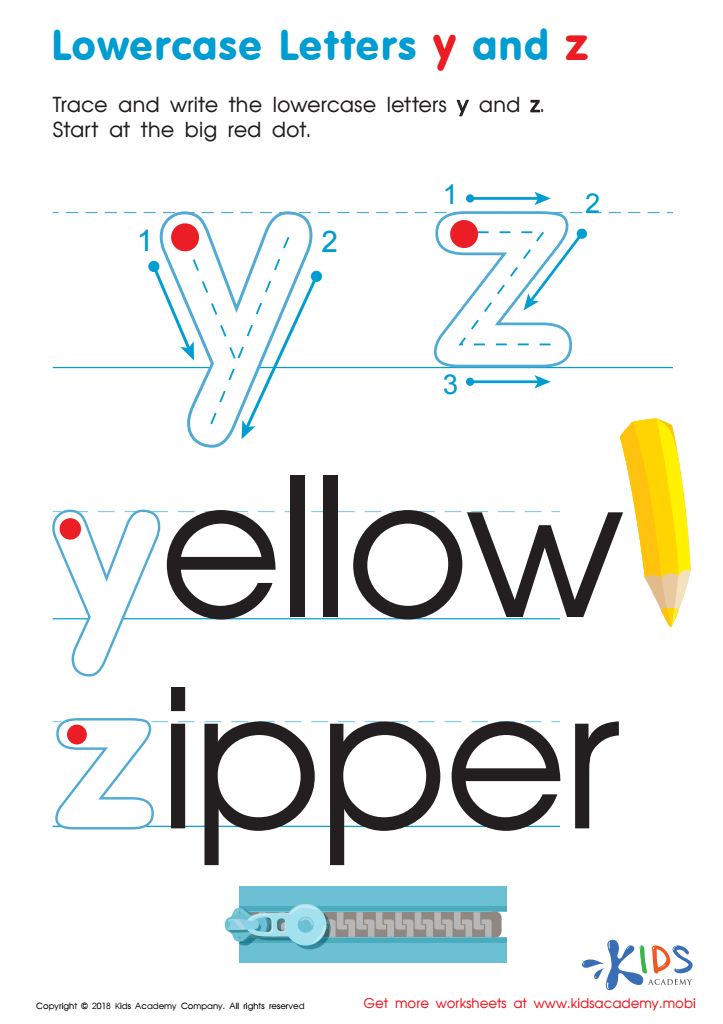
Lowercase Letters y z Worksheet
Help your child get a good start in writing and reading by tracing and writing the lowercase letters y and z. With this activity, they will learn the alphabet, which is essential for literacy success. Guide them through the worksheet and make sure they form the letters correctly. This will help them learn the basics needed to write and read fluently.
 Assign to My Students
Lowercase Letters y z Worksheet
Worksheet
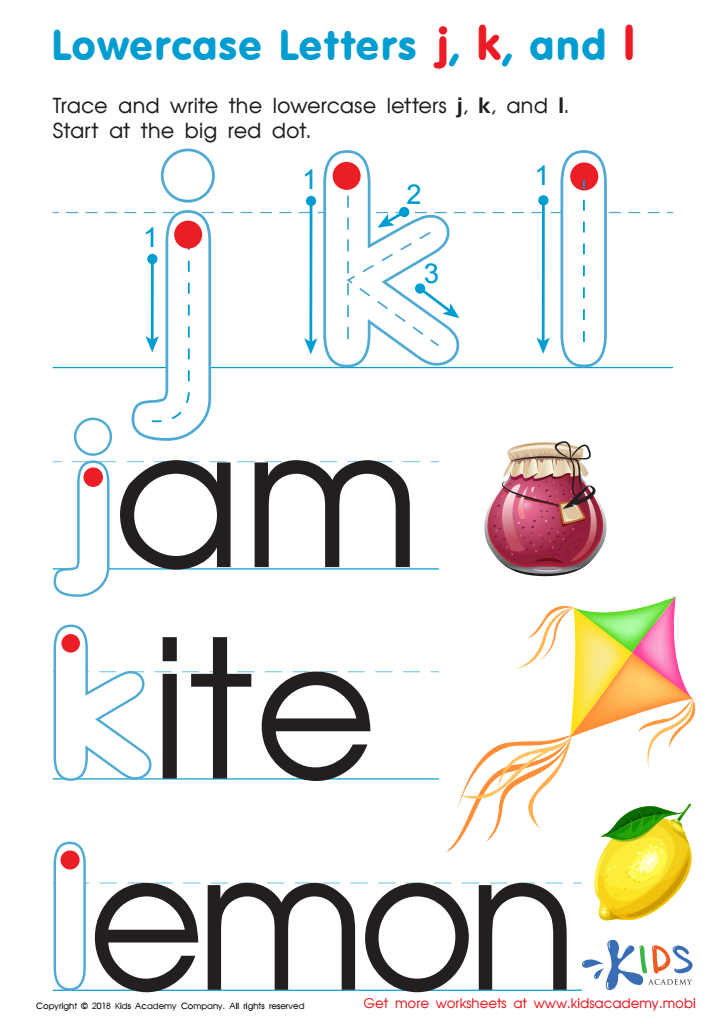
Lowercase Letters j k l Worksheet
Teach your child the difference between uppercase and lowercase letters. Have them trace and write the lowercase letters j, k, and l, starting at the red dot. Guide your child's hand to form the letters correctly.
Lowercase Letters j k l Worksheet
Worksheet
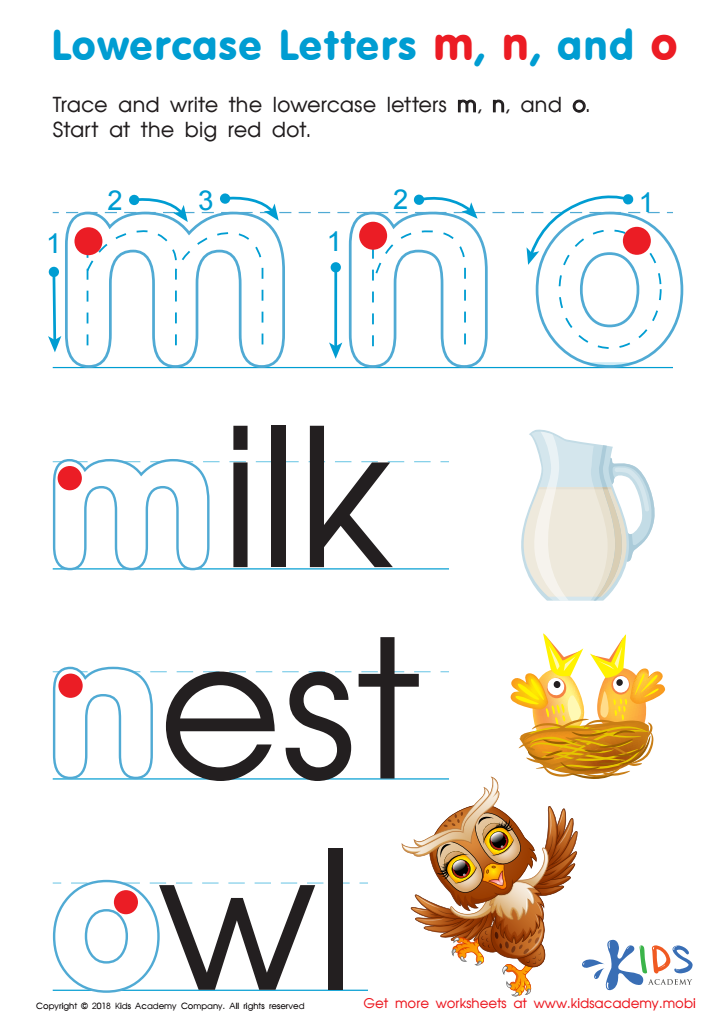
Lowercase Letters m n o Worksheet
Help your child learn the alphabet with letter tracing. Show them the difference between uppercase and lowercase letters by working through this free worksheet, tracing and writing lowercase m, n and o.
Lowercase Letters m n o Worksheet
Worksheet
Join Kids Academy for Free
Who is primarily going to use this learning content?







Teaching lowercase letter writing to children aged 4-5 is crucial for early literacy development. At this stage, children are gaining foundational skills that will support their reading and writing abilities for years to come. Lowercase letters are more frequently used in both print and handwriting than uppercase letters, appearing in the majority of written text. Mastery of lowercase letters, therefore, directly contributes to reading fluency as children become more comfortable recognizing and writing them in the context of words and sentences.
Moreover, learning lowercase letter writing enhances fine motor skills and hand-eye coordination, promoting better penmanship as children progress through their school years. Writing lowercase letters involves more intricate movements compared to uppercase letters, thereby giving children vital practice in controlling their writing instruments.
Incorporating both uppercase and lowercase letters in early learning also builds a solid understanding of the structure of language. Children start to see the difference in contexts where each is used—such as at the beginning of sentences, or in proper nouns—helping them grasp basic grammar rules.
Overall, parents and teachers investing time in teaching lowercase letter writing are setting the stage for children to develop stronger literacy skills, better handwriting, and a more comprehensive understanding of language conventions. This foundational knowledge is pivotal for their success in both academic and everyday settings.








