Visual-motor skills Worksheets for Ages 4-5
4 filtered results
-
From - To
Explore our engaging Visual-Motor Skills Worksheets designed specifically for children ages 4-5! These interactive resources aim to enhance hand-eye coordination, fine motor skills, and spatial awareness, crucial for early development. Each worksheet features fun activities, such as tracing, coloring, and connecting dots, tailored to captivate young learners while promoting essential skills needed for writing and other everyday tasks. Designed by educators, these printables foster creativity and learning through play, ensuring your child develops confidence and dexterity. Download our Visual-Motor Skills Worksheets today to support your child’s growth and preparedness for future learning adventures! Perfect for home or preschool settings!
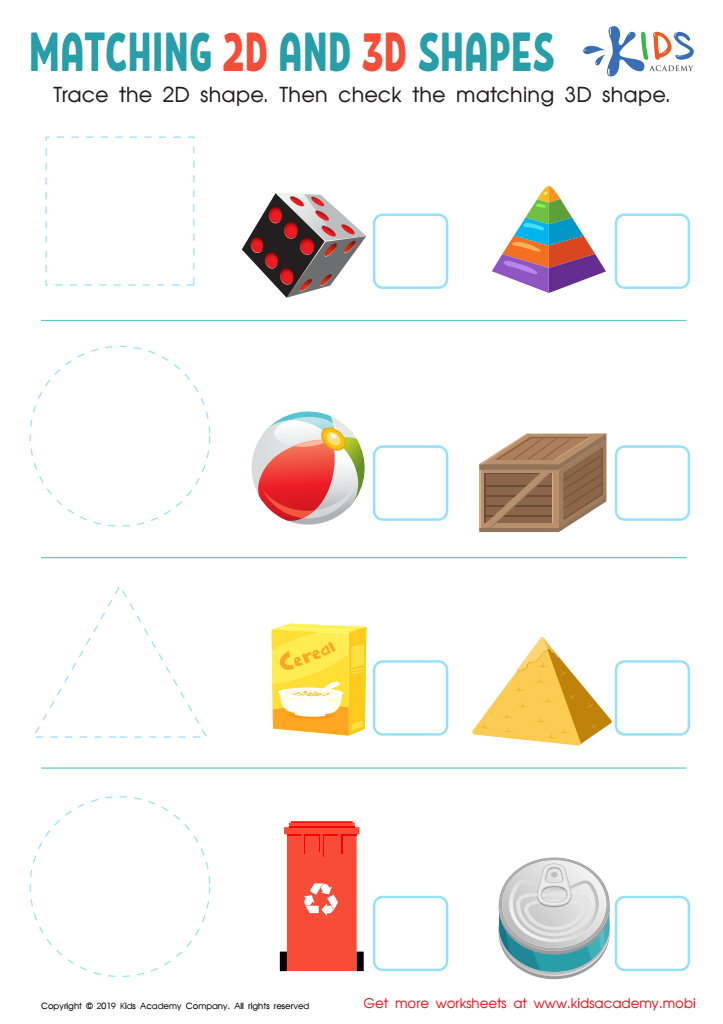
Matching 2D and 3D Shapes Worksheet
 Assign to My Students








Parents and teachers should care about the development of visual-motor skills in children aged 4-5 because these skills are foundational for various aspects of learning and daily functioning. Visual-motor skills involve the coordination of visual input with motor responses, which is crucial for tasks such as writing, cutting with scissors, and other fine motor activities, including handwriting. At this age, children are beginning to engage in more structured learning, and these skills directly impact their ability to participate effectively in classroom activities.
Furthermore, strong visual-motor skills contribute to children's overall academic success. For instance, effective visual processing facilitates the understanding of shapes, letters, and numbers, laying a critical groundwork for literacy and numeracy. If a child struggles with visual-motor integration, they may face challenges that can affect their self-esteem and motivation to learn.
Encouraging activities that promote visual-motor skills—such as puzzles, drawing, tracing, and interactive games—can significantly enhance a child’s ability to coordinate and explore their environment. Parents and teachers can play a vital role in fostering these skills, ultimately helping children become more confident learners and better prepared for future educational challenges. Investing in visual-motor development is essential for holistic childhood growth.








