Improving counting skills Addition & Subtraction Worksheets for Ages 4-5
3 filtered results
-
From - To
Enhance your child's counting skills with our focused Addition & Subtraction Worksheets designed exclusively for ages 4-5. Thoughtfully created to support early math learning, these worksheets help young learners master the basics of counting, addition, and subtraction through engaging exercises. Our colorful, easy-to-follow activities ensure that mastering these crucial skills becomes a fun and enjoyable experience for your child. By developing a solid foundation in counting, your young learner will gain the confidence and skills needed for future mathematical success. Visit our website to explore more and give your child the perfect head start in math!
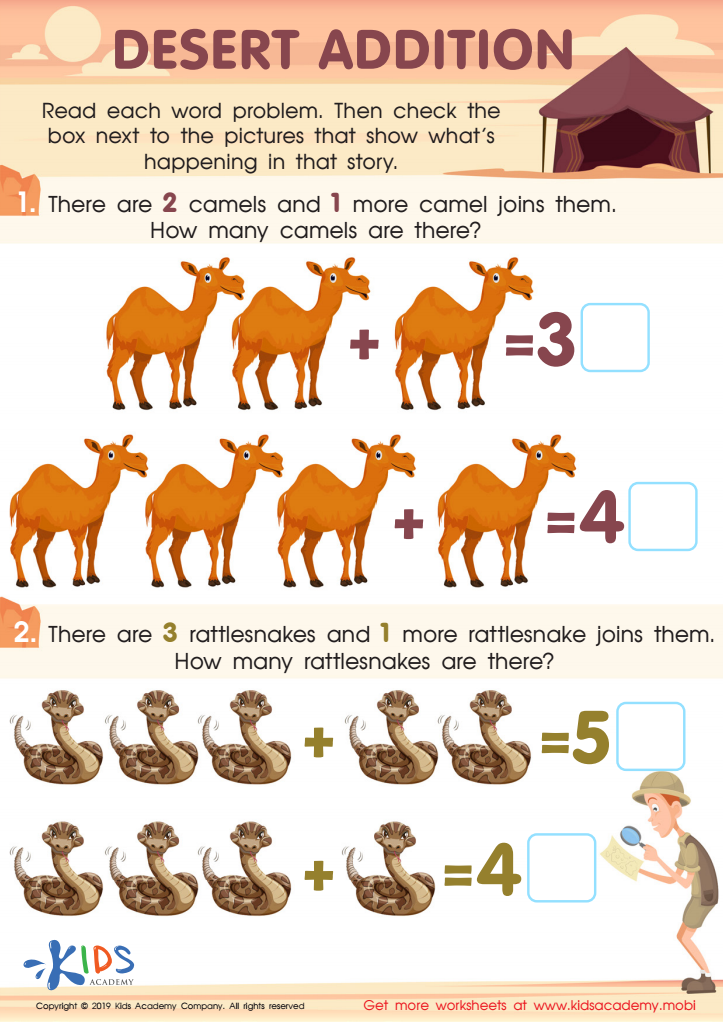
Desert Addition Worksheet
 Assign to My Students
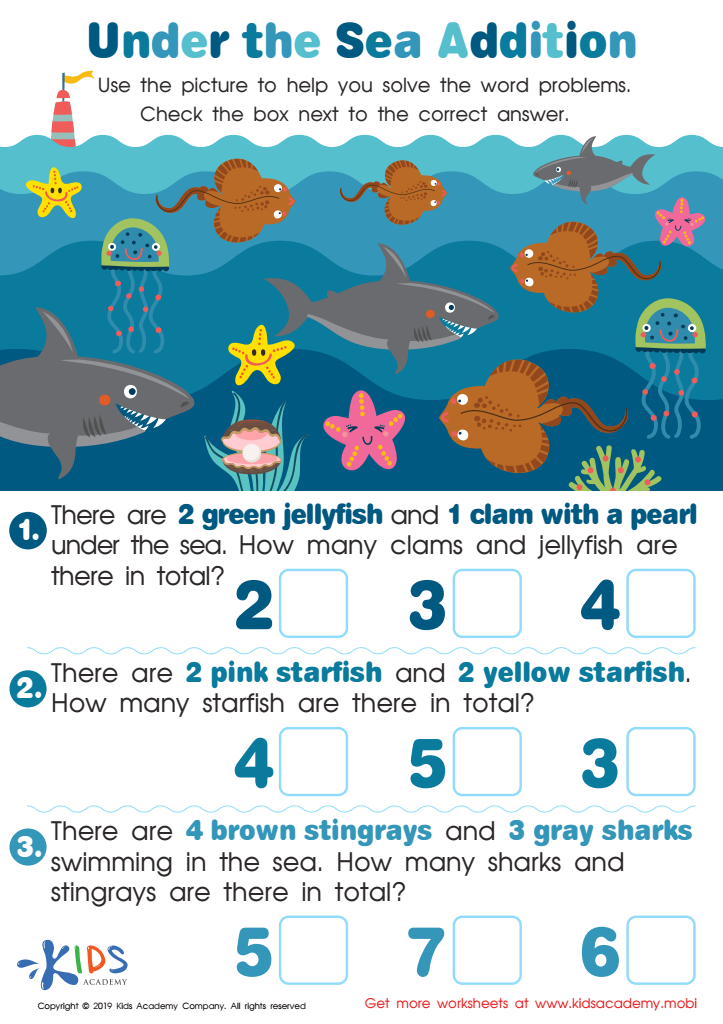
Under the Sea Addition Worksheet








Improving counting skills, addition, and subtraction for children aged 4-5 is fundamental for their academic and cognitive development. At this early stage, children's brains are incredibly receptive to learning foundational concepts that will support their future mathematical understanding.
First, solid counting skills serve as the building blocks for all mathematical learning. Counting helps children grasp the idea of quantity, number recognition, and sequencing. Without these essential skills, more complex mathematical concepts will be challenging to understand.
Secondly, fostering abilities in addition and subtraction at a young age teaches basic problem-solving skills. It encourages logical thinking and the ability to understand relationships between numbers. Simplified operations, such as combining groups of objects (addition) or removing some objects from a group (subtraction), align with their experiential learning through play and everyday interactions.
Additionally, early math skills are linked to overall academic success. Research shows that a strong foundation in early math correlates with higher academic performance in later years, not just in mathematics but also in literacy and critical thinking.
Parents and teachers play a crucial role in creating a supportive and stimulating environment. By making math fun and engaging, they can instill confidence and a positive attitude toward learning. Using interactive activities, such as counting games, number songs, and manipulative toys, can make this learning process enjoyable.
Focusing on these early skills sets the stage for lifelong learning and helps develop a mindset that is curious, logical, and ready to tackle challenges.








