
Attention to Detail Addition Worksheets for Ages 4-5
3 filtered results
Difficulty Level
Grade
Age
-
From - To
Subject
Activity
Standards
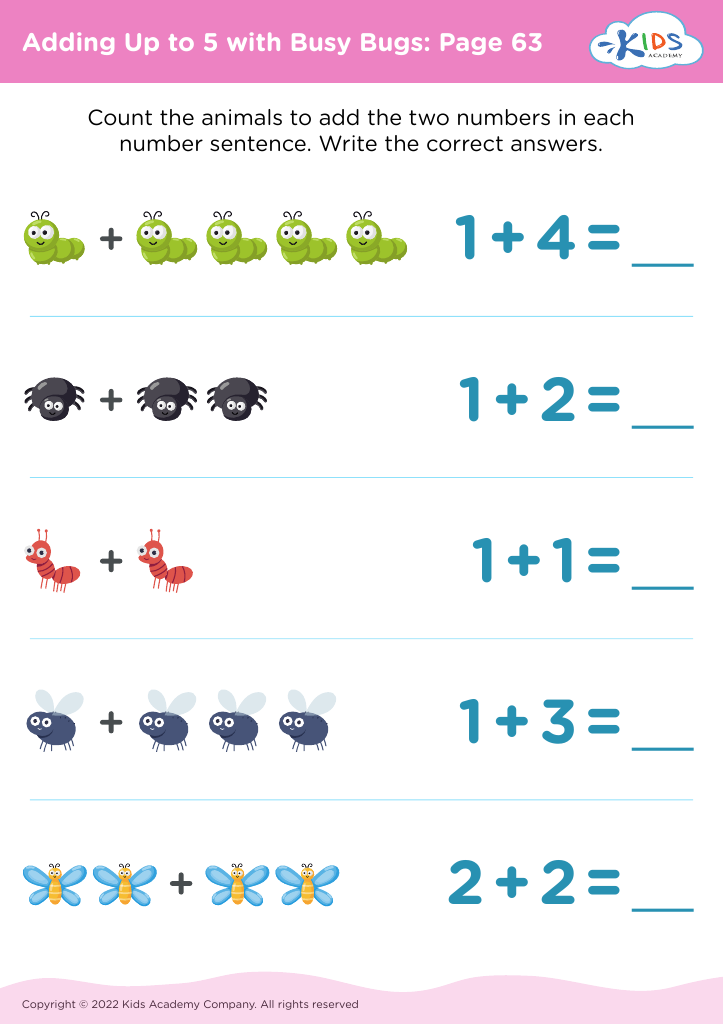
Help your child develop essential math skills with our Attention to Detail Addition Worksheets for Ages 4-5! Designed to engage young learners, these worksheets focus on enhancing attention to detail through fun addition exercises. Each activity encourages children to identify patterns, recognize numbers, and improve their concentration skills while solving simple addition problems. Ideal for preschool and kindergarten settings, our worksheets promote both cognitive development and early math confidence. Parents and teachers alike will appreciate the clear layouts and engaging visuals that make learning enjoyable. Download your free printable worksheets today and watch your child thrive in their mathematical journey!
Favorites
With answer key
Interactive
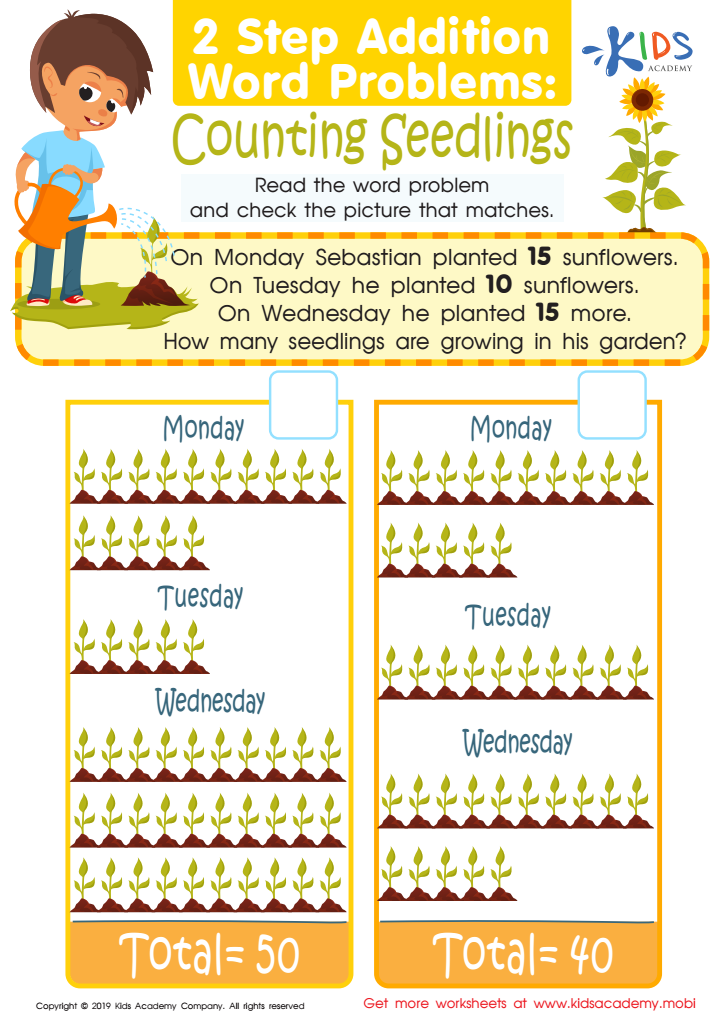
Counting Seedlings Worksheet
Understanding math word problems is key. Multiple steps can prove challenging - this free worksheet provides one-to-one picture representation to help kids solve multi-step addition word problems. Strengthen addition skills by choosing the matching picture to the answer.
 Assign to My Students
Counting Seedlings Worksheet
Worksheet
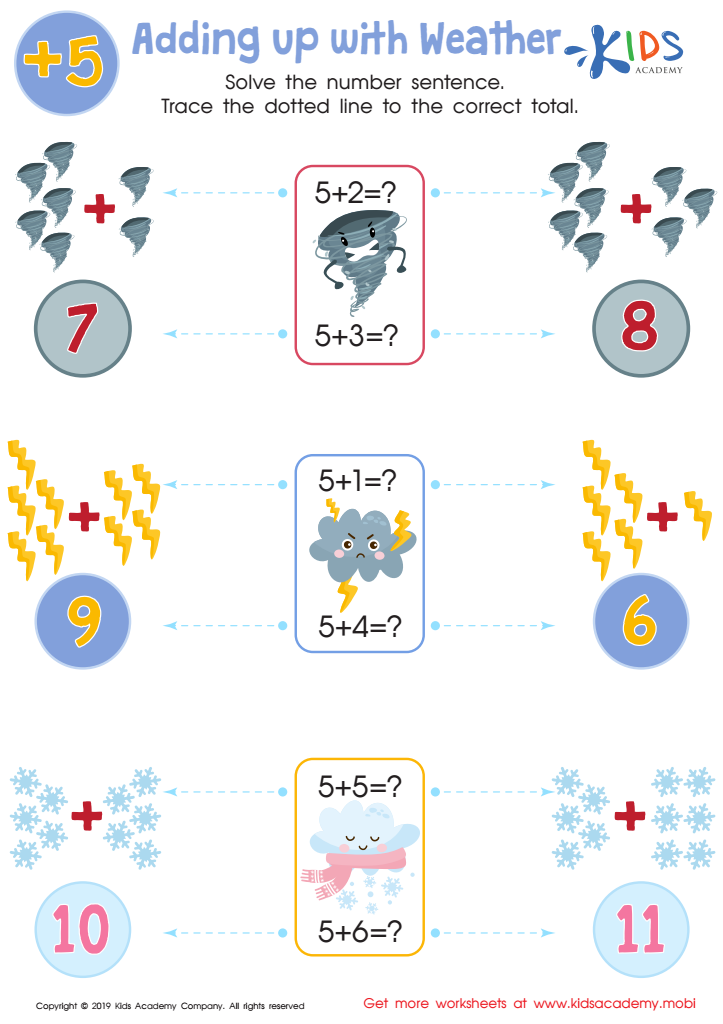
Adding up With Water Worksheet
Ask your kids to name different kinds of weather and what it's like outside now. Then, help them solve the number sentences on the worksheet by tracing the dotted line to the correct total.
Adding up With Water Worksheet
Worksheet
Join Kids Academy for Free
Who is primarily going to use this learning content?








Attention to Detail Addition for ages 4-5 plays a crucial role in early childhood education for several reasons. At this developmental stage, children are beginning to grasp basic mathematical concepts, and fostering attention to detail helps them build a strong foundation for future learning. Engaging in activities that require careful examination of quantities—such as counting objects, sorting them, or matching them—encourages focus and enhances cognitive skills.
Moreover, attention to detail is directly linked to problem-solving abilities and critical thinking. When children practice meticulousness in activities like addition, they develop a mindset that values accuracy and thoroughness. This practice not only aids in mathematical comprehension but also promotes perseverance; students learn to double-check their work and understand the importance of striving for correctness.
Additionally, reinforcing these skills contributes to their overall emotional and social development. Children who pay attention to detail are often better listeners and communicators, fostering collaboration with peers and teachers. This holistic approach prepares them for a successful transition into more complex learning environments. Therefore, both parents and teachers should recognize the significance of attention to detail in early math activities as it sets the stage for lifelong learning and success.








