
Division practice Division Worksheets for Ages 4-5
4 filtered results
Difficulty Level
Grade
Age
-
From - To
Subject
Activity
Standards
Unlock your child's math potential with our engaging Division Practice Worksheets designed for ages 4-5! At Kids Academy, we offer a fun, interactive approach to fundamental division concepts. Each worksheet features colorful illustrations and simple exercises that nurture early math skills while keeping young minds intrigued. Our age-appropriate tasks promote numerical understanding, boost confidence, and build a strong mathematical foundation. perfect for at-home practice or classroom enrichment, these worksheets are crafted by education experts to ensure optimal learning. Help your child embark on a math adventure with division practice that’s both enjoyable and highly effective!
Favorites
With answer key
Interactive
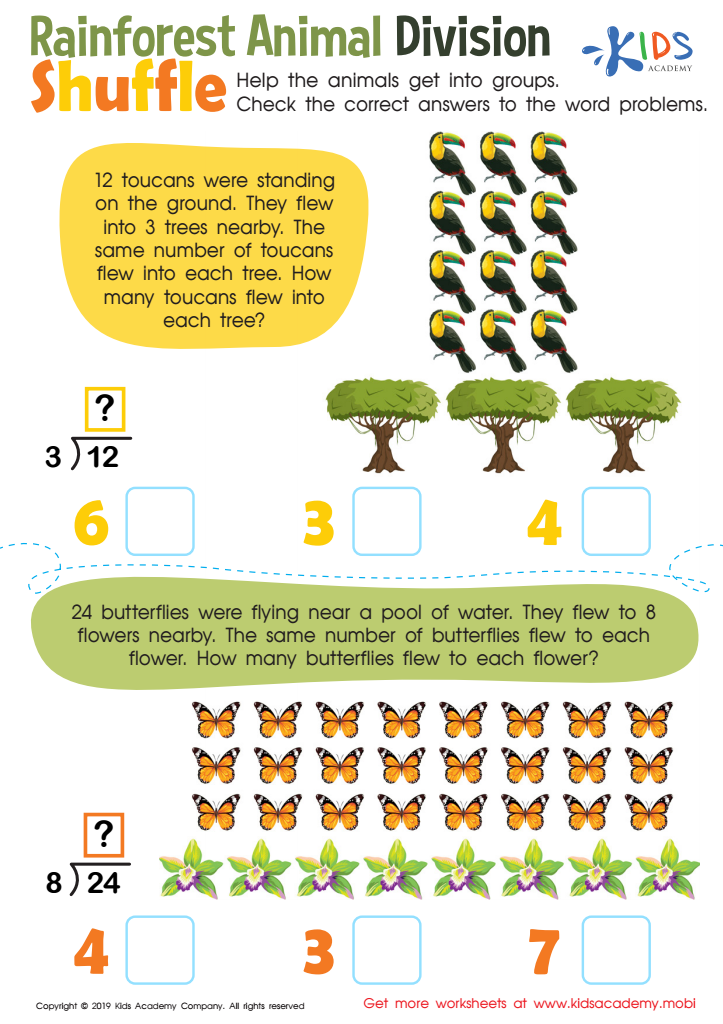
Rainforest Animal Division Worksheet
Children can save the rainforest and learn about division with this worksheet! It helps kids understand that division involves creating equal groups of specific numbers, and with its visual representation, they can grasp the concept more easily. They'll have fun learning about their place in the world and their role in protecting the environment.
 Assign to My Students
Rainforest Animal Division Worksheet
Worksheet
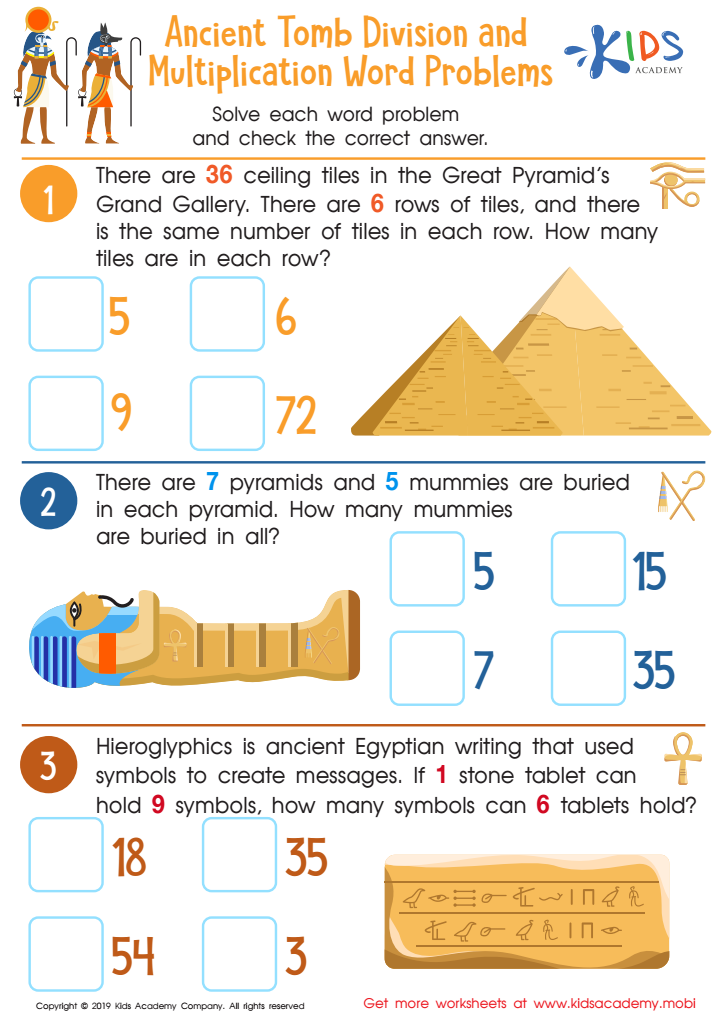
Ancient Tomb Division and Multiplication Word Problems Worksheet
This worksheet teaches kids math, plus a bit about ancient Egypt. Read the text and point to the pictures to explain them. There are three word problems - help kids interpret and solve each one, then find and check the answer. 80 words
Ancient Tomb Division and Multiplication Word Problems Worksheet
Worksheet
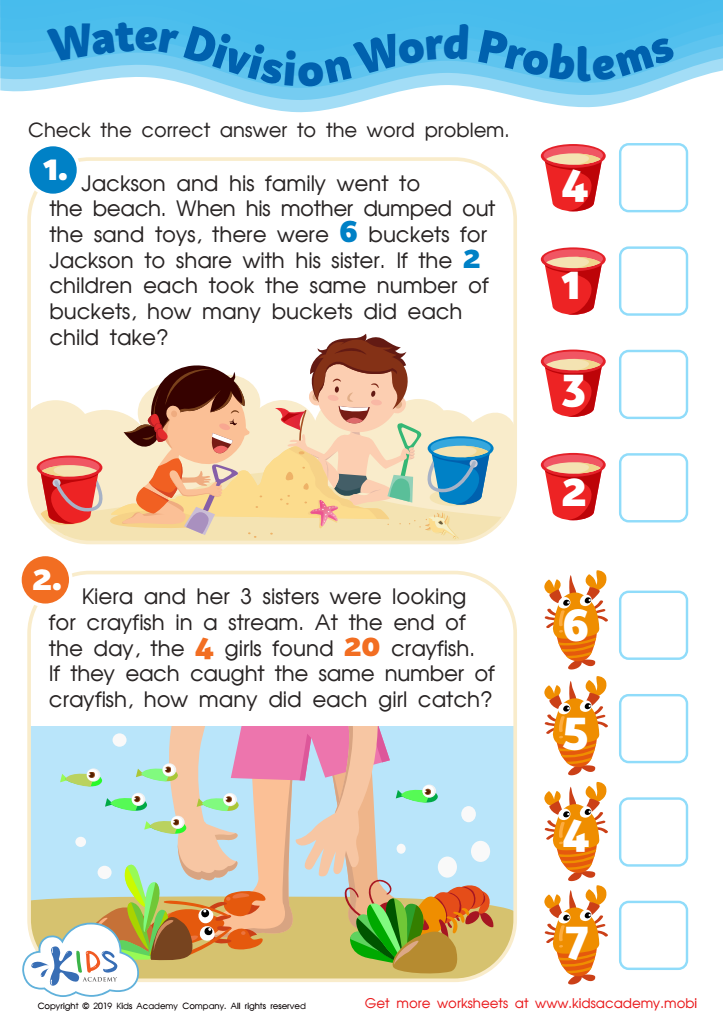
Water Division Word Problems Worksheet
Kids can sharpen their math skills with this fun PDF! They'll see pictures of friends at the beach, plus bold numbers and colorful pictures. All they need to do is read and understand the problem to find the answer - without even realizing they're doing division. A great way to make math enjoyable!
Water Division Word Problems Worksheet
Worksheet
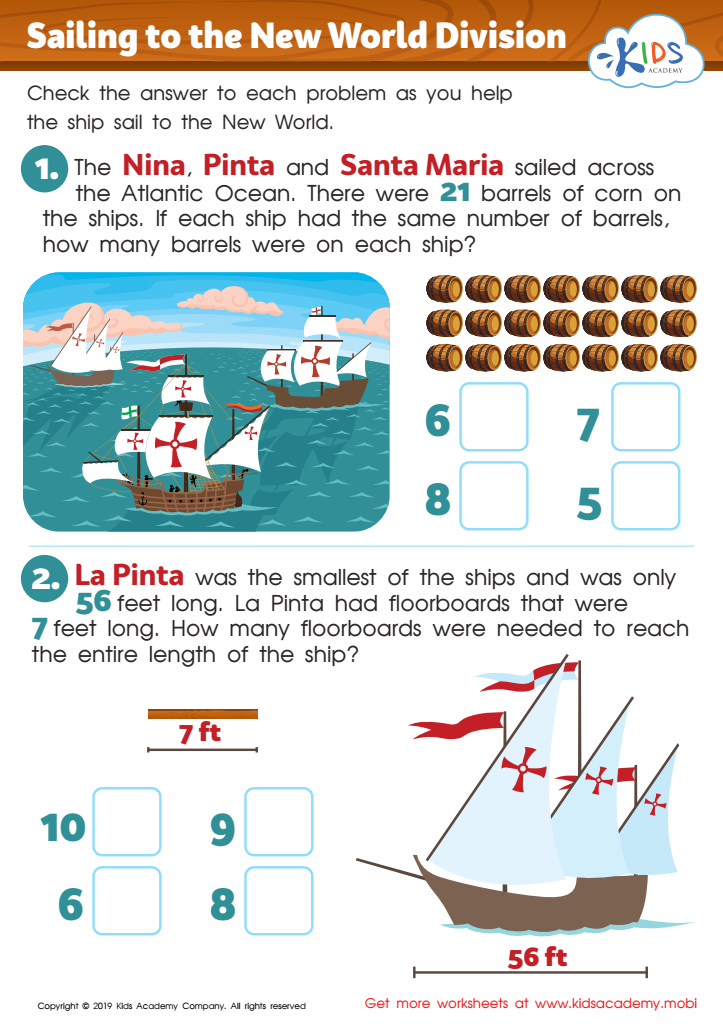
Sailing to the New World Division Worksheet
This worksheet combines history and math, helping kids make sense of problem-solving. Christopher Columbus sailing the ocean blue is combined with picture representations of division word problems in bold colors and highlighted numbers. Kids can learn while having fun figuring out the problems, regardless of whether it's math or history.
Sailing to the New World Division Worksheet
Worksheet
Join Kids Academy for Free
Who is primarily going to use this learning content?








Introducing division practice to children aged 4-5 is remarkably beneficial for early cognitive development. Though advanced mathematics is not typically part of their curriculum, young children are naturally curious and capable of learning basic concepts when taught in an engaging and age-appropriate manner. By incorporating division into everyday play, such as dividing toys or snacks, parents and teachers can help children understand the concept of sharing equally, which is foundational.
Early exposure to division reinforces number recognition, counting skills, and the basic principles of grouping and sorting. It also helps children improve their problem-solving abilities and critical thinking, laying a strong groundwork for more complex math skills in later years. As they see objects being divided, they start to comprehend quantities and parts of a whole, making abstract concepts more concrete.
Furthermore, building math confidence at a young age can lead to a positive attitude toward learning. Encouraging a fun and stress-free approach to division can make math less intimidating and more enjoyable. Given these benefits, parents and teachers should definitely incorporate basic division into early learning to stimulate intellectual growth and prepare children for future mathematical challenges.








